For guitarists who can hear the line but can't get their fingers to play it clean
Get your playing clean and fluent, so the line you hear in your head is the line you play.
Five steps for your hands, on camera: one simple shape played with real control, a one-string drill against the click, a mini gym for each finger, scrambled finger orders, and legato. Then we play most of them together, in time with the click.
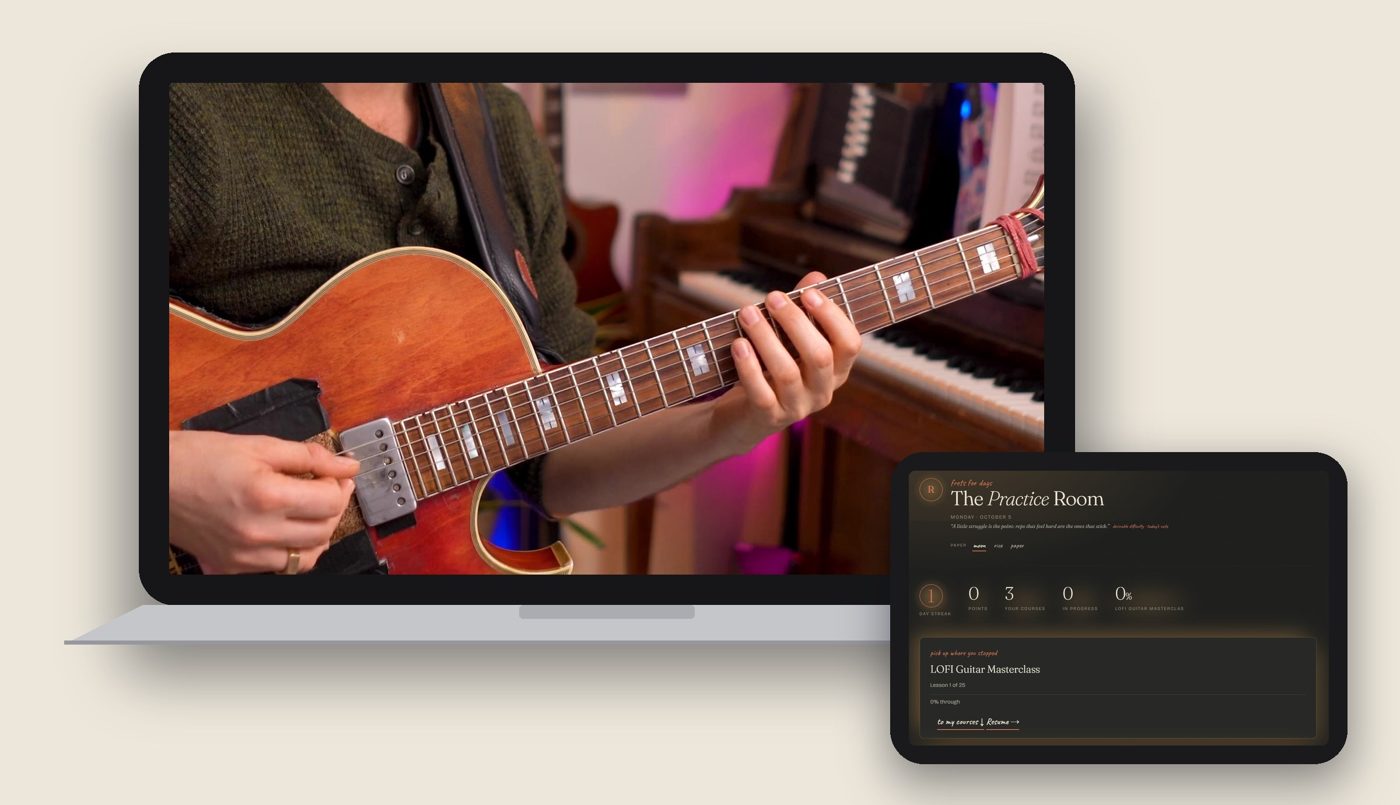
One payment of $47 · Lifetime access
Get 5 Steps to Freedom17 video lessons · 15 with PDF worksheets · 30-day guarantee
- One chromatic shape, played with total control
- A string-skip drill for missed strings
- A mini gym for all six finger pairs
- 2-1-3-4, 3-1-2-4 and the mirror
- 8ths to sextuplets without stopping
- Legato that matches your picking
When I was studying in school, I was very concerned that I'd never be able to play fast. I was quite worried about it. I'm just not talented enough, I thought. This short course is the work underneath speed: control, accuracy, strength and time, one simple shape at a time. Fast is the step after that, and we don't rush it.
Watch before you buy
Two full lessons from the course.
These are real lessons, exactly as they play in the member area. Most of the playing is filmed close up on both hands, so you can see what each hand is doing.
A letter from Rotem
For a long time, I was afraid of missing the string.
When I was studying in school, I was very concerned that I would never be able to play fast. I was quite worried about it. I thought, I'm just not talented enough to play fast, and I was trying to figure out what to do.
And there was another fear, one I had for a long time. One of the hardest things when we're soloing and expressing is missing the strings.
Here's something I saw on a tour in Mexico and Europe. We did some workshops and clinics at universities, and I gave some of the students a very simple exercise: playing one note, in time.
They thought the exercise was kind of simple and easy, so they didn't really pay attention, and they messed it up the first time. I told them, you're not playing this note accurately. They did it again. A little better. Then I asked them to really pay attention to what I said, and the third time, maybe 45 seconds after the first, a lot of them did it way, way better.
I was trying to think what happened between the first and the third time. I realized it's just CPU power. A lot of people, when they're working on technique, aren't using their full CPU power.
Now, simple exercises work. The chromatic shape at the start of this course is something a lot of people can play right off the bat. That's the trap. You play it thinking "oh, this is easy, whatever," and the sound isn't consistent, one note is softer than the next, you're looking at the strings, and you've missed the musicality that's there even in a simple exercise.
And there's a second trap. As you can probably imagine, it's unrealistic that we always play 1-2-3-4, up and back down, when we're playing music. Real lines scramble your fingers. If your practice never does, a solo is the first place your fingers meet those orders.
That isn't a talent problem, even though I once told myself it was. It's the details nobody asked you to listen for.
- Take one simple shape and play it with total control: a consistent sound, clear velocity, as effortless as possible, without looking.
- Then change one thing at a time, and put it in time with the click, so your fingers are ready for what real music asks of them.
That's how the five steps are built. First the basic shape, very clear and very honest, no approximation. Then that shape moving along one string, with the metronome on 60 BPM, through different subdivisions without stopping. Then a mini gym for the fingers, because when we get tired we're less accurate. Then the variations: new finger orders, a mirror on one string, the ones that feel like tongue twisters. Then legato, where the finger does the pick's job.
Here's what starts to happen. You start to hear when two notes aren't balanced, while you're still playing slow enough to fix it. Your fingers start learning where the string is, without you looking. You can shift from eighth notes to triplets on the same shape without taking your hands off the guitar, which is the flexibility you want when you're soloing and improvising. And because the tongue-twister variations are so hard, the normal stuff gets easier, and you'll hear it.
What it won't do. It won't make you fast this week. I don't need it to be fast just yet; speed is the next step, and we get there by making sure the first steps are really covered. Some days are easier and some days are harder. It's also a small course, and I want you to know that before you buy: 17 short lessons, most of them under two minutes, with PDF worksheets alongside 15 of them. No songs, no licks. It's five exercises and how I practice them. The real work happens after the video ends.
Technique is here to serve the ideas. If I'm imagining a sound in my mind, I want to be able to pull it into reality, into the guitar. That's what these five steps are for. We get stronger as musicians, we articulate what we want, and we tell our fingers and brain what to do.
Rotem
Look inside
Two real lessons, up close.
Here's exactly what you'd be working on, taken straight from the course.
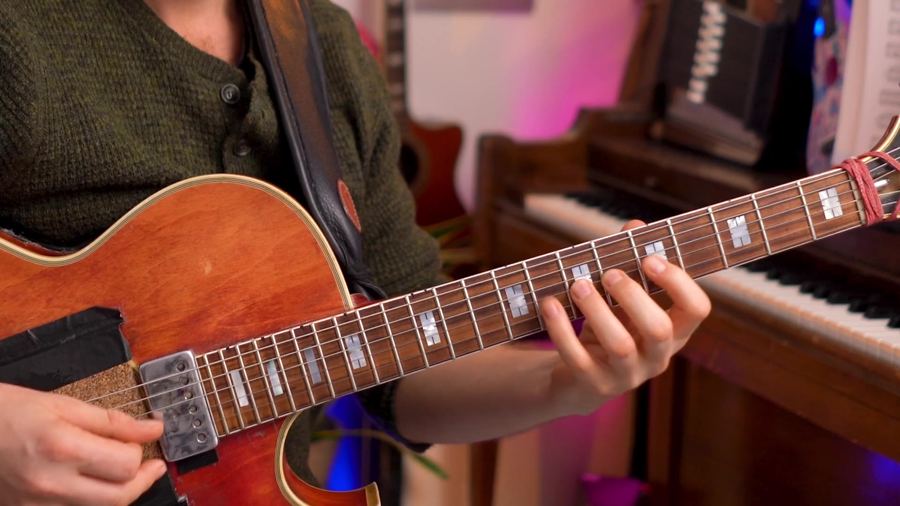
One shape, many variations
We take the shape we just played, a chromatic scale going up the strings, and start finding its permutations. Ascending. Descending each string. Then shifting between the two. All relaxed and calm, not fast at all, and not in time yet. We're just learning the motions.
Then one more variation: jumping strings. The same exercise, ascending, but with a skip of a string. It's there for the fear I had for a long time, not hitting the string I mean to play.
At the end I show you how I find more ideas: write the exercise down on a piece of paper. What is it? Going from fret 5 to fret 8, ascending chromatically. Naturally, once you think about it that way, you can descend, ascend and descend, or try different shapes.
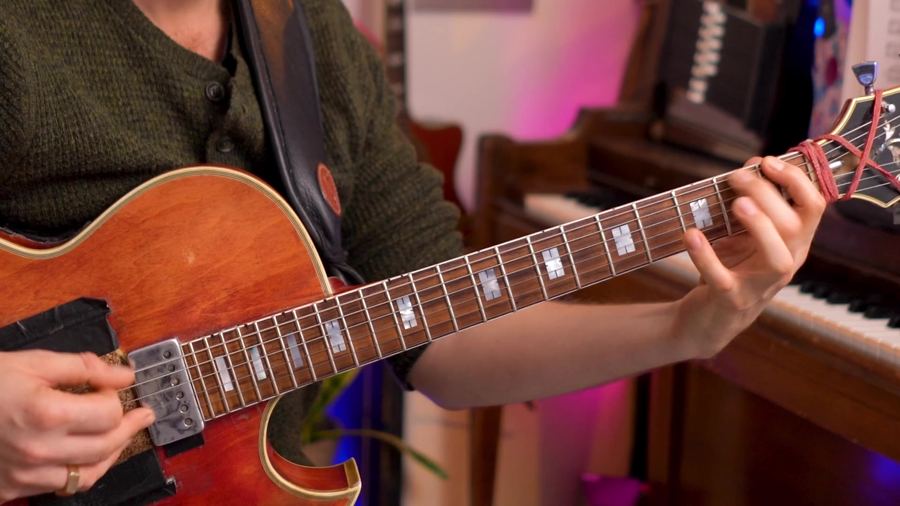
A mini gym for the fingers
Getting our fingers strong is important, because when we get tired we're less accurate. So this is sort of like a gym, a mini gym for the fingers.
You play one note and hammer on the next, and you don't only hammer on, you push on the string. It's a little like lifting weights at the gym. I usually do four repetitions, then shift to the next finger, through the pairs: 1-2, 1-3, 1-4, 2-3, 2-4, 3-4. Then I put the click on and we do it together.
In the next lesson I talk about 1-4: sometimes I push with all the fingers, which is easier, and oftentimes I make the fourth finger do the pushing on its own, with the other two held out.
Inside the members area
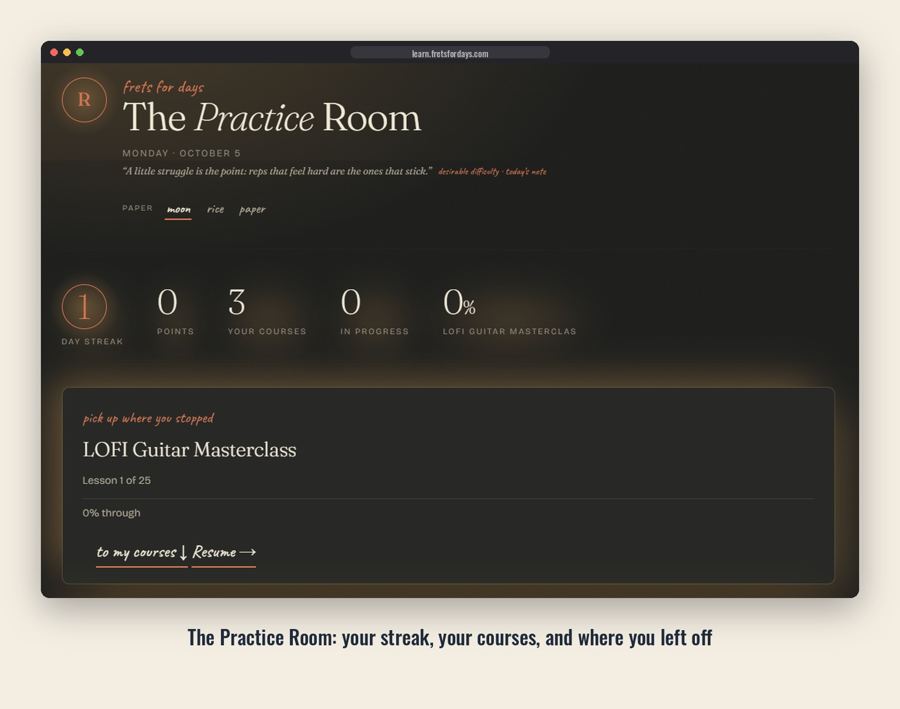
Here's what you see when you log in.
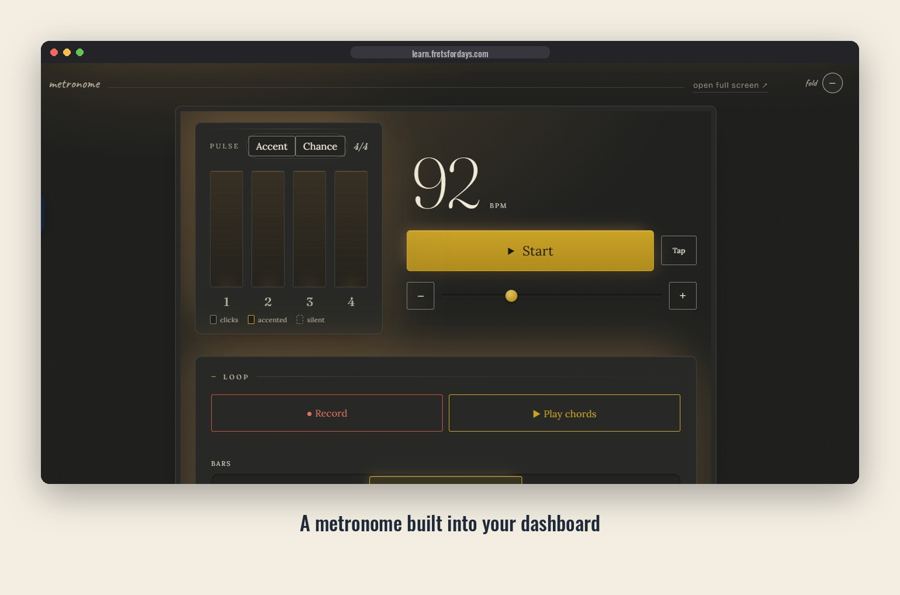
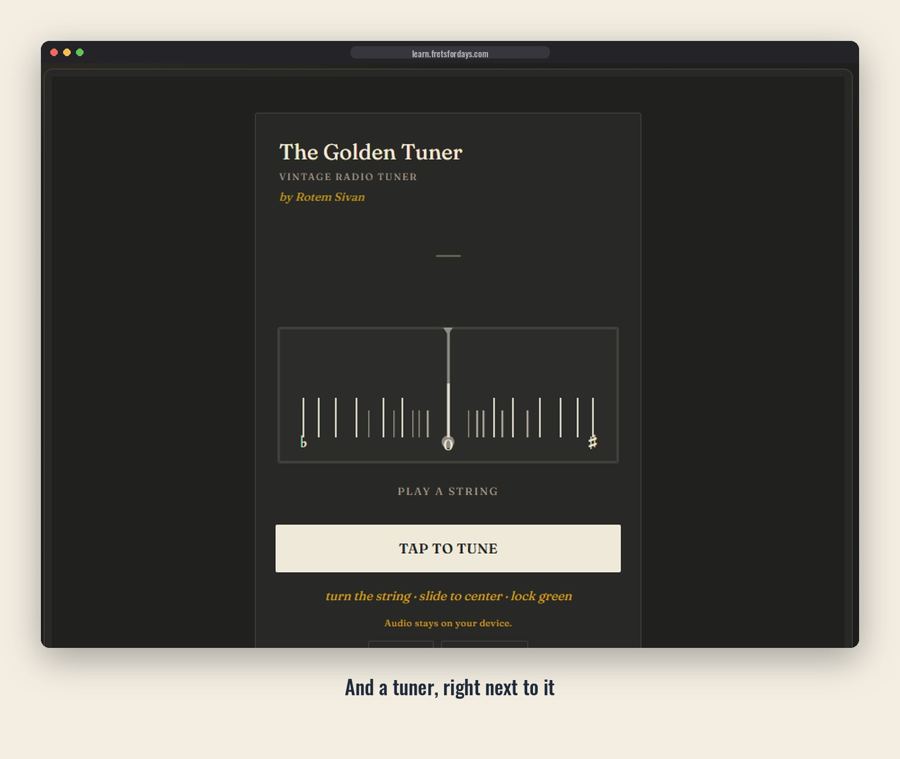
Real screens from the Frets For Days member area. The Practice Room keeps your streak and shows where you left off, and there's a metronome and a tuner right in your dashboard, so the 60 BPM click is one tap away.
What's inside
17 lessons, step by step.
Every shape, finger order and move below is something I play or explain on camera.
1 Locking in the hands
- The chromatic shape from the 5th fret that a lot of people can do right off the bat, and the things I pay attention to in it, starting with control.
- Down, up, down, up: what a consistent sound and velocity really means on a shape this simple, and the thought to leave out: "oh, this is easy, whatever."
- Teaching your fingers where the string is, very accurately, without looking at the board. (If it's hard in the beginning, you can look.)
- "Very clear, very tight and very honest." What I mean by no approximation.
- The dynamics drill: decide you're playing soft and stay there, decide you're playing louder and stay there. Control over the dynamic range, the fingers and the motion.
- Ascending, descending, and shifting between them string by string.
- The string-skip variation for a fear I had for a long time: missing the string I meant to play.
- The pen-and-paper way I turn one exercise into a list of variations.
2 The one-string drill
- The same chromatic shape, now moving along a single string, and why I want you to check the motion on each string before the click goes on.
- The metronome at 60 BPM, and we play it together.
- Eighth notes on the G string, knowing exactly which notes I'm playing: F, F sharp, G, G sharp.
- What to do at the top of the run: stop, or change direction.
- Eighths, triplets, sixteenths and sextuplets on one shape without stopping and without taking your hands off the guitar.
- Imagining the next subdivision before you play it, the flexibility you want when you're soloing and improvising.
- The little pinky move a dear friend of mine showed me when we talked about technique one day, and I kind of embraced it. It's for stability when I want to play something fast. You don't have to do it; try it and see if it works for you.
- What's totally fine to do slower, what's totally fine to do faster, and the one thing I care about either way.
3 The finger gym
- The hammer-and-push move that turns a plain hammer-on into weight training for one finger at a time (the full lesson is in "Look inside" above).
- The six finger pairs, 1-2, 1-3, 1-4, 2-3, 2-4 and 3-4, four reps each, then on to the next one.
- Pushing with all your fingers versus pushing with the fourth finger alone. One is easier. The other is the one I do oftentimes when I practice.
- Changing the subdivision in the gym, and why the slower subdivision is the one where you work harder.
- "The faster subdivision doesn't mean it's better, it's just faster." The tempo is not really the point.
- How long I do it: three to five minutes a day, and that's it. Feel the burn a little, then rest, drink some water, and let the body heal.
4 Variations
- 2-1-3-4 and 3-1-2-4: scrambling your fingers to make a different shape, and finding a new one when you practice.
- Moving 2-1-3-4 around the board at 60 BPM, then pushing the tempo or the subdivision once it's comfortable.
- Eighths, then triplets, then sixteenths, coming back a half step higher each time: ascend on the 7th fret, descend on the 8th.
- The weird fingerings that show up when you push the tempo, and the stretch beyond four notes, which brings its own difficulty.
- The mirror on one string: 2-1-3-4 up the neck, and around the 12th fret, 3-4-1-2 back down.
- Every string, in time, with no stopping between them. "Just go when it's done."
- The tongue-twister variations that are surprisingly difficult, and what working on them does to the normal stuff.
5 Legato
- Blurring the line between alternate picking and legato, so the picked note and the hammered note sound very close (you can watch this lesson above).
- The imbalance to avoid: hitting the picked note as hard as you can, then a weak hammer-on. "Even if this action seems easy, it's actually not."
- The pull-off where your second finger becomes the pick itself, and why the accuracy matters so much.
- Down, hammer. Up, pull-off. The basic motion, in time, in one fingering.
- Opening it up through triplets, sixteenths, sextuplets and 32nds, depending on the tempo.
- The two things that make it fall apart when it gets faster, and why you can already hear them when you play slow.
- "Take your time. Let your system absorb the information." What I say about the days it feels harder.
The curriculum
Every lesson, in order.
All 17 lessons, step by step. Tap a step to open it.
Step 1Locking in the hands3 lessons
- 01The basic shape (watch it above)
- 02Control
- 03Permutations
Step 2The one-string drill5 lessons
- 04The motion
- 05Together in time
- 06Subdivisions on one note
- 07Triplets and 16th notes
- 08Closer look at subdivisions
Step 3The finger gym3 lessons
- 09Step one
- 10Gym together
- 11Double time example
Step 4Variations3 lessons
- 122-1-3-4
- 13In time together
- 14On one string
Step 5Legato3 lessons
- 15The technique (watch it above)
- 16In time together
- 17Take your time
One simple shape. Five steps. Hands that play what you hear.
One payment · Lifetime access · 30-day guarantee
Who it's for
Built for the player whose ears are ahead of their fingers.
Read both lists. If the second one sounds like you, save your money.
This is for you if...
- You can hear lines you can't quite play cleanly yet.
- Some notes in a run sound louder than others, and you couldn't say why.
- You worry about missing the string in the middle of a solo.
- Your fourth finger lets the others do its work.
- You'll put the click on at 60 BPM and play simple things slowly and honestly.
This isn't for you if...
- You want songs, licks or solos. This is five exercises for your hands.
- You want to be fast this week. Speed is the step after control.
- You want a big course. It's 17 short lessons, most under two minutes.
- You want theory or chord work. This one is all about your hands.
The offer
One payment. $47. Yours for life.
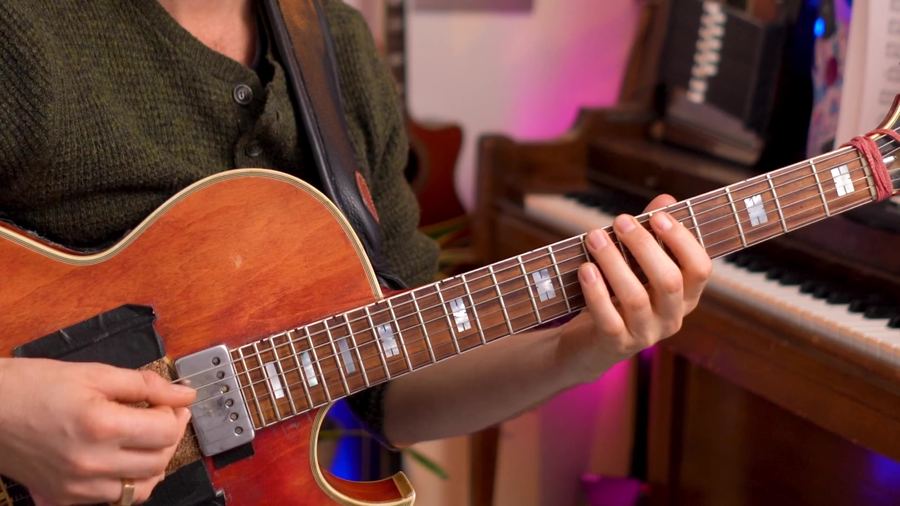
5 Steps to Freedom is $47, once. You get all 17 lessons, plus the PDF worksheets that go with 15 of them, in your Frets For Days member area, and they stay there.
One payment · Lifetime access · 30-day guarantee

About your teacher
I'm Rotem Sivan.
I'm a jazz guitarist and educator in New York. I'm from Israel, and I studied at The New School.
I'm not telling you that to impress you. While I was studying, I was the guitar player worried he wasn't talented enough to play fast, and for a long time I was scared of missing the string. These five steps are the simple things I'd want you to practice with real attention: one shape, played honestly, then changed one thing at a time.
Rotem
FAQ
Questions before you buy.
What's the format?
17 short video lessons in five steps. Most lessons are under two minutes, and the longest is just over three. There are PDF worksheets with 15 of the lessons. Everything lives in your Frets For Days member area, and you watch at your own pace.
What level is it for?
If you can hold a pick and fret a note, you can start. The first shape is simple on purpose, and it may be something you've done before. The work is in how clearly you play it, which is why it's just as useful if you've been playing for years.
Do I need to read music?
No. In the videos I explain with fret numbers and finger numbers (2-1-3-4), and you watch my hands up close.
How much time per week will it take?
The lessons are short. The practice is the point, and it doesn't need to be long: for the finger gym, I'd do it three to five minutes a day, and that's it. Take your time with the rest. Some days are easier, some days are harder.
How long do I have access?
For life. One payment, and the course stays in your member area.
What if it isn't for me?
There's a 30-day guarantee. Work through it, and if it isn't right for you, email [email protected] within 30 days for a refund.
Simple shapes. Honest work.
Get more out of one simple shape, then change it one step at a time. That's what all 17 lessons are for.
$47 one time · 17 lessons · PDF worksheets with 15 of them · lifetime access
Get 5 Steps to Freedom: $47P.S. Here's a test you can run tonight. Put your first finger on the 5th fret and play four notes up the string, chromatically, alternate picking: down, up, down, up. Shift to the next string and keep going. Now do it again without looking at the strings, and keep every note at the same volume. Did one note jump out louder? Did you peek? If it felt easy but didn't sound even, that's the gap this course works on, one step at a time.
Hugs,
Rotem