For guitarists who've always felt they just aren't talented enough to play fast
Play faster without fumbling, with both hands locked together, from a short routine you can run every day.
Ten short lessons, one a day: the picking hand, subdivisions, a finger gym, legato, the pentatonic in new combinations, perfect repetition, and then a solo over a 2-5-1 that pulls from all of it. Plus the 28-page method I wrote from my own first 30 to 60 minutes of practice.
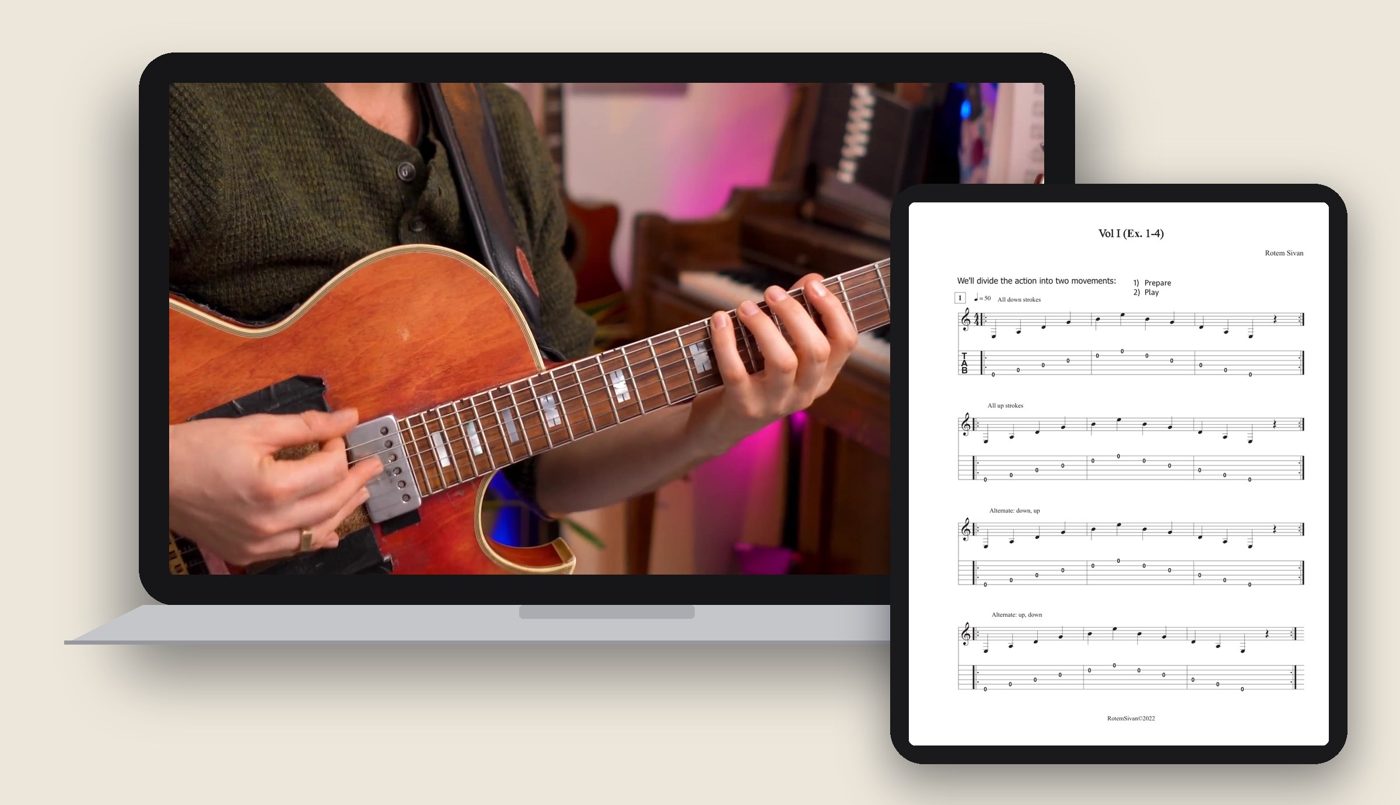
One payment of $27 · Lifetime access
Get Technique & Speed10 video lessons · 18 PDF worksheets + the 28-page method · 30-day guarantee
- Alternate picking without looking
- Quarters to 16ths on one click
- A finger gym for the fretting hand
- Legato that matches your picking
- The pentatonic in skips, threes and double stops
- A solo over a 2-5-1 in C
When I was studying, I was very concerned that I would never be able to play fast. I was quite worried about it. I'm just not talented enough to play fast, I thought. I used to be scared to miss strings or hit the wrong one. What helped wasn't talent. It was a set of very mechanical exercises, played slowly, every day, until my hands knew where the strings were. This course is built on that routine, one short lesson a day for ten days.
Watch before you buy
Two full lessons from the course.
These are real lessons, exactly as they play in the member area.
A letter from Rotem
I was worried I'd never be able to play fast.
When I was studying, I was very concerned that I would never be able to play fast. I was quite worried about it. I'm just not talented enough to play fast, I told myself.
And it was in my hands, not just my head. I used to be scared to miss strings or hit the wrong one. We make a lot of demands of the picking hand, and it's only fair that we teach it and show it the path.
I'm not saying there aren't people who absorb patterns faster than others. But you can work on these things if you really want it. Here's the part most of us get wrong: we practice speed by testing ourselves. Play it as fast as you can, miss, try again, tense up a little more. That's a test, not practice.
The idea that changed it for me came from high school, back in Haifa, from my classical guitar teacher, Arik Triado. He taught me to first prepare the finger on the string, and then release. Years later I realized that's great advice for picking as well. Prepare, then play.
So I built a routine. I personally worked at 40 BPM for weeks before I started moving the tempo up. The right hand work really created a lot of freedom for me, and I'd do it first thing in the morning when I picked up the guitar.
- Play slow. Practice, don't test yourself.
- Control of quarter notes, triplets, 8th notes and 16ths, in time, is what lets you get fast later on.
That's how the course is built. Day 1 locks the two hands together with one simple shape. Then the picking motion with a metronome, the subdivisions (you can start by singing them), a finger gym for the fretting hand, and permutations that are surprisingly difficult, kind of like tongue twisters. Then legato, which is one of my favorite sounds on the guitar. A lot of people want to play fast, and legato is a very easy technique to use for fast lines. I think it sounds beautiful, sort of like a horn player.
After that we take the A minor pentatonic and play it in different combinations, and then perfect repetition. On Day 10 I play over a 2-5-1 in C and weave in and out of everything we worked on, and then I tell you what I was pulling from.
One more thing, because it matters for speed: pay attention to your body. Is there tension? Where? Sometimes just opening your mouth ever so slightly will release jaw tension. Music is the art of listening, so pay attention.
What it won't do. It won't make you fast this week. In the method I say that within a few weeks of working on these exercises you'll start feeling it, and that's if you actually do them. It's also small on purpose: ten short lessons, most of them around two minutes, plus the worksheets and the method. It's a technique routine, not licks or songs. It covers alternate picking and legato; it doesn't teach economy or sweep picking. And a lot of it is slow, plain, mechanical work with a click.
There's a lot of musicality even in these simple exercises. Take your time, and feel free to create your own variations.
Rotem
Look inside
A lesson and a worksheet, up close.
Here's exactly what you'd be working on, taken straight from the course.
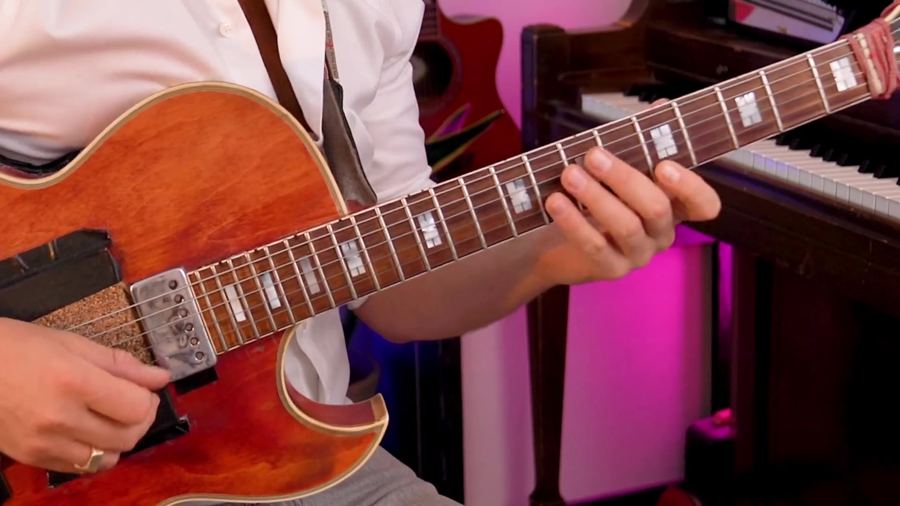
Legato, slow enough to hear the difference
I start with the two main ideas: alternate picking, where every note alternates down and up, and legato, where you hit one note and hammer the next one on. Coming down, it's the pull-off, and your finger becomes almost like the pick itself.
The first step is understanding the mechanism and doing it extremely slow, even without a metronome. I compare the sound with the pick and without it, and try to get the two close, so it's not really loud and then really soft.
Then we play it together in time at 60 BPM: quarter notes, triplets, 8ths and 16ths. "If I stop you now, know what note you're playing." It's the longest lesson in the course, and its worksheet writes the whole exercise out, from quarter notes up to 32nds.
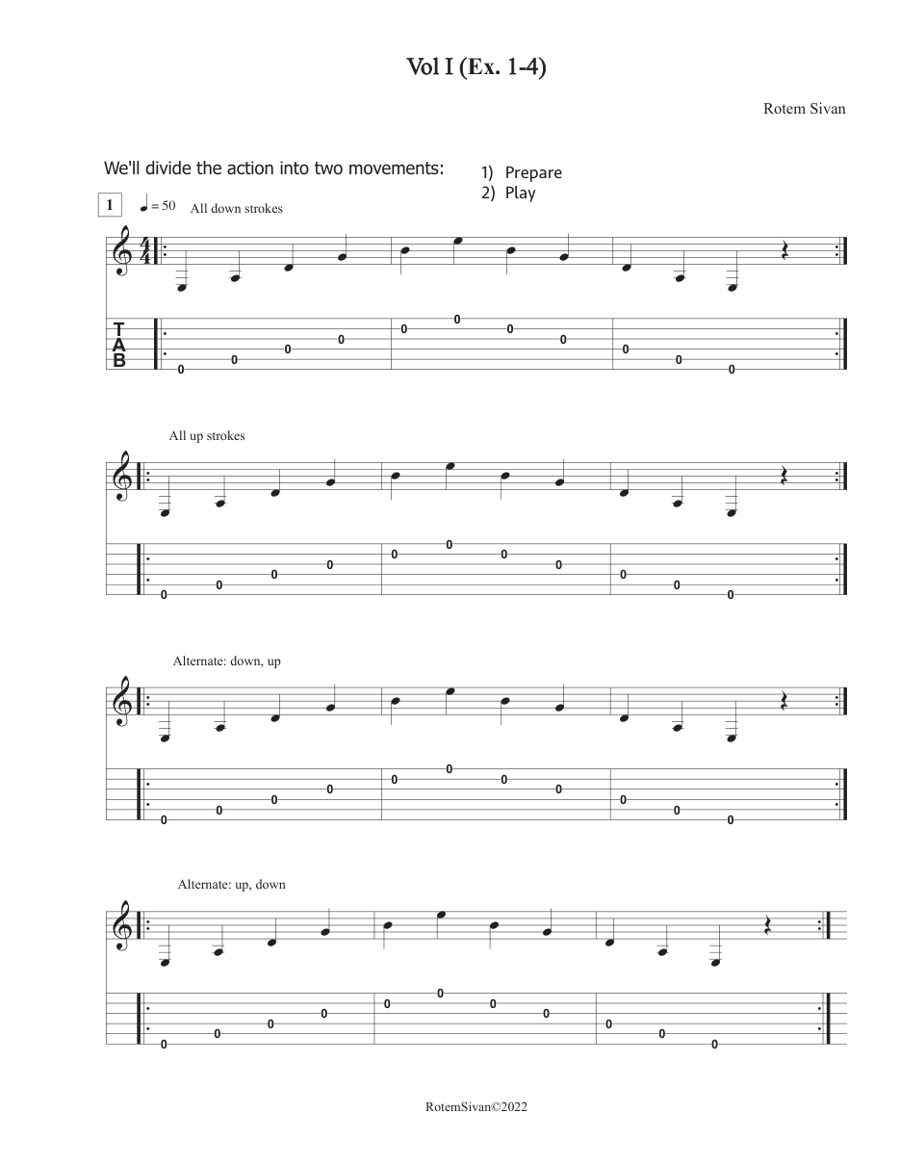
Prepare, then play
The first page of exercises splits every pick stroke into two movements: prepare, then play. Open strings only, at 50 BPM, so there's nothing to think about except where the strings are.
Each exercise goes four ways: all downstrokes, all upstrokes, alternate starting down, alternate starting up. Then doubles, doubles with a string skip, and an anchor exercise.
After that, the method goes on to subdivisions from 1 to 12, eight chromatic exercises (6 to 13), a few of which really help string skipping, and a legato set (14). It's all in notation and tab, with my notes on how long to spend on the picking and legato sets.
Inside the members area
Here's what you see when you log in.
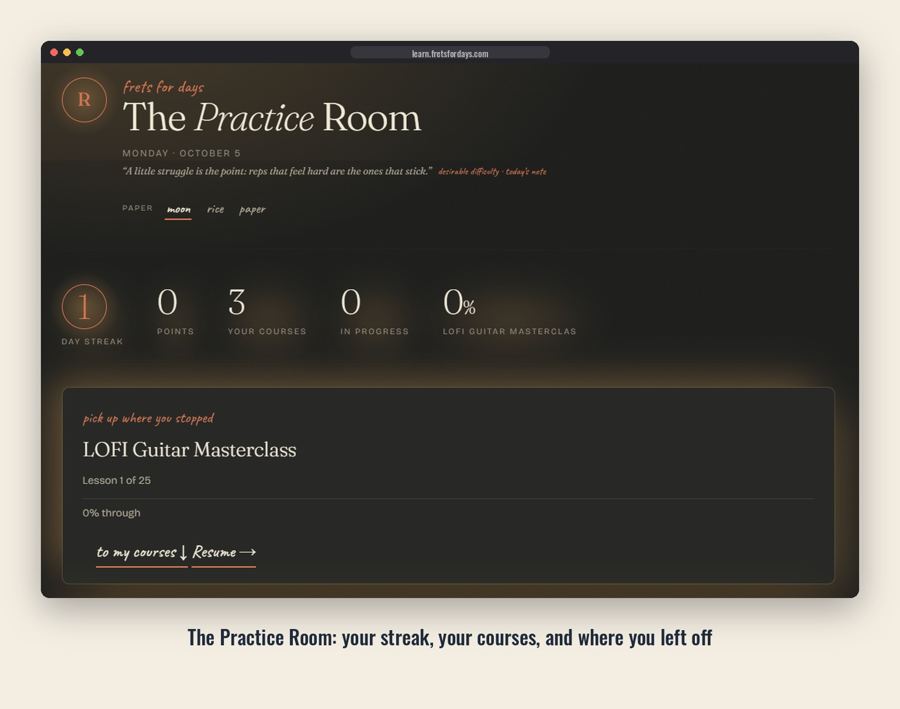
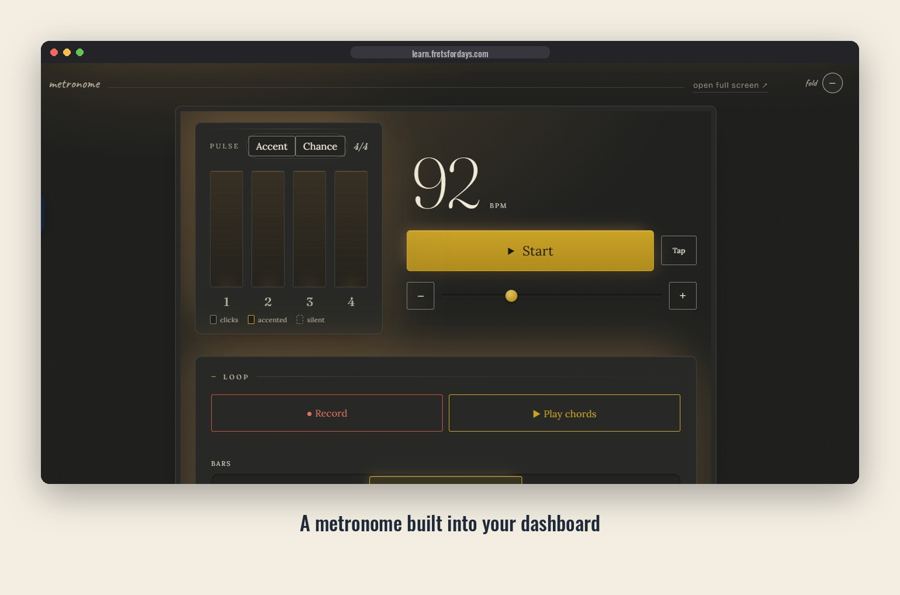
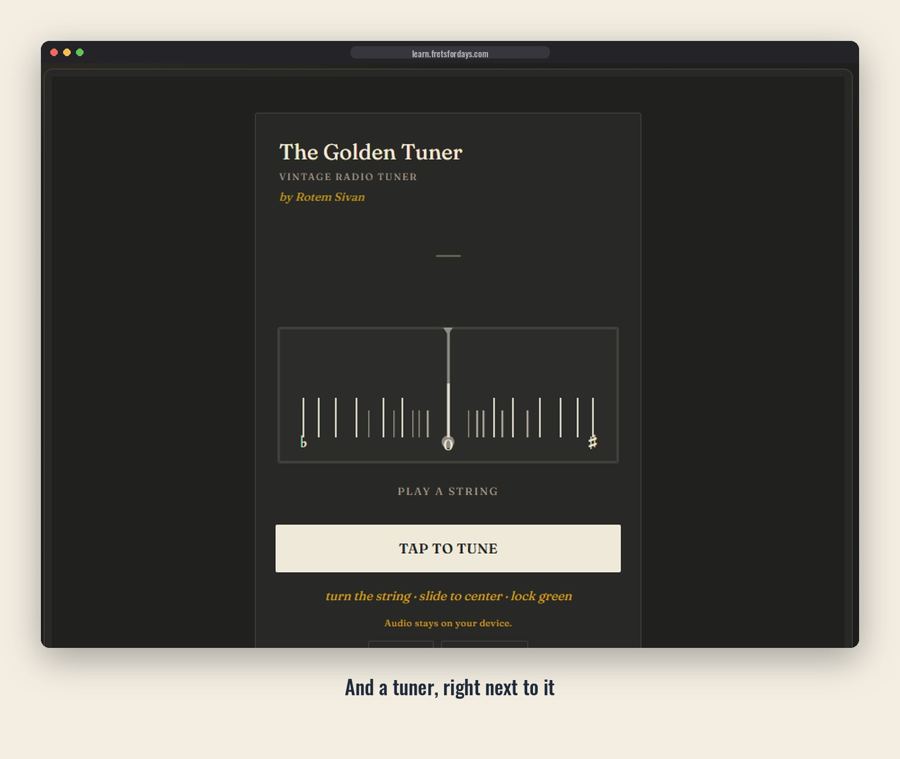
Real screens from the Frets For Days member area: the course outline, a lesson page with its downloads, and the practice room, metronome and tuner that are there when you practice.
What's inside
10 lessons, day by day.
Every exercise below is something I play or explain on camera, or something written out in that day's worksheets.
1 The Foundation: Locking in the Hands
- Why the link between your left and right hand has to be very strong and clear, and the simple exercise I start with (watch it above).
- First finger on the fifth fret, alternate picking, then shifting strings, with a consistent sound on every note.
- Playing without looking at the board or the strings, so your fingers learn where the string is.
- Worksheets: the basic shape, and its permutations, including descending and string skipping.
2 Picking Motion: Right Hand Mechanics
- The chromatic shape moving up along one string, then on each string to check the motion.
- Bringing in the click at 60 BPM and doing it together.
- Worksheets: the motion on one string, and the same idea in triplets and 16th notes.
3 Subdivision Mastery: Rhythmic Control
- Quarter notes, 8ths, triplets and 16ths against one click: slicing the beat like a cake into two, three and four.
- The Carnatic syllables I use (ta-ka, ta-ki-ta, ta-ka-di-mi), and why they help when the rhythm gets faster and more complex. Counting numbers is fine too.
- Locking in at 60 BPM and feeling the accuracy with your body. It sounds almost too simple, but it's not that easy.
- The same idea on one string. Worksheets: sing the subdivisions, and a closer look at them.
4 Finger Gym: Left Hand Strength
- Why finger strength matters: when we get tired, we're less accurate.
- One note, then hammering on the next and pushing into the string, like lifting weights at the gym, string by string.
- Four repetitions, then the next finger pair: 1-2, 1-3, 1-4, 2-3, 2-4, 3-4.
- Doing it together in time, with a 100 BPM groove track to play along with.
5 Variations: Finger Permutations
- 2-1-3-4 on one string, up the fretboard, then the mirror, 3-4-1-2, around the 12th fret.
- On every string, in time, without stopping between, ascending and descending.
- From 8ths to triplets, 16ths, sextuplets and 32nd notes once you're comfortable.
- Why the tongue-twister ones are worth the trouble: the normal stuff starts to feel easier.
6 Legato: Hammer-Ons & Pull-Offs
- The basic motion: down, hammer, down, hammer, then up, pull-off, up, pull-off.
- The goal: blur the line between alternate picking and hammer-on and pull-off, so both notes are balanced.
- The mistake to avoid: hitting the first note as hard as you can, then trying to match it with the hammer-on.
- In time together, in this exact fingering, then finger variations on the worksheet.
7 Legato Across the Fretboard (3NPS)
- Alternate picking vs legato, and why legato is a very easy technique for fast lines (more in "Look inside" above).
- Extremely slow first, without a metronome, comparing the sound with and without the pick.
- Playing it with me at 60 BPM in quarters, triplets, 8ths and 16ths, knowing every note as you go.
- Worksheet: the legato exercise written out, from quarter notes up to sextuplets and 32nds. Also attached: a C major three-notes-per-string chart in seven positions.
8 Scale Articulation: Skip, Group, Double Stops
- The same five notes of A minor pentatonic, seen in different ways.
- Skipping a note: A to D, C to E, D to G, all the way up, slowly together.
- An optional fingering: flattening the finger, and sometimes separating the fingers instead.
- Worksheets: skip a note, groups of three notes, and double stops.
9 Creative Technique: Phrasing with Clean Execution
- Perfect repetition: one simple idea, in the same place in time, a little better every time (watch it above).
- Trying it at different tempos, with a track or a click, fast and slow.
- Worksheets: the perfect repetition example, and change the rhythm.
10 Integration: Full Workout + Performance
- The track: a 2-5-1 in C (Dm7, G7, Cmaj7 to C6) three times, then Bm7, E7 to Am7, the false cadence, with the shell chords I'm using.
- A solo where I weave in and out of the ideas from the course, then what I pulled from: repeating a phrase, playing on one string, going high for contrast, dyads, and a few fast lines against the groove.
- Also attached: Green Point Solo, a solo over the same chords in notation and tab, and a Tension & Color sheet.
- The original Technique and Speed method, Vol. 1: 28 pages, exercises 1 to 14.
The curriculum
Every lesson, in order.
All 10 lessons. Tap to open.
CourseCourse Contents10 lessons
- 01Day 1: The Foundation, Locking in the Hands (watch it above)
- 02Day 2: Picking Motion, Right Hand Mechanics
- 03Day 3: Subdivision Mastery, Rhythmic Control
- 04Day 4: Finger Gym, Left Hand Strength
- 05Day 5: Variations, Finger Permutations
- 06Day 6: Legato, Hammer-Ons & Pull-Offs
- 07Day 7: Legato Across the Fretboard (3NPS)
- 08Day 8: Scale Articulation, Skip, Group, Double Stops
- 09Day 9: Creative Technique, Phrasing with Clean Execution (watch it above)
- 10Day 10: Integration, Full Workout + Performance
Two hands. One click. Ten short lessons.
One payment · Lifetime access · 30-day guarantee
Who it's for
Built for the player who's ready to stop testing and start practicing.
Read both lists. If the second one sounds like you, save your money.
This is for you if...
- You've told yourself you're just not talented enough to play fast.
- Your pick misses strings, or you have to look to find the next one.
- Your time slips when you switch from 8ths to triplets or 16ths.
- Your hammer-ons and pull-offs come out louder or softer than your picked notes.
- You'd rather run a short daily routine than collect random exercises.
This isn't for you if...
- You want licks and songs. This is a technique routine, with one solo at the end.
- You want speed this week. I worked at 40 BPM for weeks before I moved the tempo up.
- You want economy or sweep picking. This is alternate picking and legato.
- You're still learning to fret your first notes and chords.
The offer
One payment. $27. Yours for life.
Technique & Speed is $27, once. You get all 10 lessons, every worksheet, the Guitar Pro files, the tracks and the 28-page method in your Frets For Days member area, and they stay there.
One payment · Lifetime access · 30-day guarantee

About your teacher
I'm Rotem Sivan.
I'm a jazz guitarist and educator in New York. I'm from Israel, and I studied at The New School.
I'm not telling you that to impress you. I was the student who worried he'd never play fast, and who was scared of missing strings. This course comes out of the routine I built for myself. The method in it is my own first 30 to 60 minutes of practice, starting from my classical guitar teacher's advice to prepare, then play. The lessons go in the order I'd hand it to you: lock the hands, feel the time, strengthen the fingers, then make music with it.
Rotem
FAQ
Questions before you buy.
What's the format?
10 video lessons, Day 1 to Day 10, each with its downloads: 18 PDF worksheets in notation and tab, 18 Guitar Pro files, a 100 BPM groove track and a C major jam track. Day 10 also has the original 28-page Technique and Speed method. Everything lives in your Frets For Days member area, and you watch at your own pace.
What level is it for?
You should be able to fret notes and hold a pick. Day 1 might be something you've done before. The point is doing it with control, a consistent sound, and without looking. Day 8 uses the A minor pentatonic, and Day 10 is a solo over a 2-5-1 in C.
Do I need to read music?
No. I show everything on the guitar, and every exercise worksheet has tab under the notation. The Guitar Pro files are there too if you use Guitar Pro.
How much time per week will it take?
The lessons are short: most are around two minutes, and the longest, Day 7, is seven. The practice is the real time. The method is built from my own first 30 to 60 minutes of practice, and I suggest 5 to 15 minutes for the open-string picking and 5 to 15 for the legato set. You don't have to do everything every day.
How long do I have access?
For life. One payment, and the course stays in your member area.
What if it isn't for me?
There's a 30-day guarantee. Work through it, and if it isn't right for you, email [email protected] within 30 days for a refund.
Stop testing yourself. Start training both hands.
It isn't a talent problem. It's two hands that haven't been taught to move together yet. Here's the routine that teaches them, one short lesson a day.
$27 one time · 10 lessons · 18 PDF worksheets · the 28-page method · lifetime access
Get Technique & Speed: $27P.S. Here's a test you can run tonight. It's the first thing we do on Day 1. Put your first finger on the fifth fret and play frets 5, 6, 7 and 8 with alternate picking: down, up, down, up. Move to the next string and do it again, all the way across, then come back 8, 7, 6, 5. Don't look at the strings. Listen: is every note the same volume, and did your pick find each new string on its own? If either answer is no, that's where the course starts.
Hugs,
Rotem