For blues players who know the pentatonic box but can't hear how their solo connects to the song
Play blues solos that move with the chords, and take your lines from A to F without leaving your spot on the neck.
The 12-bar blues from simple triads to 9th and 13th chords. Eight blues lines over it, each one taken apart note by note, most of them played in time with me. The singing and rhythm work that makes them yours. Then we move the lines from A to F, staying in the same spot on the neck.
One payment of $77 · Lifetime access
Get Simple Blues Soloing42 video lessons · PDF worksheets with 41 of the lessons · 30-day guarantee
- The 12-bar blues, triads to 13th chords
- Singing every note of the pentatonic
- Quarters, triplets and 16ths on one string
- Eight blues lines, taken apart note by note
- The 6th, the 9th and double stops over A7
- Lines and chords moved from A to F
A lot of us play the blues already. A lot of guitar players can comfortably play the pentatonic position. But it's not enough, and a lot of people fall at this exact point. A lot of times, what holds people back from really expressing and really being free is not paying attention to the sounds: the degrees, what each note is against the root, and how it feels. That's what we work on here, one note, one chord and one line at a time.
Watch before you buy
Two full lessons from the course.
These are real lessons, exactly as they play in the member area. The camera switches between me and a close-up of the neck, so you can see where every note is.
A letter from Rotem
I called a song at a jam in Israel. It was in a different key, and I was totally lost.
When I started playing and sitting in, I went to a jam in Israel. I called a song, and I was really excited. Then it was in a different key, and I was totally lost. It took me so long to reorient myself, and I was super stressed and nervous anyway.
It's not that I woke up one morning and could transpose and play any line everywhere. I spent, and I'm still spending, a lot of time transposing, learning and paying attention to the sound of colors. Singing, trying, transcribing.
So in one of these lessons, I play a line in A, built on the sound of the 6th. Then I go to F. I stay in the same area of the neck, and I don't move the shape. "I've never played this line before, but I'm able to think about the color."
Now, the pentatonic works. Knowing the fingering and the position is important, and it's a big part of this course. But notice what happens when the position is all you have. The chord moves to D7 in bar 5, and your line doesn't know. You're playing the key, not the chord.
And when somebody says, hey, man, let's play it in F, you can slide the shape to a new spot, and sometimes that's helpful. But you're copying and pasting a shape. You're not hearing what you play, so you can't change one note of it on purpose.
That's not a talent problem. You were shown where the notes are. Nobody asked you to sing them, so nobody showed you what they are.
- Tag every note: know what it is against the center, the 1, and how it feels. You get there by singing it.
- Then a line stops being a shape and becomes a set of sounds, like 5, 7, 1, 9, that you can aim at a chord or carry into a new key without leaving that spot on the neck.
That's how the course is built. We start with the 12-bar blues itself, the chords from simple triads to shell chords to 9ths and 13ths, and we sing the bass motion while we play them. We sing the A and feel every note of the pentatonic against it. We play quarter notes, triplets and 16ths on one note, on one string, because time is one of the things that separates a lot of musicians from guitar players.
Then come eight lines: a slide that pays a little homage to the chord, a line in triplets, a line that crosses positions, the major 6th, the 6 and the 9 together, double stops, and a diminished sound that's very intense with a very rewarding resolution. In Line 6, I play notes from E minor pentatonic over an A7, a scale you probably already know, heard against a chord it isn't named after.
And at the end, we take lines from A to F without shifting position, the way I did in that drill, thinking about the color of each note, not the shape.
What it won't do. It won't make you fast. It's not about speed. It also won't happen overnight. I know it takes time, and I know it's not easy. It won't get you ready for every key, either: we go from A to F, and that's it. And it isn't a songbook: no tunes, no transcriptions of famous solos. It's the 12-bar blues in A and F, eight lines, and you, your voice and your guitar.
The pentatonic isn't the problem. It's five notes you already own. This course is how you start hearing each one of them, so the next time you take a chorus, the chord changes in bar 5 and your line goes with it. And when somebody says let's play it in F, you've been there before.
Rotem
Look inside
Two real lessons, up close.
Here's exactly what you'd be working on, taken straight from the course.
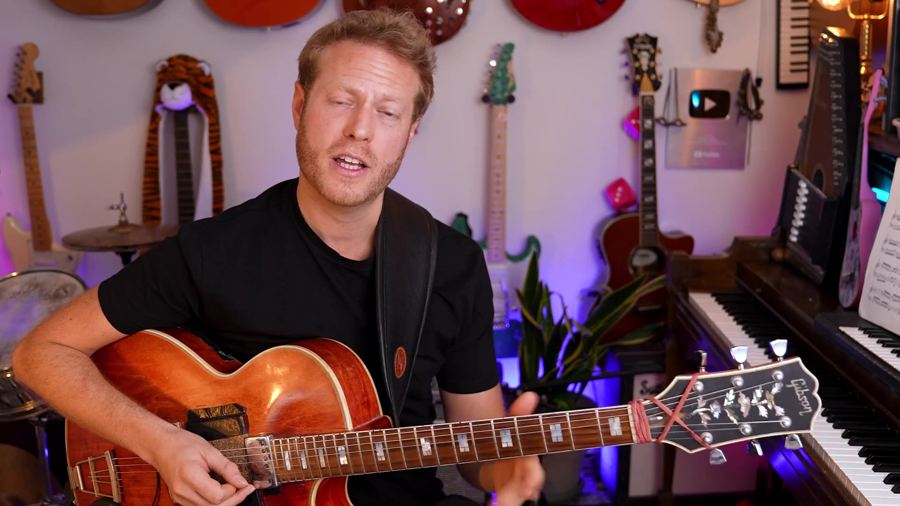
The "wrong" scale over an A7
The first part of this line is just four notes: the 5, the 7, the 1 and the 9 of A. Those same notes are also part of E minor pentatonic. So over an A7 blues, I can grab E minor pentatonic, a scale you probably already know, as long as I hear how it changes the color against the A7.
The second part targets the A major triad, 1, 3, 5 and 1, and surrounds each note with a scale note above and a chromatic note below before it lands. Then I slide up to the B, the 9. And because we've already played four bars, the chord has moved to D7, and that same B is now the 13. Same note, different chord, different color.
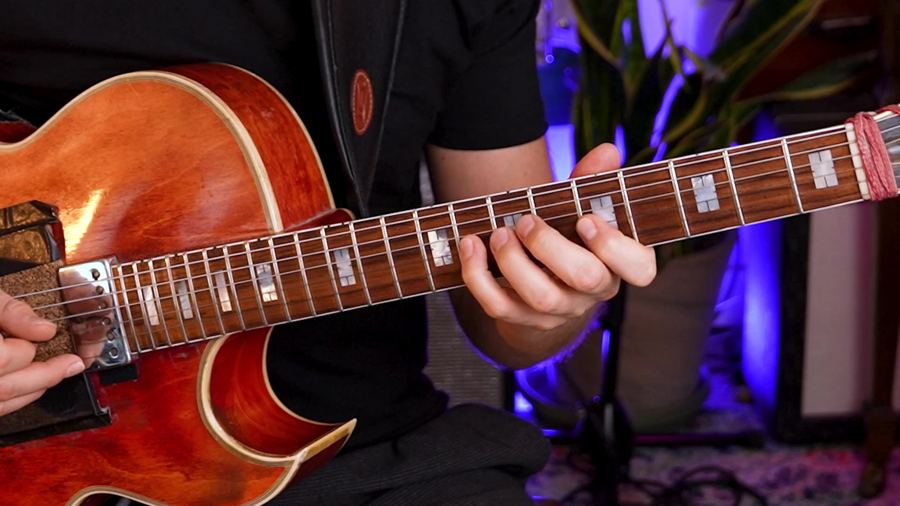
From A to F, without moving the shape
We start in A, with a line built on the 6th sound: 6, flat 3, 1, 5. I tell you we're going to change key very shortly, so don't only listen. Think about what's happening.
Then we go to F. I stay in the same area of the neck and I don't move the shape. "I've never played this line before, but I'm able to think about the color." Six, flat 3, 1, 5, flat 7, in F. And then I ask you to try it yourself: even two or three notes, shifted into a different key.
Inside the members area
Here's what you see when you log in.
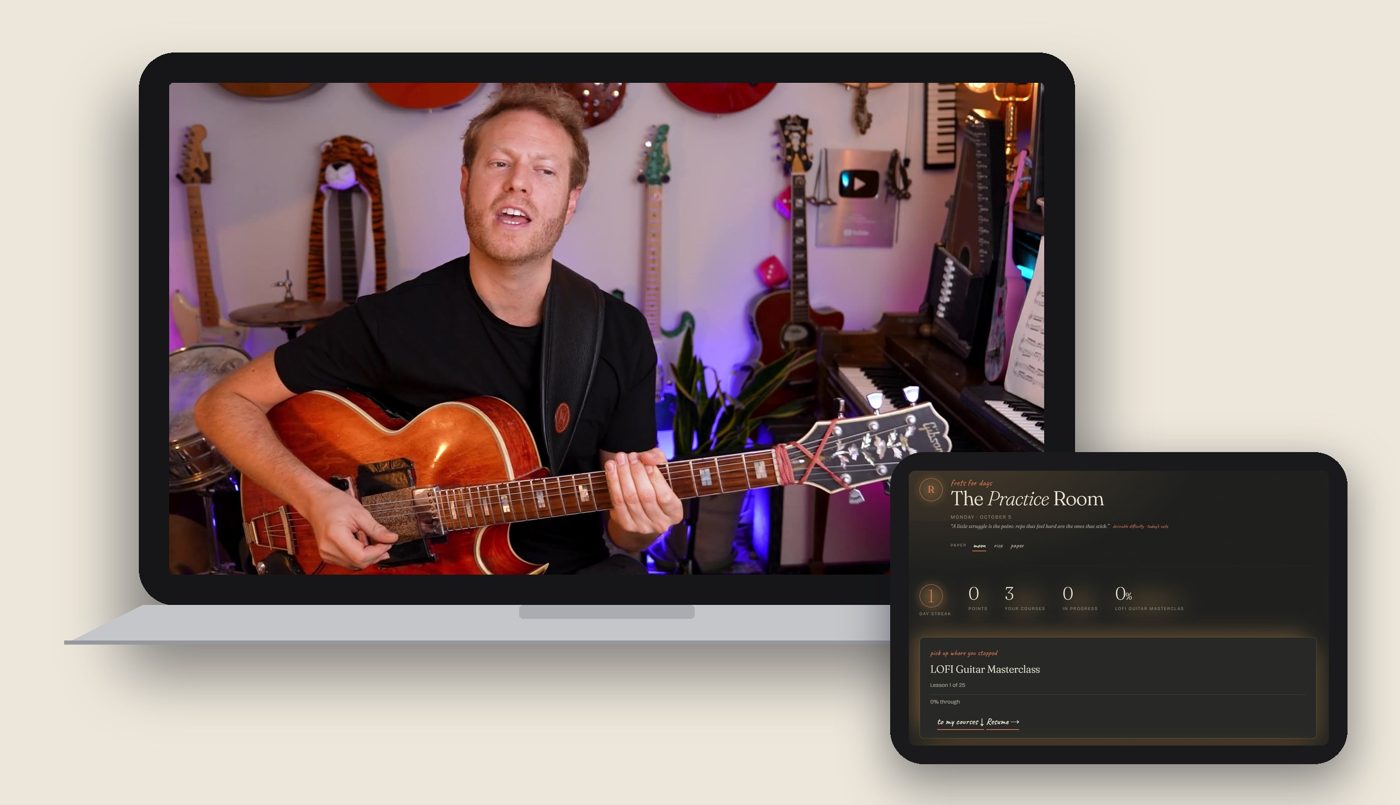
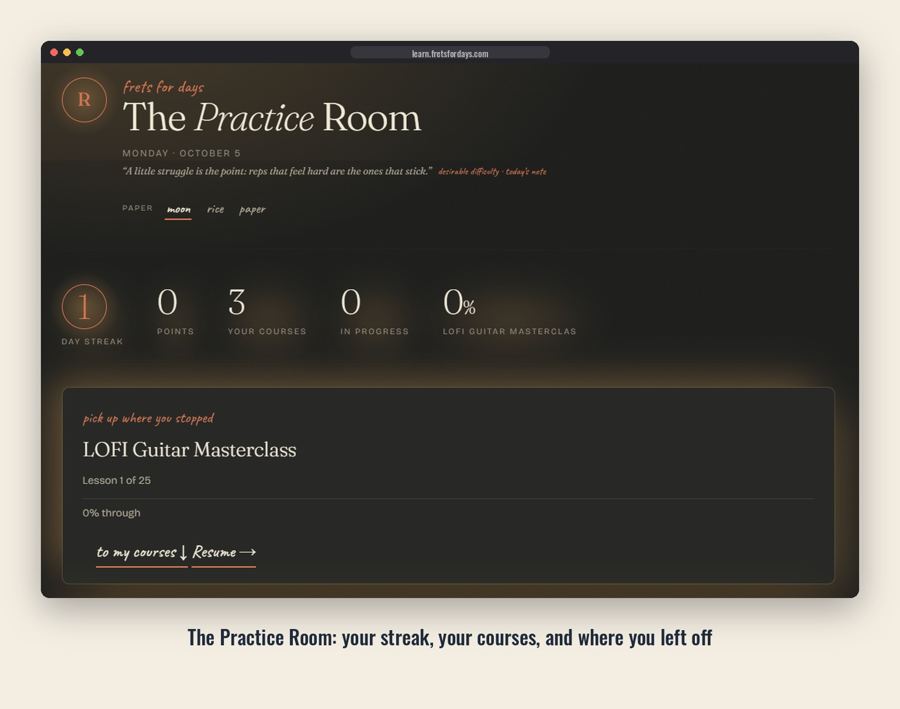
Real screens from the Frets For Days member area. The Practice Room keeps your streak and shows where you left off, and there's a metronome and a tuner right in your dashboard, so you can slow a line down whenever you need to.
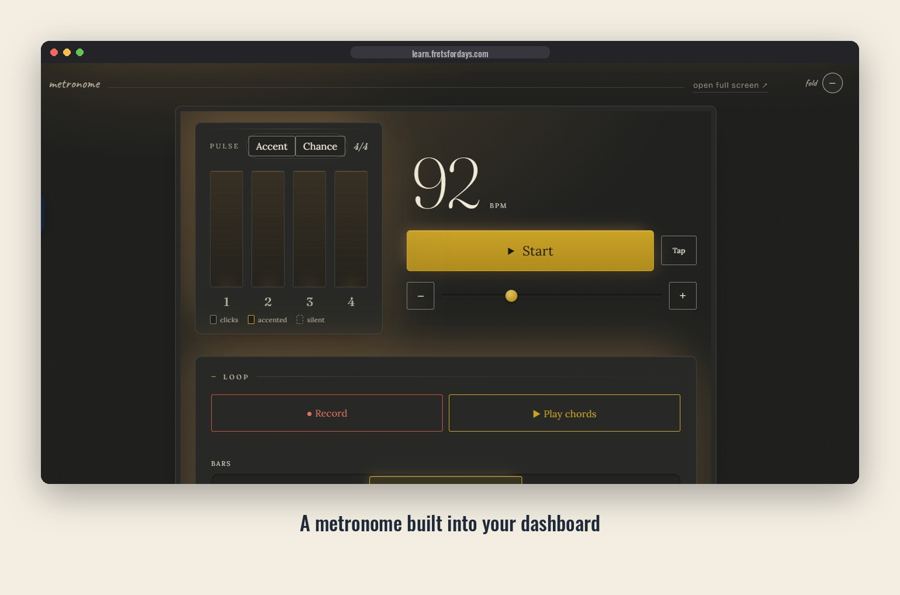
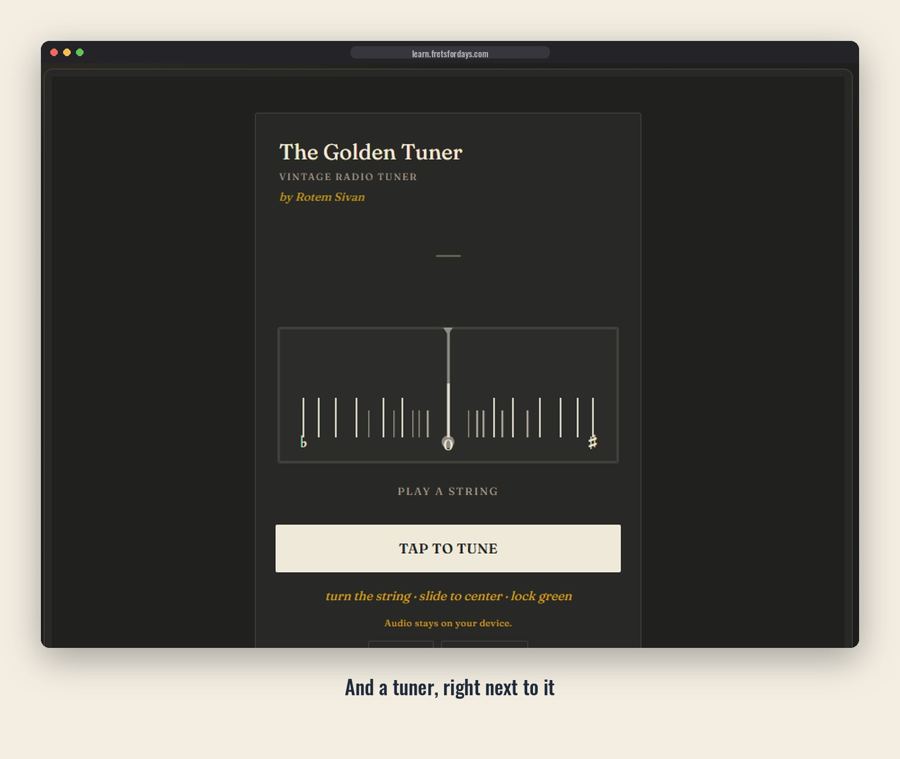
What's inside
42 lessons, grouped by topic.
Every chord, line and exercise below is something I play or explain on camera.
1 The 12-bar blues
- An A major triad shape I recommend checking out instead of your barre chord, a D major triad you probably know, and what I mean by "1, 5 and 3" when I play the D.
- The 12 bars as the 1, the 4 and the 5, played in time, always thinking ahead to the next chord.
- Singing the bass motion while you play the chords. "If this does not feel easy, it's a good thing. It means you're in the right place."
- How to change to a shape that isn't comfortable yet: a long count per chord, then shorter, still landing on beat one every time. Plus the "dots of light" I picture before my hand moves.
- Shell chords for A7, D7 and E7, and the fingering I'd choose.
- A richer blues: the 2-5 with E minor, F sharp to B minor, and a 1-6-2-5 turnaround, first with triads, then with shell chords, plus a diminished chord "just why not."
- What a 13 and a 9 are ("it's actually very simple"), and the one note you add to each shell to get A7(13) and D7(9).
- The whole form with 9s and 13s, a D sharp diminished, and the flat 13 on the F sharp 7 that leads to B minor.
- For when your buddies say "let's play an F blues": seeing the form as relationships, so F, B flat and C come out "instead of panicking."
- A blues in F with every extension, including the flat 9 on D7, and the option of a sharp 9 on C7, "just a little bit more tension."
2 Hear it, sing it, play it in time
- Singing the A and feeling every note of the A minor pentatonic against it, tagged as a note and as a color (the full lesson is above).
- The reverse: hold one note on the guitar and sing the other. "We don't need to be an opera singer."
- Call and response: I sing a phrase, you sing it back, no guitar at all.
- The same exercise from the second position, and how thinking in notes, not just position, lets you hear and see the same five notes repeat.
- Singing the scale degrees as you play, because not paying attention to them is, a lot of times, "what holds people back from really expressing and really being free."
- One position over the 12-bar form in quarter notes, 8th notes and triplets, keeping track of where you are in the form.
- One note on one string: quarters, triplets, 8ths and 16ths.
- Quarter notes up to 16ths at 60 BPM, then the same subdivisions sung. "One of the elements that distinguish between a lot of musicians and guitar players."
- How I practice a new phrase: slow, then faster, then weaving it into a real solo so it doesn't sound like an exercise.
3 Lines 1 to 3
- Line 1: the slide from C to C sharp over A7, the crunchy note against the chord tone, and a tiny bend on the flat 7.
- Line 1, second half: straight up the pentatonic in triplets, played clearly against the groove.
- Phrases as building blocks you can adjust: change the first note, change the last. "The same thing as a language."
- Dynamics: one half of the line louder, the other softer, almost call and response.
- Line 2: triplets with a little syncopation, the slide again, and the flat 7 to the root, G to A.
- Line 3: a line that slides across positions and resolves on the A, and how the notes revolve around that center.
4 More color: Lines 4, 5 and 6
- Line 4: the major 6th, F sharp, in the middle of the A blues sound. "This major six gives a lot of flavor."
- Laying back on the beat, and the dynamic range: "the same way if I'm whispering or I'm shouting."
- Line 5: the 6 and the 9 together, why it lands on A7 and not as well on D7, and how moving it carries a full chorus (the full lesson is above).
- Line 6: E minor pentatonic over A7, surrounding the triad, and a B that turns into the 13 when the chord changes to D7.
- A triplet line down the blues scale with the flat 5, after the 9 resolving to the 1 and the 6 to the 5.
- Getting comfortable switching between quarter notes, 8th notes and triplets inside one phrase, and digging into a note with a small bend before you resolve.
5 Double stops and beyond the pentatonic
- Line 7: double stops in sixths that spell out A major, sliding chromatically. "It's a classic sound, a classic move with guitar."
- Line 8: the A7 arpeggio, the 9 and the 6, then a diminished sound. "It's very intense... then the resolution is very rewarding."
- Where Line 8 lands: the C natural, the flat 7 of D7.
- One line idea moved around the 12 bars, what happens in the turnaround when someone comps a different chord, and hanging on the 9 instead of resolving.
- How to use your lines in a solo: half a phrase, broken apart. "Integrate them and then disintegrate them."
6 From A to F
- Line 1 in F: 5, 7, 1, 9, thinking F minor pentatonic as F, A flat, B flat, C and E flat, and staying in the same area of the neck on purpose. "It's not out of laziness. On the contrary."
- The Line 2 drill: 6, flat 3, 1, 5, moved to F by thinking about the color (the full lesson is described above).
- A line in A, then in F, without shifting position. "It's not magic. It was a lot of hard work in the past."
- The flat 7 or the 6, in A and in F: seeing the root as the center and every note around it, so the color notes stand out.
The curriculum
Every lesson, grouped by topic.
All 42 lessons, grouped by what they cover. Tap a group to open it.
Part 1The 12-bar blues14 lessons
- 01THE Blues
- 021-3-5 in time
- 03Pay attention
- 04Practice this again
- 05How to move between shapes
- 067th chords
- 07Adding more chords
- 087th with more chords
- 09More color chords
- 10Slow together
- 11In time
- 12Even more color
- 13How to transpose chords
- 14Let's practice blues in F
Part 2Hear it, sing it, play it in time10 lessons
- 15The shapes and ears (watch it above)
- 16Play and sing with me
- 17Q&A: try it now
- 182nd position: feel it
- 19Hear and sing it
- 20Time and rhythm: framework essentials
- 21Playing in time together
- 22How to get free, plus a one-string exercise
- 23Subdivisions: just singing
- 24Know how it works
Part 3Lines 1 to 35 lessons
- 25Line 1
- 26Line 1 (2nd half)
- 27Line 1: in time together
- 28Line 2
- 29Line 3
Part 4More color: Lines 4, 5 and 65 lessons
- 30Line 4: the major 6th sound
- 31Line 5: the 6 and 9 color (watch it above)
- 32Line 6: hearing the chords
- 33Hear it, know it and play with me
- 34Exploring the inside of the line: play together in time
Part 5Double stops and beyond the pentatonic4 lessons
- 35Line 7: double stops
- 36Line 8: explore the sounds
- 37One line idea on 12 bars
- 38How to use your lines
Part 6From A to F4 lessons
- 39Here is how to do it together: Line 1
- 40Transpose drill: Line 2
- 41Line 3: A to F
- 42Adjust the b7 to the 6th
The form. Every note. Eight lines. Then F.
One payment · Lifetime access · 30-day guarantee
Who it's for
Built for the player who owns the box and wants to hear what's in it.
Read both lists. If the second one sounds like you, save your money.
This is for you if...
- You know the A minor pentatonic position and your solos rarely leave it.
- You can play a 12-bar blues, but your line sounds the same over the A7, the D7 and the E7.
- Somebody says "let's play it in F" and you'd rather sit that one out.
- You're willing to sing quietly while you practice. You don't need to be an opera singer.
- You'd rather know eight lines well enough to take them apart than collect eighty you can't.
This isn't for you if...
- You don't know the pentatonic position or a barre chord yet.
- You want speed. This course is about hearing, not velocity.
- You want to learn songs or famous solos note for note. This is the 12-bar blues, in A and F.
- You want it all in a weekend. I tell you plainly that this takes time.
The offer
One payment. $77. Yours for life.
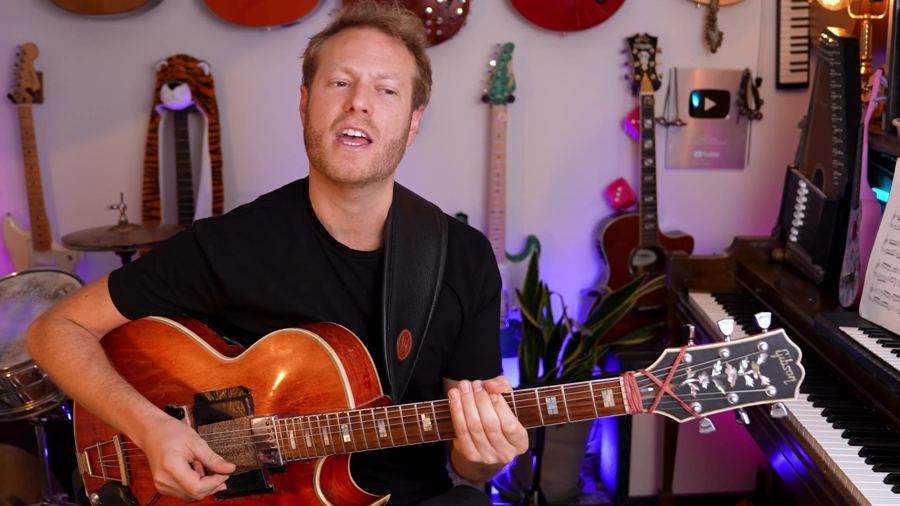
Simple Blues Soloing is $77, once. You get all 42 lessons and the PDF worksheets in your Frets For Days member area, and they stay there.
One payment · Lifetime access · 30-day guarantee

About your teacher
I'm Rotem Sivan.
I'm a jazz guitarist and educator in New York. I'm from Israel, and I studied at The New School.
I'm not telling you that to impress you. I'm telling you because I've been the guitar player at a jam who called a song, heard it in a different key and was totally lost. This course starts with the form, then hearing every note, then the lines, then taking them to a new key.
Rotem
FAQ
Questions before you buy.
What's the format?
42 video lessons, with PDF worksheets alongside 41 of the lessons. Most lessons are me explaining, then playing with you in time. Everything lives in your Frets For Days member area, and you watch at your own pace.
What level is it for?
Intermediate. You should know the A minor pentatonic position and a few basic chord shapes. We start from the 12-bar blues with simple triads, so if you've played the blues many times, some of it will be a refresher. Either way, it's the foundation the lines stand on.
Do I need to read music?
No. I explain everything with note names, numbers like 1, flat 3 and 5, and singing, and the camera shows the neck up close while I play.
How much time per week will it take?
Most lessons are under two minutes, and the longest is just under six. The practice is the part that takes time. There's no schedule. If something isn't 100% clear, go back one step, make sure you own it, and then move on.
How long do I have access?
For life. One payment, and the course stays in your member area.
What if it isn't for me?
There's a 30-day guarantee. Work through it, and if it isn't right for you, email [email protected] within 30 days for a refund.
Hear every note you play over the blues. Then take it to F.
The five notes are already under your fingers. Here's the form, the singing, eight lines and a new key, one step at a time.
$77 one time · 42 lessons · PDF worksheets with 41 of the lessons · lifetime access
Get Simple Blues Soloing: $77P.S. Here's a test you can run tonight. Play an A on the guitar and sing it. Keep that A in your ear and play your A minor pentatonic slowly, singing each note as you go: the C, the D, the E, the G. Which ones feel like home and which ones pull away? If you felt the difference, you just tagged your first notes. The course does that for the whole blues, eight lines, and a second key.
Hugs,
Rotem