For guitarists who feel boxed in by the one pentatonic shape they know
Hear every note under your fingers, and move freely from one pentatonic position into the next.
One A minor pentatonic position, until you can hear it, sing it and name every note in time. Then a second position that melts into the first, and the same notes heard from C.
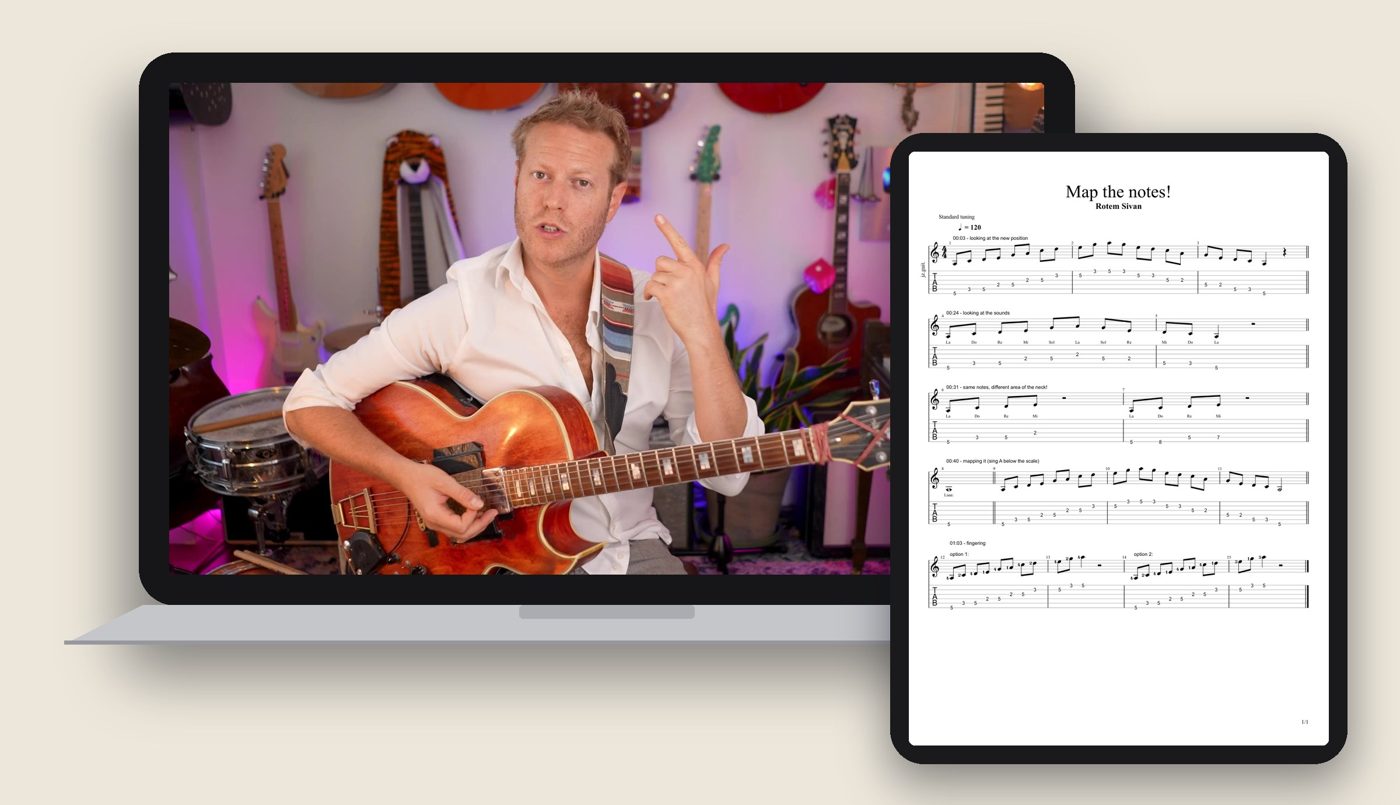
One payment of $57 · Lifetime access
Get Solo Vision28 video lessons · 32 PDF worksheets · 30-day guarantee
- Two A minor pentatonic positions, mapped note by note
- Singing the note names as you play
- Double stops, 3-note groups, skip-a-note
- Legato: hammer-ons and pull-offs
- Quarters, eighths, triplets and 16ths, in time
- C major pentatonic from the same notes
One of the most frustrating feelings we have with guitar is the feeling that we're boxed in. I had that, and I know a lot of people have that feeling. We can't really see how to get out of these couple lines that we can play. In this course we look at the board, understand, hear and sing, all so we can create. It feels and sounds complicated, but it actually is very simple.
Watch before you buy
Two real lessons from the course.
These are real lesson videos, exactly as they play in the member area.
A letter from Rotem
I could sing the solo before I could find it on the guitar.
The first solo I ever transcribed was a Hank Mobley solo, a blues on the Miles Davis album Someday My Prince Will Come. I remember it so strongly because it was the first time I tried to transcribe jazz.
I listened to it a lot. After that I could sing the whole solo pretty well. Then I tried to find the notes on the guitar. How do you go about it? How does it work? I didn't really know.
The sound was in my ear. Finding where those notes were on the neck was the hard part.
For many guitar players it's the other way around. You've got one position. It's under your fingers. You start a solo, and a few bars in you're back in the same couple of lines, and you can't really see or understand how to get out of them.
Now, the position works. A lot of people know it. But here's the issue that happens oftentimes with guitar players: the position we know is actually not linked to enough information. We know the fingering. That's about it.
That's what I mean by just the fingering, and here's what it costs you. You can play things that sound cool and not know what's happening there. If I stopped you in the middle of a line, could you tell me what note you're on? And when the chord moves from C major to A minor, you play the same fingering and hear nothing change, because to your hands nothing did.
That's not a talent problem. A tab gives you fret numbers. A video gives you a shape. Neither one asks you to hear the note, say its name and feel what it does against the center. When I practiced these things in the beginning, I was very clueless and I lost a lot of time. I want to save this time for you.
- The position you already know has to be embedded in your system: you hear it, you know every note, you sing it, and you can play it in time.
- Then the same five notes show up in a second place on the neck and with a second center, and the separate boxes melt into one big soundscape.
That's how the course is built. We start with the A minor pentatonic position, and we sing the note names as we play them, in solfege or in letters. You don't need to be an opera singer. Then we come at the same position from different angles: skipping a note, double stops, groups of three, legato. And we play in time together, quarter notes, eighth notes, triplets and 16ths, switching between them.
Then a second A minor position, one you've probably played in your life, looked at from a brand new perspective and mapped note by note. We shift between the two while I call it, until they melt into each other.
Then we keep the same notes and move the center to C. The fingers already know where to go. What changes is how every note sounds, and that's the part we work on.
Something starts to happen while you do this. The guitar stops being this foreign thing. It's a lot of notes you're good friends with, and it's the same five notes. You start hearing them more and more clearly, and the eighth notes, triplets and 16ths get embedded.
What it won't do. It won't give you all five pentatonic positions. It's two positions and two centers, A minor and C major, worked deeply. It won't teach you jazz vocabulary or how to play through jazz chord changes. The only centers here are A minor and C major. And it won't happen this week. There's a lot of information, and I want you to take your time and be patient. Every day a little bit is how this works.
I want you to be freer to improvise, to create, to write, to make music. I really believe you can do it. Let's dive in.
Rotem
Look inside
One real lesson. One real worksheet.
Here's exactly what you'd be working on, taken straight from the course.
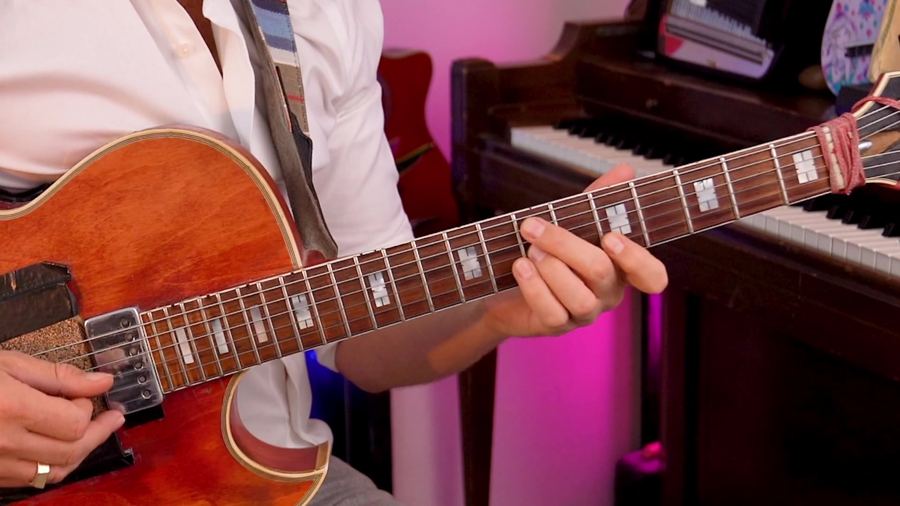
Shift when I call it
By this point you've mapped two A minor pentatonic positions. In this lesson we play in time, and when I say "shift," we move to the other one. Quarter notes first, then eighth notes, then triplets, then 16ths. You can even shift more if you want. It's totally fine.
Every time, I want the fingering and the shift to be as clear as possible. I know the notes. I know the sound. By the 16ths, I know it's not easy.
What we're trying to do is melt these two positions into one big beautiful soundscape. It takes time, it takes effort, but you understand the path.
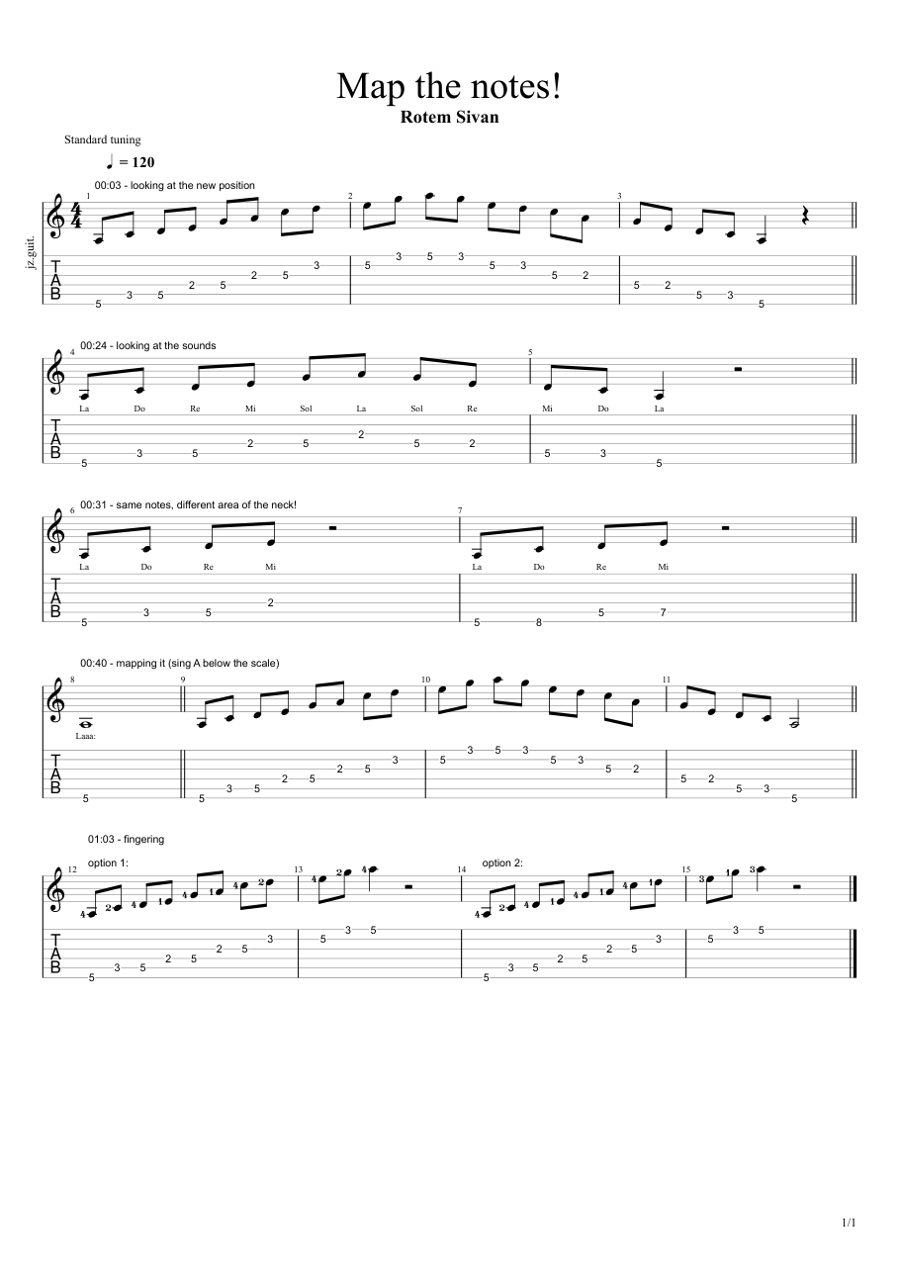
The new position, note by note
The worksheet for "Map the notes" writes the second position out in notation and tab. Then a passage with the solfege written under each note: la, do, re, mi, sol.
Below that: the same notes in a different area of the neck, a line where you sing an A below the scale, and two fingering options side by side. Every part is marked with the time it happens in the video, so you can jump straight to it while you practice.
Inside the members area
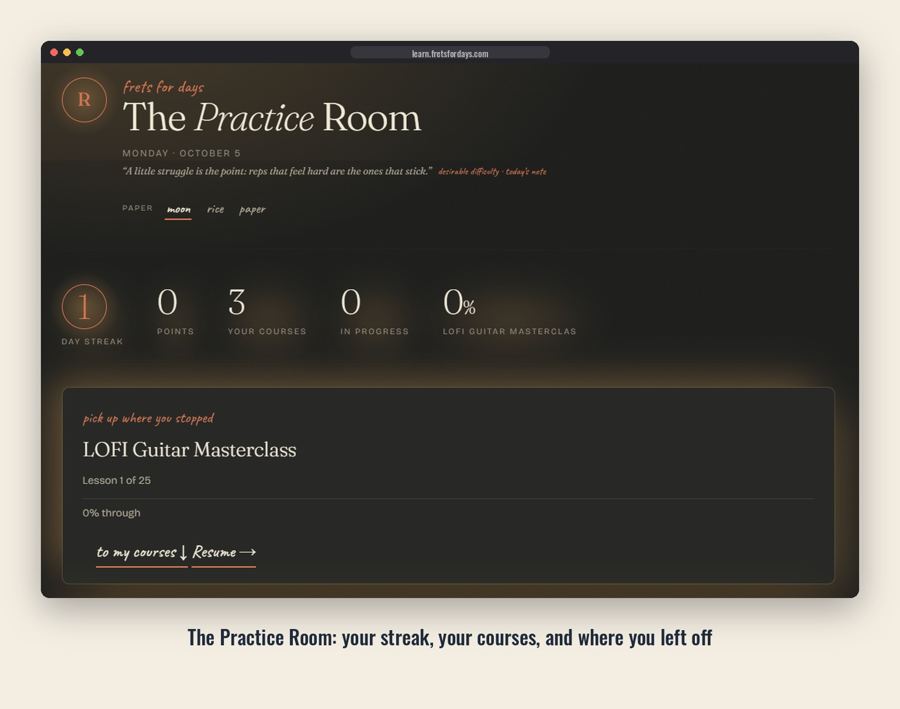
Here's what you see when you log in.
Real screens from the Frets For Days member area: your course, your lessons, and the practice room with a metronome and a tuner.
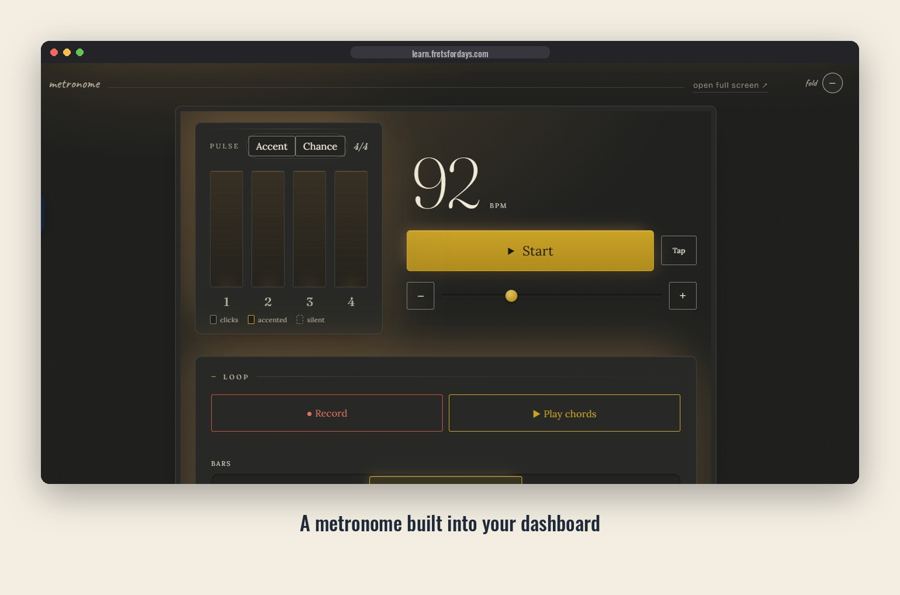
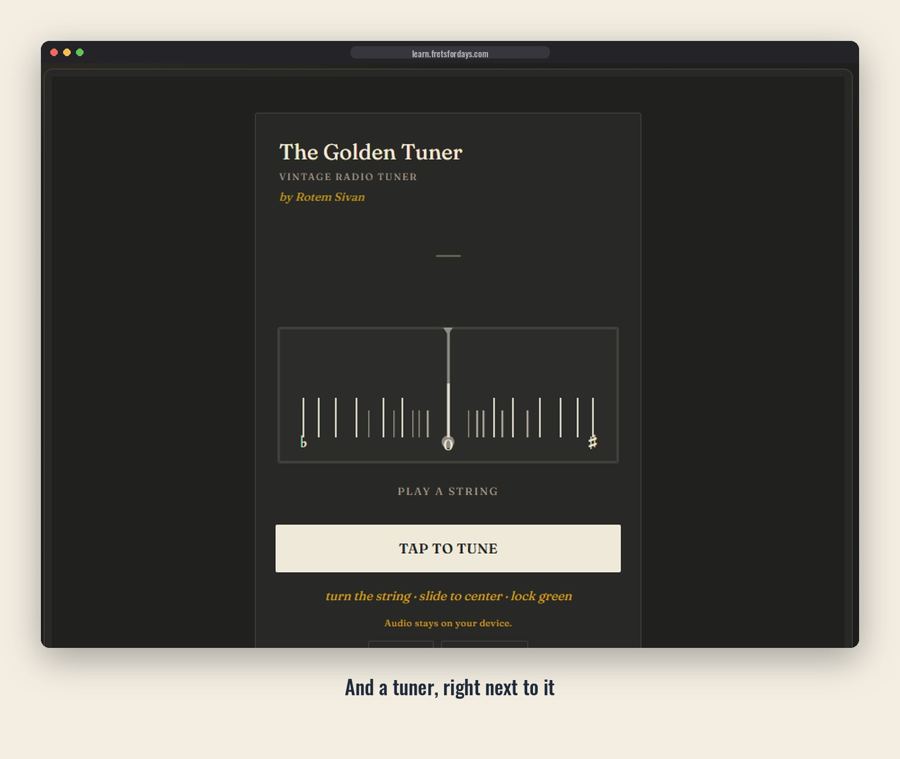
What's inside
28 lessons, section by section.
Every position, exercise and move below is something I play or explain on camera, or something written out in the worksheets.
Hi + Start How to go about it
- The feeling of being boxed in, and how simple the way out actually is. "Like a lot of things it feels and sounds complicated, but it actually is very simple."
- Hear it: "Music is the art of listening." What it means to lock in the color you're dealing with, and how fast you get once you can tag it.
- Sing it: the link between your fingers, your mind and your ears, and a way to strengthen it with no guitar at all, while you're listening to a song.
- The Board: the real problem with the position you already know: it isn't linked to enough information.
- Understand: a lot of people play things that sound cool and don't know what's happening there. What that costs you in learning speed.
- Take your time: "I really believe you can do it, but just take your time and be patient."
1 The A minor pentatonic
- The position with the names of the notes: singing them as you play, in solfege or in letters. "You don't need to be an opera singer."
- A worksheet that writes out how each note feels against the A, from the flat 3 to the flat 7, and how those sounds repeat across the scale.
- Skip-a-note through the position, in time, and the reason I keep saying the note names even in a fingering exercise. "It's the path to freedom, knowing how I see it."
- Double stops: the same skipped notes played together. Almost every interval is a 4th, except the major 3rd from C to E, and we listen to the low note, then the top note.
- Groups of three notes, starting from each note in turn, and the accent you can leave out.
- Legato: hammer-ons and pull-offs, the technique I think sounds "sort of like a horn player," and the one thing I listen for when I compare picked and hammered notes.
- Play with me, in time, at 60 BPM: quarter notes, eighth notes, triplets and 16ths, and switching between them. "Looks easy but it's actually not."
- What to do if 60 is too fast for you, and where to stop before the 16ths.
- The music: what I need in order to create with these sounds freely.
2 The hidden A minor
- A second A minor pentatonic position, one "you probably played in your life," looked at from a brand new perspective.
- Mapping it note by note, with the open E string sitting right there.
- Two fingerings for it, 2-4-2-4 or 1-3-1-3. I alternate between them, depending on the situation. "There's no one way to do things."
- Play with me, in time: "No discounts, just accuracy." And why I don't accent every 4.
- Moving between the two positions while I call the shift, from quarter notes up to 16ths (more on it in "Look inside" above).
- A line that starts from a G and melts one fingering into the other.
- Being stuck in one area, which happens oftentimes with guitar players, and where the "true magic" is instead.
3 The major pentatonic
- The major pentatonic is "easier than you think, because you already know it." Same notes, new center.
- The note that's the 4 in A minor and the 9 in C, and how it sounds against the C.
- The common mistake I want to address in this section, and how to hear past it.
- Playing really soft: "the moment that sound happens," and how much energy your hands actually need. (Oftentimes, both hands use too much.)
- A 90 BPM loop with C as the center. "It's not just the fingering."
- A short line with a little bend for "that crispy flat 3 over the major," and where the crispness really comes from.
- Very short melodies locked on C, and a passing note that's in neither scale.
4 Mixing positions and making music
- C major to A minor and back, the same fingerings with a different feeling, in quarter notes and then eighth notes.
- Turning it into music: playing a line and pausing, repeating an idea, soft against loud, double stops against a line.
- The questions to ask when you stumble upon a wall, so you know exactly what to fix.
- A worksheet with a chord progression over a descending bass line (C, G/B, Am, Em/G), with the C major and A minor pentatonic written out under it.
5 + Thanks Fun lines
- Seven bonus lines, each written out on its own page in notation and tab.
- The closing lesson: "I want to shorten your path. I want you to succeed faster and be freer to improvise, to create, to write, to make music."
The curriculum
Every lesson, in order.
All 28 lessons, section by section. Tap a section to open it.
WelcomeHi1 lesson
- 01Hello
Start hereHow to go about it5 lessons
- 02Hear it
- 03Sing it
- 04Take your time
- 05The board
- 06Understand
Section 1The A minor pentatonic8 lessons
- 07Double stops
- 08Group 3 notes
- 09Know what it's all about
- 10Legato
- 11Play with me, in time
- 12Skip 1 note
- 13Sound and color
- 14The music
Section 2The hidden A minor5 lessons
- 15Line
- 16Map the notes
- 17Moving between 2 positions
- 18Play with me, in time
- 19Seeing a new position
Section 3The major pentatonic6 lessons
- 20What is the major pentatonic? (watch it above)
- 21Another position
- 22Framework: let's practice together
- 23Line
- 24Practice together
- 25Short lines
Section 4Mixing positions and making music1 lesson
- 26Practice with me (watch it above)
Section 5Fun lines1 lesson
- 277 bonus lines
ClosingThank you1 lesson
- 28Thanks for making music
Two positions. Two centers. Four subdivisions. Then music.
One payment · Lifetime access · 30-day guarantee
Who it's for
Built for the player who has the box and wants out of it.
Read both lists. If the second one sounds like you, save your money.
This is for you if...
- You know one pentatonic shape and keep coming back to the same few lines in it.
- You play things that sound cool, and you couldn't say which note you're on.
- You want your ears leading your solos, not only your fingers.
- You're willing to sing quietly while you practice. You don't need to be a singer.
- You'll put on a metronome, go slow and stay with one position until it's yours.
This isn't for you if...
- You're still learning to fret notes cleanly.
- You want all five pentatonic positions. This is two, worked deeply.
- You want jazz vocabulary or soloing over jazz chord changes. This is the pentatonic, from A and from C.
- You want it all in a weekend. One of the first lessons is called Take your time.
The offer
One payment. $57. Yours for life.

Solo Vision is $57, once. You get all 28 lessons and every PDF worksheet in your Frets For Days member area, and they stay there.
One payment · Lifetime access · 30-day guarantee

About your teacher
I'm Rotem Sivan.
I'm a jazz guitarist and educator in New York. I'm from Israel, and I studied at The New School.
I'm not telling you that to impress you. When I practiced these things in the beginning, I was very clueless and I lost a lot of time. So this course goes in this order: look at the board, understand it, hear it, sing it, and then create.
Rotem
FAQ
Questions before you buy.
What's the format?
28 video lessons: a welcome, five short lessons on how to go about it, Sections 1 to 5 and a thank-you. Many are a minute or two. The play-alongs, where we play in time together, are longer. There are 32 PDF worksheets in notation and tab. Everything lives in your Frets For Days member area, and you watch at your own pace.
What level is it for?
You should be able to fret notes cleanly and know at least one pentatonic shape. Section 1 starts from the A minor pentatonic position a lot of people already play, and then we go deep into it.
Do I need to read music?
No. I use note names, in solfege or in letters, whichever is comfortable for you, and every PDF worksheet has tab under the notation.
How much time per week will it take?
There's no schedule to keep up with. The first play-along is at 60 BPM, and if that's too fast, you play at 30, 40 or 50. You don't have to go all the way to 16ths at first. A little bit every day is what I ask.
How long do I have access?
For life. One payment, and the course stays in your member area.
What if it isn't for me?
There's a 30-day guarantee. Work through it, and if it isn't right for you, email [email protected] within 30 days for a refund.
Stop repeating the same few lines. Hear the notes you're playing.
The position is already under your fingers. Here it gets linked to your ears, the note names and the time, and then it gets a neighbor and a second center.
$57 one time · 28 lessons · 32 PDF worksheets · lifetime access
Get Solo Vision: $57P.S. Here's a test you can run tonight. Put a metronome on 60. Play the A minor pentatonic position you know in quarter notes, and say each note's name out loud as you play it. Then switch to eighth notes and keep saying them. If the names fall apart before your fingers do, your position is linked to your fingers and not much else. That's the gap this course closes, one position at a time.
Hugs,
Rotem