For blues players who know the pentatonic and keep hearing the same old riffs in it
Make your blues solos sound like more than recycled licks and scales, one borrowed move at a time.
B.B. King's soft lines against a strong octave. Clapton's short phrases around the 1-3-5. Derek Trucks moving between major and minor pentatonic. John Mayer's double-stop bend. Stevie Ray Vaughan's double stops. I break each one down over its own blues, then we practice it in the pentatonic you already know.
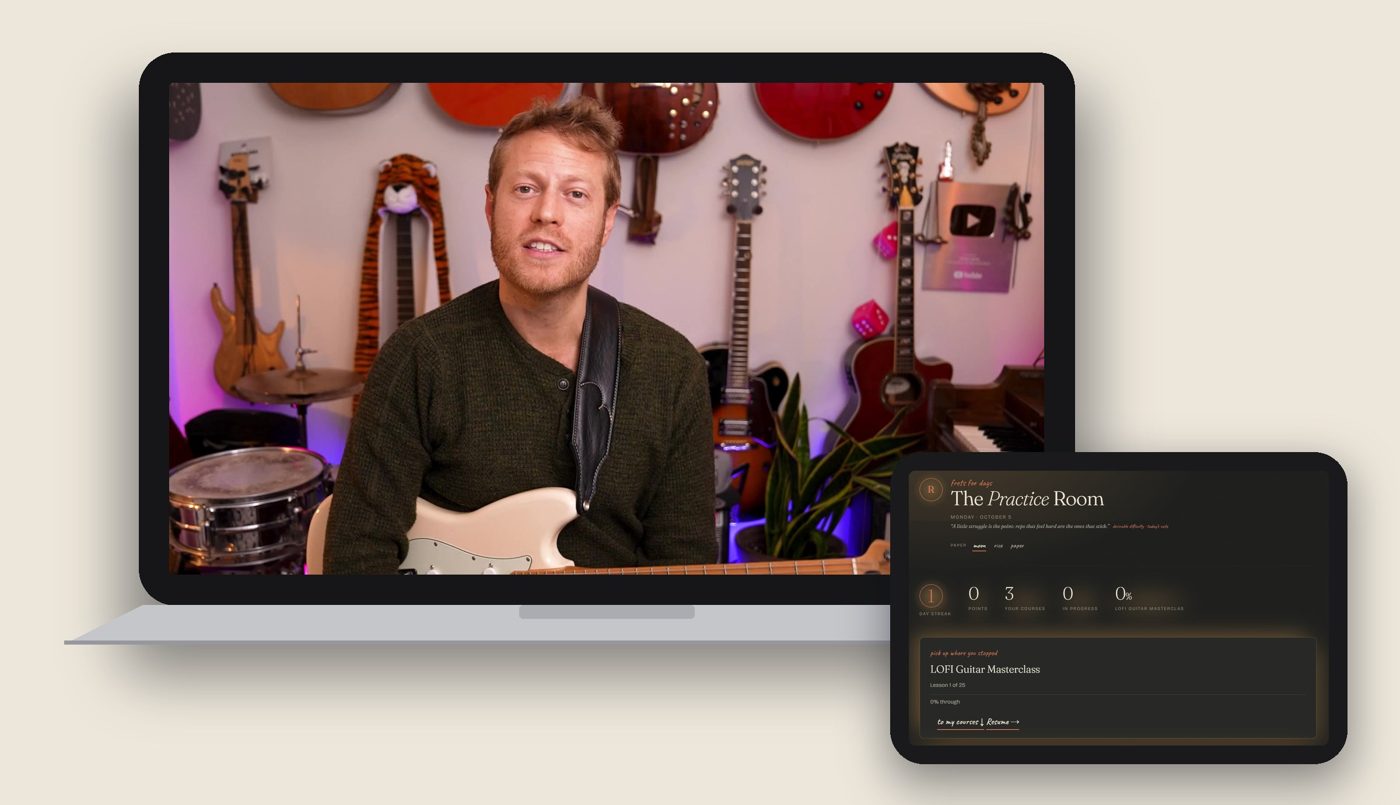
One payment of $97 · Lifetime access
Get Famous Artist Phrasing52 video lessons · 5 players, 5 blues · 30-day guarantee
- B.B. King's octave, over a B minor blues
- Clapton's 1-3-5 phrases, in G
- Three G triad shapes on the top three strings
- Major to minor pentatonic on one string
- SRV's double stops, from the 12th fret
- Mayer's double-stop bend, in A
When I just moved to New York, I had a gig in the back room of a bar in Brooklyn, and in the middle of it I felt like I was just repeating ideas in A minor pentatonic. It was okay. It was just kind of scale. In this course we do something about that, one player at a time: we listen to an artist, figure out one thing he's doing, and grab it. Then we practice it in time until it's part of how we play.
Watch before you buy
Two full lessons from the course.
These are real lessons, exactly as they play in the member area.
A letter from Rotem
I was on a gig in Brooklyn, repeating A minor pentatonic.
When I just moved to New York, I got this gig in the back room of a bar in Brooklyn. It was called Freddy's Back Room. I don't know if it still exists.
We played some of my songs. One was very simple, really sitting in A minor, and I soloed around A minor pentatonic. In the middle of the gig I was in my head, feeling like I was just repeating ideas in A minor pentatonic.
I remember being almost angry at myself. I remember specifically imagining a sound over that A minor chord, the 9.
Now, the pentatonic works. Most of us already know at least one position of it. Knowing the position is great. But here's what I see with a lot of guitar players: they know the positions, and it's tough to get out of them, because they don't see the notes and they don't really hear them. The shape is under the fingers. The sound isn't tagged.
That's what I mean by just kind of scale. And here's what it costs you. You take a solo over a blues, and the same licks come out, because the shape is all you've got to go on.
That's not a talent problem. Think about how most of us study our heroes. We listen to B.B. King or Stevie Ray and say, I want to play all that. Which is great. But these players have a lot of things happening at once, and it's tough to get everything, especially when the music gets more complex. So we grab a lick, it sits in our hands as one fixed thing, and we can't change it into anything new.
So let's be very specific and target device by device.
- Every one of these players has a device he leans on, and you can name it: a sound, a few notes, a way of hitting them.
- Learn the neighborhood it lives in, one pentatonic position where you know every note by name and by ear, and the device has somewhere to land.
That's how every section is built. First I play a blues in that player's key and use his device again and again. With Clapton's 1-3-5, maybe almost excessively. Then we break down what I played. We build the framework: the position, played in time in quarter notes, eighth notes and triplets, with the note names said out loud and sung. Then we put the device on top, slowly, and take it to the track.
B.B. King's octave, in B minor. Clapton's phrases around the G triad. Derek Trucks moving between D major and D minor pentatonic, in position and then on a single string (he plays slide, and I'm not, so we grab the idea, not the instrument). Stevie Ray's double stops on E minor pentatonic from the 12th fret. John Mayer's double-stop bend in A.
Something else starts to happen when you study this way. You put a record on and you can say, ah, this is the 1. Oh, this is the 3. And the licks you already know aren't random anymore. You see what's happening in them:
What it won't do. It won't make you sound like B.B. King or Stevie Ray Vaughan. I'm not trying to sound like them either. There are no note-for-note transcriptions of famous solos here: the examples are me playing, using one device on purpose. There's no slide guitar. And it's focused, not huge: five players, one device each, and the John Mayer section is three lessons. It also takes time. It's a process. It's not everything in one day.
The idea isn't copying the sound and the exact articulation of these players. It's stealing, quote-unquote, one of the devices that make them sound so good, understanding why it sounds the way it sounds, and creating something new with it. In your own playing.
Rotem
Look inside
Two real lessons, up close.
Here's exactly what you'd be working on, taken straight from the course.
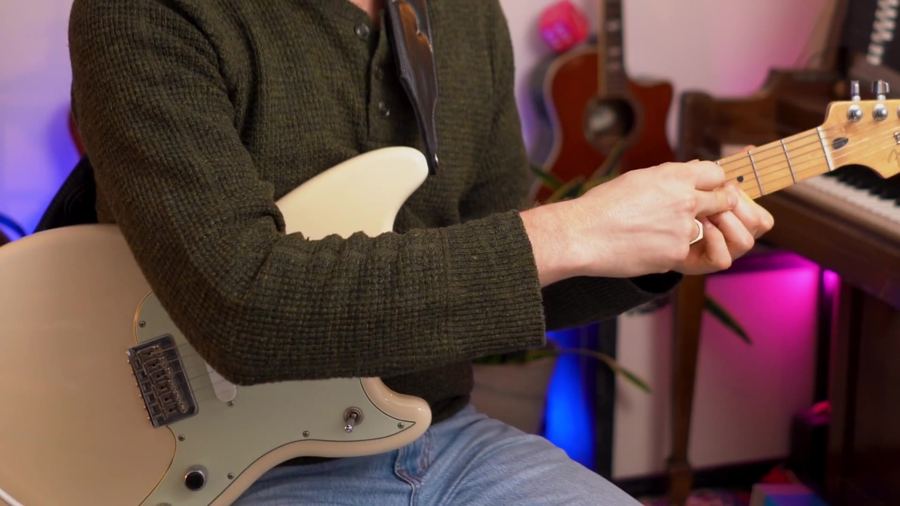
Three G shapes, and the hot notes inside the pentatonic
A very simple trick I like using. Three shapes on the top three strings, all G major, and then it repeats itself up the neck. One has the 3 on the bottom, B, D, G. One starts on the 5, D, G, B. One is 1-3-5, G, B, D. We play them in time.
That helps because the mini phrases are all around these triads, so I start seeing the hot notes. Then, with the pentatonic and its note names in view: what happens if I just slide to the 3, to the 5, and back to the 1?
And there's a line Clapton plays sometimes, 1, 5, flat 3, that sounds very strong and very clear. I show you which bar he often plays it on, and what that flat 3 becomes there.
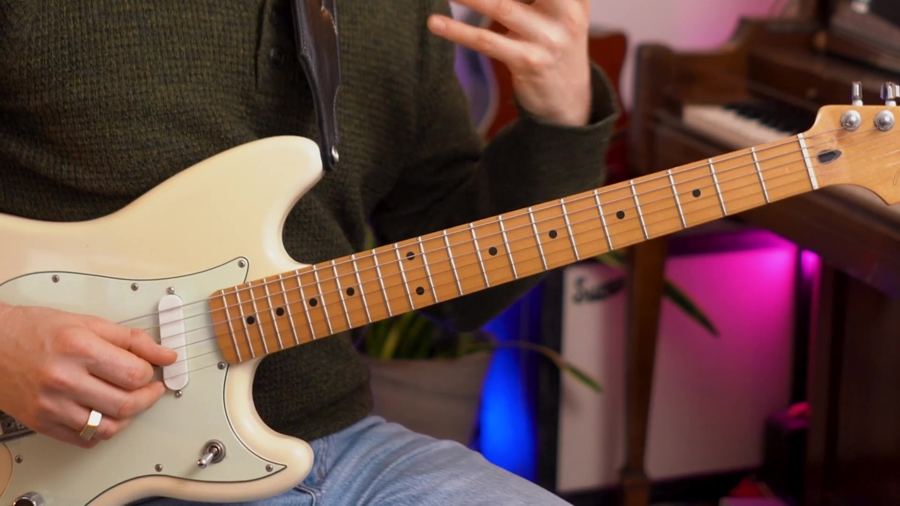
Major and minor pentatonic on the B string alone
We take D major pentatonic off the position and put it on one string, starting from the open B. You can use different fingerings, but sometimes it's nice to slide with one finger and add a little vibrato. It's of course not a slide guitar. It's that vibe, close to the human voice.
Then the move: from the major pentatonic into the minor pentatonic, on the same string. You feel the flat 3 show up all of a sudden. To me that shift is very, very emotional.
We practice it in time, with the metronome, singing it, naming each note, so it stops being "this sounds kind of cool" and becomes something you know you're doing. The next lesson does it on the top E string.
Inside the members area
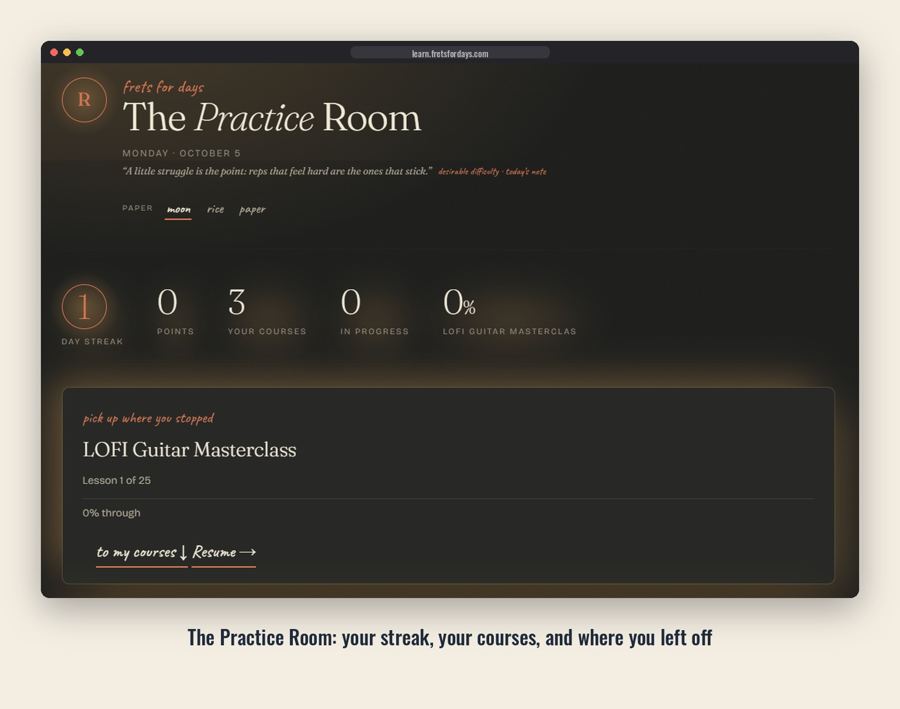
Here's what you see when you log in.
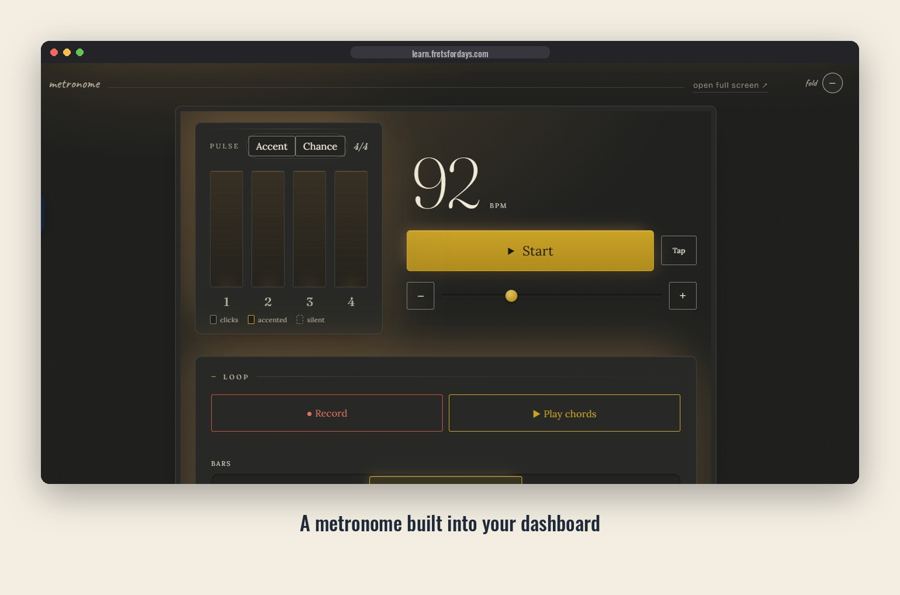
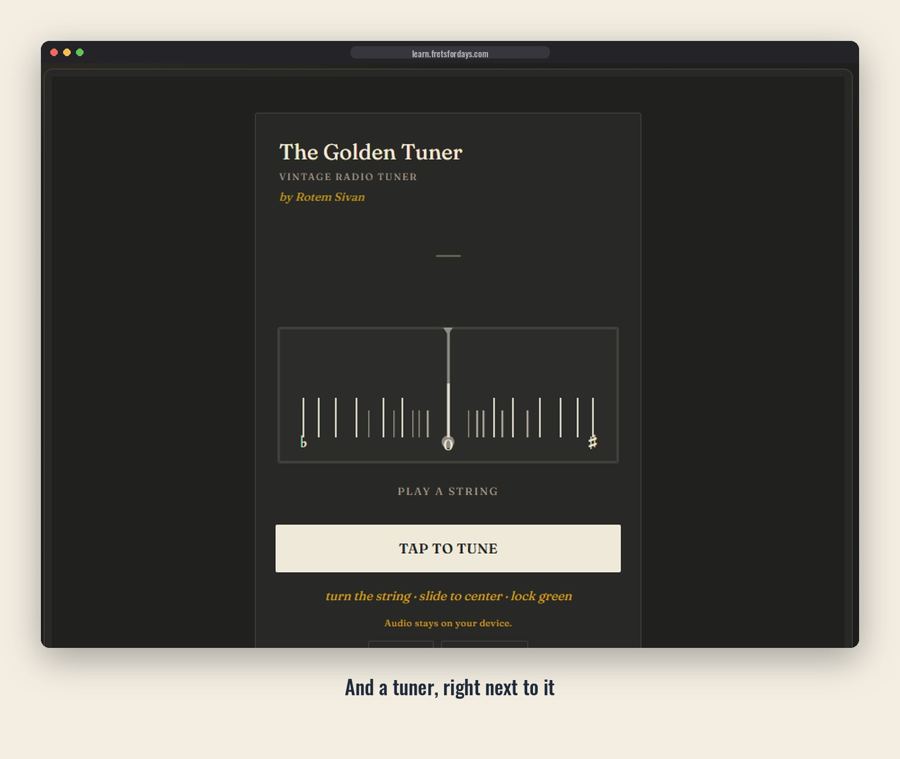
Real screens from the Frets For Days member area: the course, your lessons, and the practice room with its metronome and tuner.
What's inside
52 lessons, player by player.
Every key, position and move below is something I play or explain on camera.
1 B.B. King
- The one idea we take from him: the pentatonic, laid back with vibrato, against a very strong octave. And the thing underneath it, dynamics: "articulate something really softly and whispering and then sometimes shouting."
- A B minor blues where I use the device, softer and very intentional, then the big hit. Sometimes twice.
- The B minor pentatonic framework in time with me: quarter notes, eighth notes, triplets.
- Octaves on the scale with the first and fourth fingers, slowly and peacefully, naming each note against B as you go.
- "There is no such thing as too slow." What rushing does to your playing, and how reversible it is.
- An optional fingering that gets you the whole E string.
- The octave doesn't always have to be the B. But when the center is B, it always sounds really, really good.
- Getting it into your playing: mezzo-forte or even pianissimo, then the octave, with the jam track, knowing which octave is the 1 and which is the 5.
2 Clapton
- His device: very short, rhythmic phrases around the 1-3-5, played over a 12-bar blues in G where I use it almost excessively.
- The first phrase broken down note by note, and the little 6-to-2 move that circles the target note before it resolves.
- The G minor pentatonic in one position, saying the actual note names, not just the shape. And singing it.
- The G major triad sitting on top of the pentatonic on three strings, "this overlay of dots of light."
- The triads trick: three shapes on the top three strings (the full lesson is in "Look inside" above).
- Suspension, tension, resolution: the flat 7 to the 1, again and again, and how the classic blues lines keep gravitating toward it.
- Listen and repeat: I play mini phrases on the 1-3-5, you play them back.
- The order I'd practice it in with the jam track: the pentatonic in each of the five positions, then the triads, and only then phrases.
- Phrases as building blocks you can change, "the same way that when I'm talking to a friend" the ideas can be different every time.
3 Derek Trucks
- He plays slide, tuned differently, so it sounds very different. What we grab is the device: moving between the major and the minor pentatonic.
- A blues in D where I move between the two constantly, and the bend of the 6th near the end, broken down.
- The sound of D major pentatonic: 1, 2, 3, 5, 6. D, E, F sharp, A, B.
- D major pentatonic positions, played with me. "If it's hard, take your time, slow it down, sing it."
- Singing it: the E as the 9, the F sharp as the 3, and why that helps you hear what the masters are doing when you listen to them.
- The B string alone, with one-finger slides and vibrato for that quasi-slide vibe (the full lesson is in "Look inside" above).
- Major to minor on one string, and the flat 3 that shows up all of a sudden.
- The same thing on the top E string.
- How to keep going on your own: pick any string, find the D, and make a mini solo on it. If you miss a note, pause and ask what note it is.
4 John Mayer
- The device: double stops and octaves that create a little tension. You bend a note, push it, and hit a second note against it.
- Slow motion, with two fingers pushing the string instead of one, so your hand gets comfortable with it.
- Lines that start from the 3rd and slide 3, 1, 6, 1, the 4 and the sharp 4, and the shift from eighth notes into triplets, a connection I trace back through Clapton and Stevie Ray.
- The blues scale and A major pentatonic: two colors that complement each other here.
- The A minor pentatonic framework in quarter notes, eighth notes, triplets and 16ths, then the device in more than one spot, like bending the flat 7 up to the 1.
- The questions behind this whole course: what's the device, what environment does it live in, "what is the neighborhood?"
5 Stevie Ray Vaughan
- There's so much to talk about with him. We take one signature move: dyads, double stops.
- E minor pentatonic from the 12th fret, seen and heard and sung, in letters or solfege. "The octave of your voice doesn't matter."
- The problem a lot of guitar players have: they know the positions, but it's tough to get out of them, because the tagging isn't complete.
- Double stops through the whole position, systematically, starting from the lowest string.
- The phrase from the flat 5 to the flat 3, and the note outside the pentatonic I add, then bend: "a very strong and dissonant sound."
- Spelling out the B7 when the chord changes, with the 9 added in, even quickly, something that's very typical for him.
- Call and response: a simple blues line, answered by a double stop.
- One idea with two notes. It doesn't have to be those two notes, and it still sounds really cool.
- One element at a time: the framework in time, the double stops in time, then mixing them. "If it's everything together, it's kind of hard."
The curriculum
Every lesson, in order.
All 52 lessons, player by player. Tap a section to open it.
Section 1B.B. King10 lessons
- 01About B.B. King (watch it above)
- 02Bm blues
- 03Bm framework in time (together)
- 04Getting it in our playing
- 05In time
- 06Octave practice
- 07Octave practice on framework
- 08Optional fingering
- 09The device
- 10Why framework?
Section 2Clapton15 lessons
- 11About Eric Clapton
- 12Blues and 1-3-5
- 13Blues in G
- 14Feel it
- 15Know the notes
- 16Listen
- 17Listen and repeat mini lines
- 18Mini 1-3-5 line (watch it above)
- 19Pentatonic and 1-3-5
- 20Practice together
- 21Summary
- 22The device
- 23Triads trick
- 24Use this jam track
- 25What's in it?
Section 3Derek Trucks13 lessons
- 26About Derek Trucks
- 27Bend of 6th: breakdown
- 28Blues in D
- 29D major position practice (with me)
- 30How to go about it?
- 31Major and minor pentatonic practice
- 32One string exercise
- 33Only on E string
- 34Practice with the track
- 35Sing it
- 36The device we want to grab
- 37The process
- 38The sound of major pentatonic
Section 4John Mayer3 lessons
- 39About John Mayer
- 40Blues in A + breakdown
- 41Framework: A pentatonic
Section 5Stevie Ray Vaughan11 lessons
- 42About Stevie Ray Vaughan
- 431 idea (2 notes)
- 44Blues in E
- 45Call and response
- 46Double stops
- 47Double stops practice
- 48Framework
- 49How do we use it?
- 50In time (together)
- 51Mini line
- 52The device
Five players. One device each. The pentatonic you already know.
One payment · Lifetime access · 30-day guarantee
Who it's for
Built for the player who knows the box and wants something to say in it.
Read both lists. If the second one sounds like you, save your money.
This is for you if...
- You know at least one position of the minor pentatonic, and your solos keep landing on the same licks in it.
- You love B.B. King, Clapton, Derek Trucks, John Mayer or Stevie Ray Vaughan and want to know what one of their moves actually is.
- You'd rather work on one idea at a time than try to play all of it at once.
- You're willing to sing the notes quietly while you practice. Your voice doesn't have to be good.
- You want to practice in time, with me and with a blues track, not just read about it.
This isn't for you if...
- You're still learning your first pentatonic position.
- You want note-for-note transcriptions of famous solos to memorize.
- You want to sound exactly like one of these players. I'm not trying to either.
- You want to learn slide guitar. The Derek Trucks section is played without a slide.
The offer
One payment. $97. Yours for life.
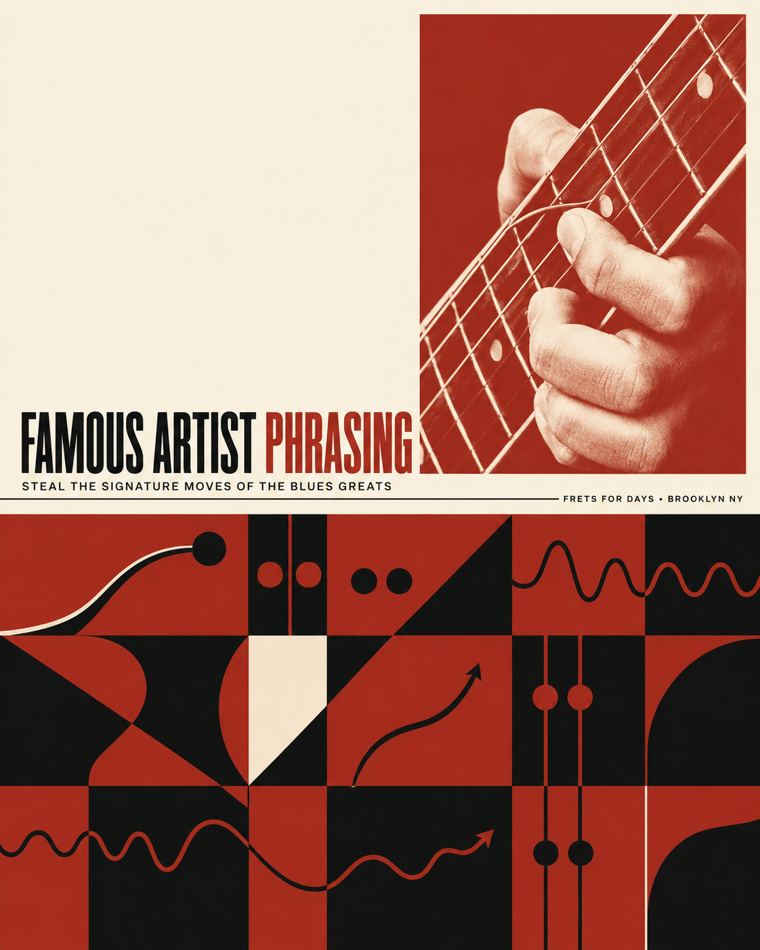
Famous Artist Phrasing is $97, once. You get all 52 lessons, and the PDF worksheets that come with 41 of them, in your Frets For Days member area, and they stay there.
One payment · Lifetime access · 30-day guarantee

About your teacher
I'm Rotem Sivan.
I'm a jazz guitarist and educator in New York. I'm from Israel, and I studied at The New School.
I'm not telling you that to impress you. I've also been the guitarist on a Brooklyn gig, repeating ideas in A minor pentatonic and almost angry at myself. This course is how I like to listen to the players I love: figure out one thing they're doing, grab it, understand why it sounds so good, and make something new with it.
Rotem
FAQ
Questions before you buy.
What's the format?
52 video lessons in five sections, one per player. Each section has me playing a blues with the device, the breakdown, the framework, and lessons where we practice in time together. It's mostly filmed close up on the neck, and there are PDF worksheets with 41 of the lessons. Everything lives in your Frets For Days member area, and you watch at your own pace.
What level is it for?
Intermediate. You should be comfortable with the minor pentatonic in at least one position. We start every section from a position most of us already know and go deeper into it.
Do I need to read music?
No. There's no notation on screen in the videos. I explain everything with note names and numbers (1, flat 3, 4, 5, flat 7), and you can use solfege if that's easier for you.
How much time per week will it take?
Most lessons are under two minutes, and the longest is about seven. The practice is the part that takes time, and there's no schedule to keep up with. There's no such thing as too slow.
How long do I have access?
For life. One payment, and the course stays in your member area.
What if it isn't for me?
There's a 30-day guarantee. Work through it, and if it isn't right for you, email [email protected] within 30 days for a refund.
Stop playing just scale. Grab one move at a time.
You don't have to play all of it. Pick one device, learn the position it lives in, and practice it in time until you can reach for it in your own solos.
$97 one time · 52 lessons · 5 players · lifetime access
Get Famous Artist Phrasing: $97P.S. Here's a test you can run tonight. Take the minor pentatonic position you know best. Play a short phrase in it quietly, almost whispering, with a little vibrato. Then play the root as an octave, first and fourth fingers, and hit it strong. Back to quiet. Do it three or four times. Same scale you've always had. Listen to how much more interest there is when the soft part and the strong part sit next to each other. That's one device from one player. The course has five.
Hugs,
Rotem
Famous Artist Phrasing isn't affiliated with or endorsed by B.B. King, Eric Clapton, Derek Trucks, John Mayer, Stevie Ray Vaughan or their estates. Their names describe the styles we study. All playing in the course is Rotem's.