For guitarists who can play other people's solos note for note but can't improvise their own
Improvise freely over real chord changes and play what you're imagining, with one framework you'll see at work in real solos I play and explain.
One small phrase, reshaped 12 ways. Eight full solos, played and then explained. And the listening, harmony and rhythm work underneath them, so the line in your head can find its way onto the neck.
One payment of $77 · Lifetime access
Get Solo Mastery62 video lessons · PDF worksheets with 45 lessons · 30-day guarantee
- 12 ways to reshape one phrase
- 8 solos played and explained
- Shell chords from the 6th and 5th strings
- Sing a line, then find it on the neck
- C major and A minor pentatonic in 5 positions
- Quarter notes to sixteenths against a click
Like a lot of guitar players, when I started I didn't really understand how to connect the dots between the scales, the arpeggios, the exercises, and the music. Over the years I learned that you don't need a ton of tedious exercises to get there. In this course we use a lot of things you actually know, and we make music with them.
Watch before you buy
Two full lessons from the course.
These are real lessons, exactly as they play in the member area. The notation and tab for both are in the PDF worksheets that come with them.
A letter from Rotem
I used to record whole jam sessions on my phone.
When I started going to jam sessions in New York, in school and after I graduated, it was really stressful for me. I'd go, and I'd always feel like I played the worst. Maybe I did.
Then I realized I could record. I'd take my phone and voice memo the whole night, so I had seven-hour voice memos where I played one song at like 4 a.m. Then I'd go back home and listen to it on the subway.
And I'd be happy. I needed to practice some things, sure. But it was better than what I thought.
That's why I tell you not to judge while you play. If I'm judging a note while I'm playing it, I'm spending a bunch of my CPU on that instead of listening to how beautiful the note is. The recording gave me a reality: what was actually there, and what I needed to practice.
Your playback might tell you something different. You know your scales. You've practiced them for years, up and down, in position. And when it's your turn to solo, what comes out is the scale.
Look, I'm a big fan of practicing scales and understanding the framework of the guitar as much as we can. It's part of the practice. But if I take C major and just ascend and descend it all the time, that's kind of like driving your car in circles in the parking lot. The point of knowing how to drive is to go somewhere. If you never leave the parking lot, you're not playing music.
And nobody tells you how to leave it. Most of what you find hands you another scale to learn. What people don't tell you about soloing is that it actually is a lot about editing. When I started playing guitar, I always thought, oh, I need to know this scale and this arpeggio and this lick. But if you just know C major scale well, you can create a full universe.
- A solo is mostly editing: a small phrase you understand, changed on purpose, again and again. Like a language, you don't need a lot of words. You need the words you know to be flexible.
- Every note you play has a color against the center. When you can hear and name those colors, you're choosing sounds, not fingerings.
That's how the course is built. We start with one simple phrase in C major, and I show you 12 points that really helped me, and still help me today, to solo well. Change the last note. Change the rhythm. Leave notes out. Play it on one string. Find the three notes the line is really about. The lines come written out in notation and tab.
Then you watch me use them. Eight full solos, over three blues, a funk groove and four more tunes, and with each one I tell you what I was doing and where my ear was pointing.
Underneath the solos is the work that holds them together. We sing, because there's really no great musician who can't hear things clearly and express them, and I'm not asking you to be an opera singer. We learn shell chords and the harmony of the key, so you know what's under you. We practice the scales you know in five positions, but by sound, so if I stop you on a note you can tell me it's the 5. And we work on time with a click, because any artist we love, whether it's Jimi Hendrix or B.B. King or Miles Davis, oftentimes has impeccable time.
What it won't do. It won't hand you licks to memorize and call that improvising. The solos are written out so you can study them, but the course is about making your own lines. It won't happen in a week either. It takes time, and I'll ask you more than once to slow down and give yourself that time. And it's you, your guitar and the jam tracks. It doesn't teach you how to play in a band or sit in at a jam.
Whether you play rock, blues, jazz or funk, these ideas of editing and of understanding the framework of soloing really work. Music at times is really frustrating, and also amazing. Let's make some music.
Rotem
Look inside
One real lesson. One real worksheet.
Here's exactly what you'd be working on, taken straight from the course.
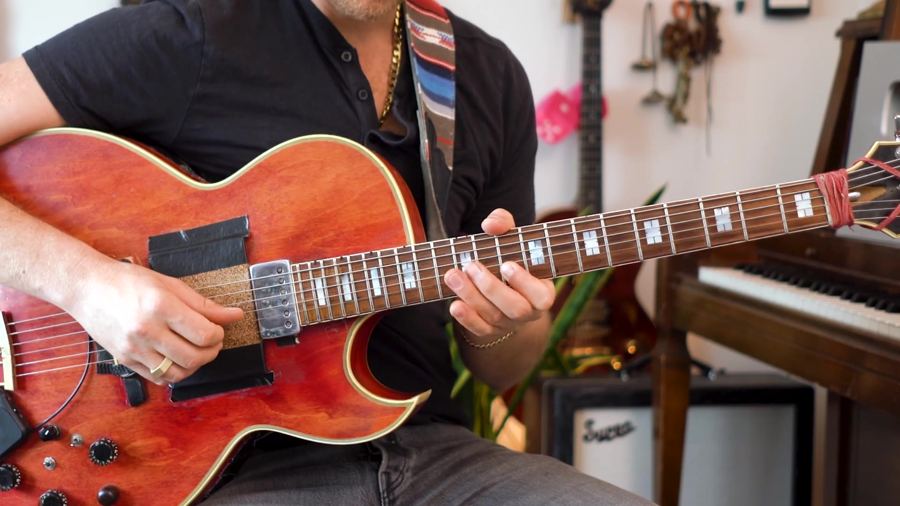
One string, no pick
When we practice, we don't want to practice what's always easy and sounds good. We want things that are tough for us. So in this lesson I limit myself: I solo on one string only. And because I'm used to a pick, I put it down and play fingerstyle.
It's not easy. But that's the point. It makes me play differently and focus on the music and the creativity, and I find things I maybe wouldn't have found otherwise.
It's one of the 12 moves in Section 2, and you'll hear it come back inside the solos later, in Green Point, where I play one string at a time and then a couple of strings.
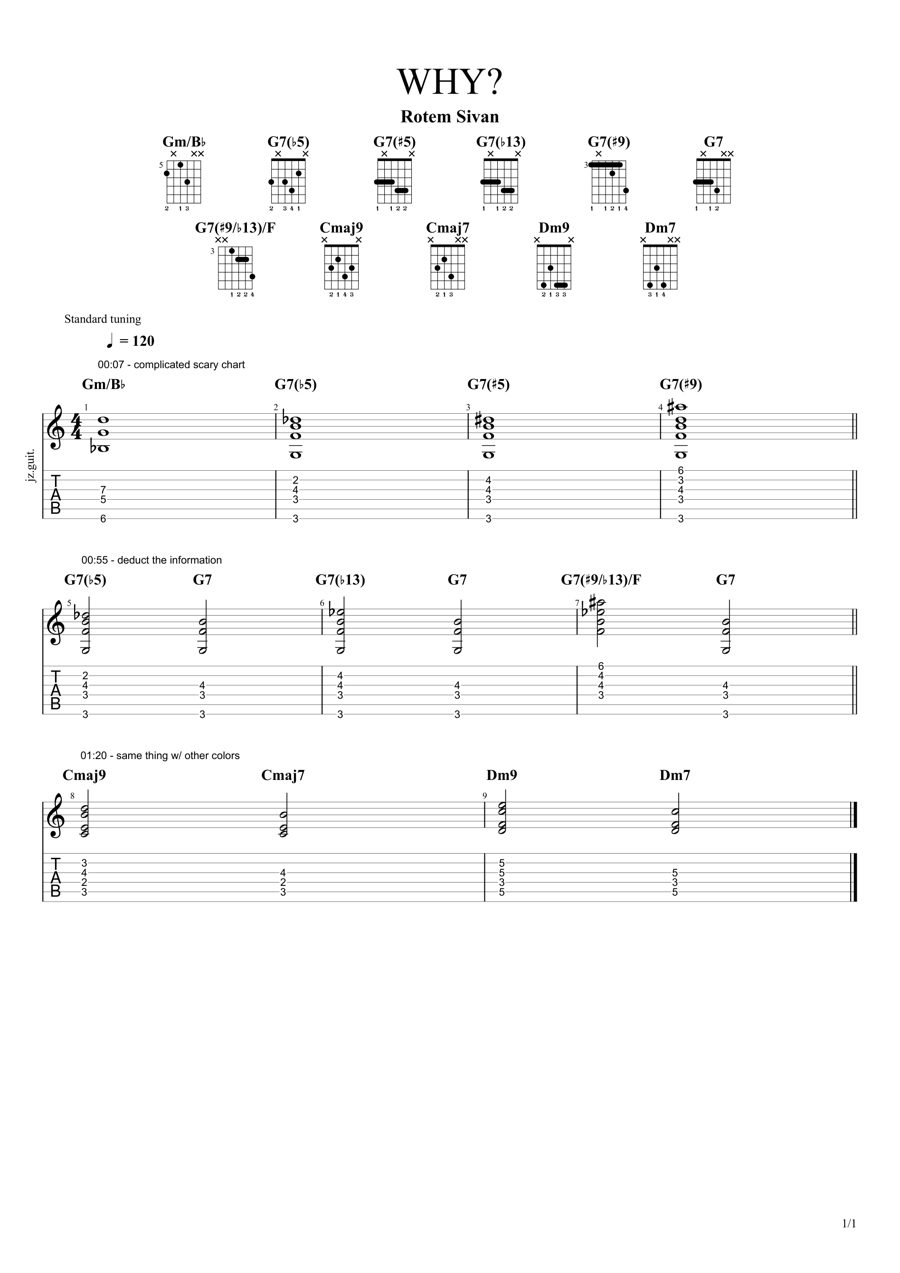
The scary chart, deducted
When I moved to New York, I was handed a chart that looked very complicated: slash chords, flat fives, sharp fives, sharp nines. At that moment I wasn't comfortable with it. So I did a trick, and this worksheet is that trick on one page.
The top line is the scary chart: Gm/Bb, G7(b5), G7(#5), G7(#9), with grids, notation and tab. The next line, marked "deduct the information," puts G7(b5), G7(b13) and G7(#9/b13)/F each next to the plain G7 underneath it. Then the same thing with other colors: Cmaj9 and Cmaj7, Dm9 and Dm7.
Inside the members area
Here's what you see when you log in.
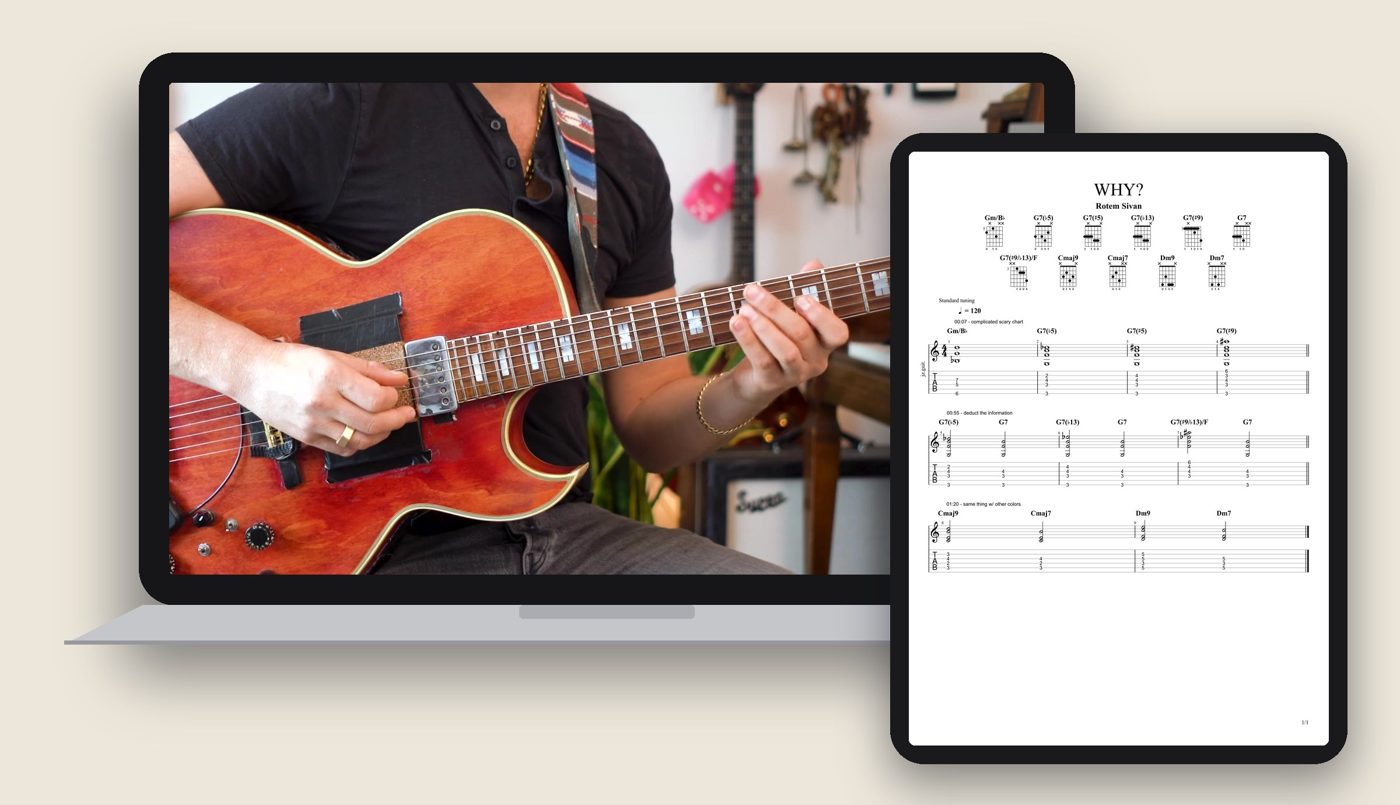
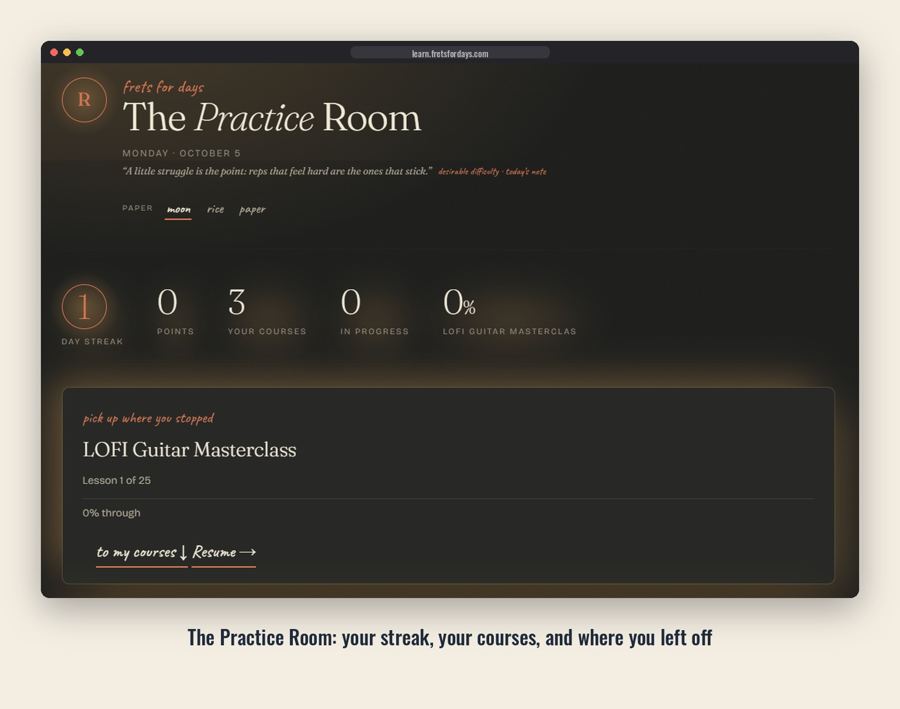
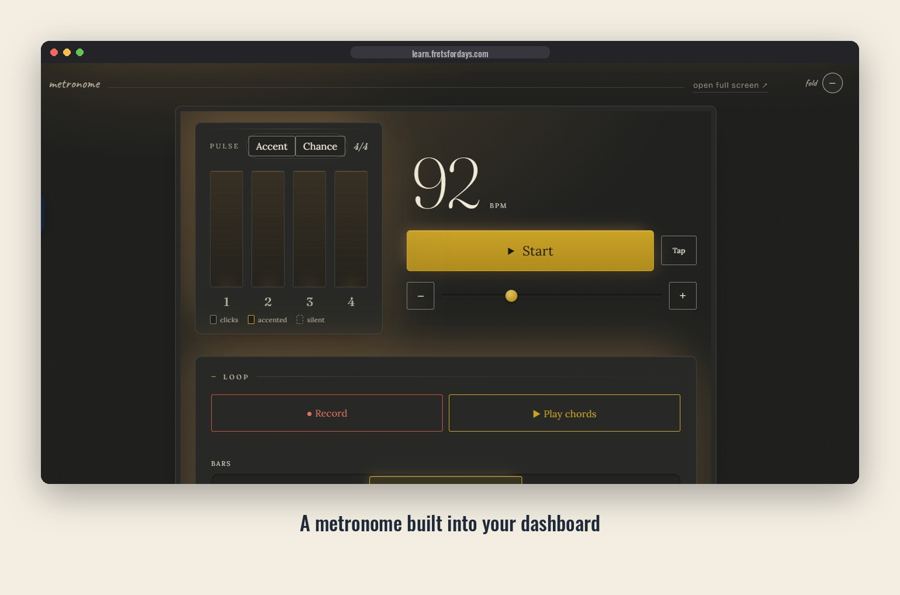
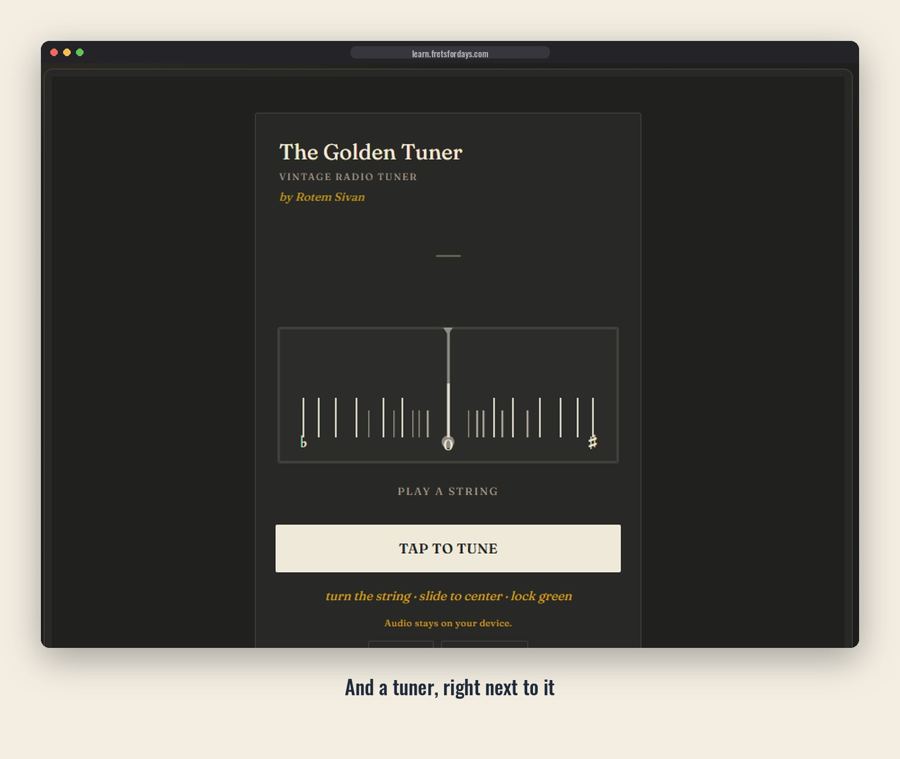
Real screens from the Frets For Days member area. Every lesson has the speed and loop controls under the video, and the practice room, metronome and tuner are there when you sit down to play.
What's inside
62 lessons, section by section.
Every phrase, chord and exercise below is something I play or explain on camera.
Welcome + 1 How to get very good at guitar
- The map of the course: over 40 concepts and ideas to solo with, and the performances where you see them become music.
- The calendar decision I ask you to make before the day starts. 7 a.m. or 9 p.m., 15 minutes or an hour, it doesn't matter which.
- Don't judge: what happens to your listening when you play a note and grade it at the same time.
- What I believe about talent, and what John Coltrane said about how much he practiced.
- Finding someone with a stronger mental image of what you're trying to do than you have.
- Sleep, food and water, and what they have to do with getting new information into long-term memory.
- The course I'd pair with this one if you want to be "very free" on the neck.
2 Truth about soloing
- "What people don't tell you about soloing," and how much one C major scale holds when you know it well.
- Add a dyad: sixths and thirds from the C major scale, at the start or the end of the phrase.
- Change the last note. Change the starting note (I start on E instead of A). Change the rhythm. Small moves, and the phrase says something new each time.
- Omit notes: taking a little eraser to the line, and the note you leave out that you can still hear.
- Perfect repetition: the same idea, in the same place in time, a little better every time. Think of how you'd practice a line you had to play on CNN.
- Reduce the core line: the three target notes underneath a whole phrase (the full lesson is in "Watch" above).
- Contrast line A with line B. Repetition creates context; then I break it with register, dynamics, tone, one note against many.
- Limit yourself to one string, close your eyes, and repeat the last notes of a line to start the next one.
3 Solo with what we know
- BK Vibes: D minor pentatonic, starting on one string, and a melody that keeps coming back as my theme.
- The same idea around a triad in two octaves, played as a question and answer between the two lines.
- The 9 (E) I hang on, and the slide-guitar kind of nuance I hear in the pentatonic.
- Green Point: a 2-5-1 in C with shell chords, Cmaj7 to C6, then Bm7 and E7 to Am7, the false cadence (the full lesson is in "Watch" above).
- Both solos written out, plus the BK Vibes chords.
4 Music is the art of listening
- Singing: the step a lot of people skip, and a big hurdle in their development as musicians.
- Matching a note with your voice "like an arrow to the target," without sliding into it. You don't need to be an opera singer.
- Singing the scale against C, then playing it slowly and telling yourself: this is E, this is the 3, this is how it feels.
- Play a line, sing it back. Then the other way: sing a line, find it on the guitar.
- An F center with the major scale and the chromatic notes, the flat 9, and the game between the minor 3rd and the major 3rd.
5 Minor blues
- C minor pentatonic as the center, then the colors around it: the b7 against the major 7, the 5 to the flat 5, the 6.
- The note I play over Fm, the one over Ab7 and the one over G7, and what each of them is doing there.
- "There's nothing wrong with a good old C minor pentatonic." What's interesting is what you add to it.
6 Dat G blues
- A blues in G with a lot of pentatonic and blues scale, and the run where I articulate G major around the triad.
- Playing with major and minor against the G, and the major 7, a harsh note against the 7, that I touch and leave quickly.
- The Am7 to D7 I play more chromatically, then back to the blues.
- The 12-bar form in three phrases, and where it shows up beyond the blues: jazz, rock and pop, Elvis Presley.
- The chords jazz players add to it: a 2-5 into the IV, the sharp IV diminished, the E7 secondary dominant and a 1-6-2-5 turnaround.
- An optional bass motion with inversions and passing chords. "If this is sounding too complicated, don't worry about it."
7 Shell chords
- The two most important notes in any chord, and the one you can leave out.
- Four colors from the 6th string and the 5th string: G major 7, G7, G minor 7, G diminished. Then C.
- The diminished shape that doubles as a minor 6, and the shortcut I use for half-diminished when I want fewer notes.
- Reading down a chart in time with shell chords only, and how staying in one area of the neck gives you voice leading automatically.
- The chart I was handed when I moved to New York, and the trick that turns G7(b13) back into G7 (worksheet in "Look inside" above).
8 Deeper look at harmony
- Tonic, subdominant and dominant, and which chords of the key fall into each.
- 1-6-2-5 in numbers before letters, so it travels when you change keys.
- The shell chords of C major and G major, degree by degree.
- The secondary dominant into each chord of C major, from the 2 to the 6, each one turned into a mini song in time.
- The moment in the car, or on Spotify, when you hear an A7 lead to the 2 and know what it is.
- Two progressions dressed up with color chords, passing chords and inversions until they stop sounding like an exercise.
9 C blues
- Articulating C7 around the triad and the 7, and the dyads on the Bb7.
- How I articulate the 2-5 on the Dm: Fmaj7, then Abm7 for the altered sound.
- The Db7 triad in place of the G7, a tritone substitution, and the 2-5s at the anchor points of the song with more chromaticism.
10 34th Lights
- A solo that shifts between C major and Ab major, with melodic, simple ideas, often from C major pentatonic.
- The point of transition: the E natural of C major becomes E flat in Ab major, and back again, and the little moments around it.
11 Wanna play better?
- What "playing better" means to me: being more free, and able to create what I'm imagining.
- Gm, Cm, Ebmaj7 and a D7 moment, played first from a bird's eye view with the common tones. Useful, but on its own it isn't freedom.
- A quick harmonic analysis in G minor, then the same progression in C minor, heard as numbers.
- The note that makes the D7 sound like a D7, and what happens when I hold it back.
- Shifting the center from A major to G major while staying in the same area of the neck.
- 1-3-5 and 1-3-5-7 solos, then chromatic notes into those chord tones, then zooming in on every change.
12 Solo Trips
- Eb minor pentatonic, then a second pentatonic over it for the extensions.
- Showing Ebmaj7 to Eb minor in the line, and one fast hammer-on line that lands on the 4.
13 Scales
- The parking lot, and how to drive out of it with the C major scale you already know.
- C major in five positions by sound: if I stop you on a note, you know it's the G, the 5.
- A minor pentatonic in five positions, naming every note against the center.
- A solo in each of the five positions over Am, E7, Fmaj7 and C, one area at a time.
- Composing a line inside A minor pentatonic until you find one you like.
- Tag it: what a line is actually made of, 5 to 6, flat 3 to 3, slowed down until you hear it.
14 Rhythmic subdivisions and phrasing
- What Jimi Hendrix, B.B. King, Brad Mehldau and Miles Davis have in common.
- Quarter notes, eighths, triplets and sixteenths, played and sung against a click.
- The syllables I use when the rhythm gets fast. You don't have to; counting works too.
- The click at 60 and lower, where you find out how accurate you really are.
- The C major scale through every subdivision, and the switch between them "with no pauses, no hiccups."
- How I practiced this myself: one subdivision, one position, for a long time.
15 + 16 Funky BRB, and thank you
- A funk solo where the subdivisions are the main idea: quarter notes, eighths, triplets, sixteenths, even sextuplets.
- The one thing I really want you to take from the course.
The curriculum
Every lesson, in order.
All 62 lessons, section by section. Tap a section to open it.
WelcomeIntroduction1 lesson
- 01Welcome
Section 1How to get very good at guitar9 lessons
- 02Be Optimistic
- 03Calendar
- 04Don't Judge
- 05Mental Image
- 06Super Important Points to Get Good at Music
- 07Take Care of Yourself
- 08Talent
- 09The Journey
- 10Unlocking the Fretboard
Section 2Truth about soloing12 lessons
- 11Add a Dyad
- 12Change the Last Note
- 13Change the Rhythm
- 14Change the Starting Note
- 15Close Your Eyes
- 16Contrast Line A with Line B
- 17Edit Yourself
- 18Limit Notes to One String
- 19Omit Notes from the Line
- 20Perfect Repetition
- 21Reduce the Core Line (watch it above)
- 22Repeat the Last Notes to Start a New Line
Section 3Solo with what we know2 lessons
- 23BK Vibes Solo
- 24Green Point Solo (watch it above)
Section 4Music is the art of listening6 lessons
- 25F Center and Colors
- 26Play a Note, Sing the Note
- 27Sing a Line and Play It
- 28Sing a Line, Play a Line
- 29Tension and Color
- 30The Center
Section 5Minor blues1 lesson
- 31Structure, Solo and Breakdown
Section 6Dat G blues2 lessons
- 32G Blues: Chords and Solo
- 33The Blues Form
Section 7Shell chords3 lessons
- 34Read a Chart, Play in Time
- 35Shell Chords
- 36Why?
Section 8Deeper look at harmony4 lessons
- 377th Chords + Shell
- 38Diatonic Triads
- 39Secondary Dominant Application
- 40Spicing up Shell Chords
Section 9C blues1 lesson
- 41Chords, Solo and Breakdown
Section 1034th Lights1 lesson
- 42Solo, Chords and Breakdown
Section 11Wanna play better?7 lessons
- 43Introduction
- 44Harmonic Analysis
- 45Know and Hear the Harmony
- 46Scales and Framework
- 47Use Chord Tones
- 48Zoom In
- 49Zoom Out: Common Notes
Section 12Solo Trips1 lesson
- 50Chords, Solo and Breakdown
Section 13Scales7 lessons
- 51Be Creative
- 52Composing
- 53Listen and Am in 5 Positions
- 54Listen Deeply
- 55Play a Solo in 5 Positions
- 56Tag It
- 57Truth and C in 5 Positions
Section 14Rhythmic subdivisions and phrasing3 lessons
- 58Introduction
- 59Play Subdivisions
- 60Sing Subdivisions
Section 15Funky BRB1 lesson
- 61Solo
Section 16Thank you1 lesson
- 62Thanks
One phrase, 12 ways. Eight solos. The ear, harmony and time under them.
One payment · Lifetime access · 30-day guarantee
Who it's for
Built for the player who knows the scales and wants to say something with them.
Read both lists. If the second one sounds like you, save your money.
This is for you if...
- You know your scales, and when it's your turn to solo, what comes out is the scale.
- You keep landing in the same pentatonic box and repeating the same ideas.
- You can hear a sound in your head and can't find it on the neck.
- You're willing to sing quietly while you practice, and to play with a click.
- You want one path through soloing, listening, harmony and rhythm instead of another scattered tip.
This isn't for you if...
- You're still learning to fret cleanly and change chords in time.
- You want licks to memorize. The solos are written out, but the course is about making your own lines.
- You want to learn to play in a band or sit in at a jam. This is you, your guitar and the jam tracks.
- You want it all in a weekend. I ask you more than once to take your time.
The offer
One payment. $77. Yours for life.
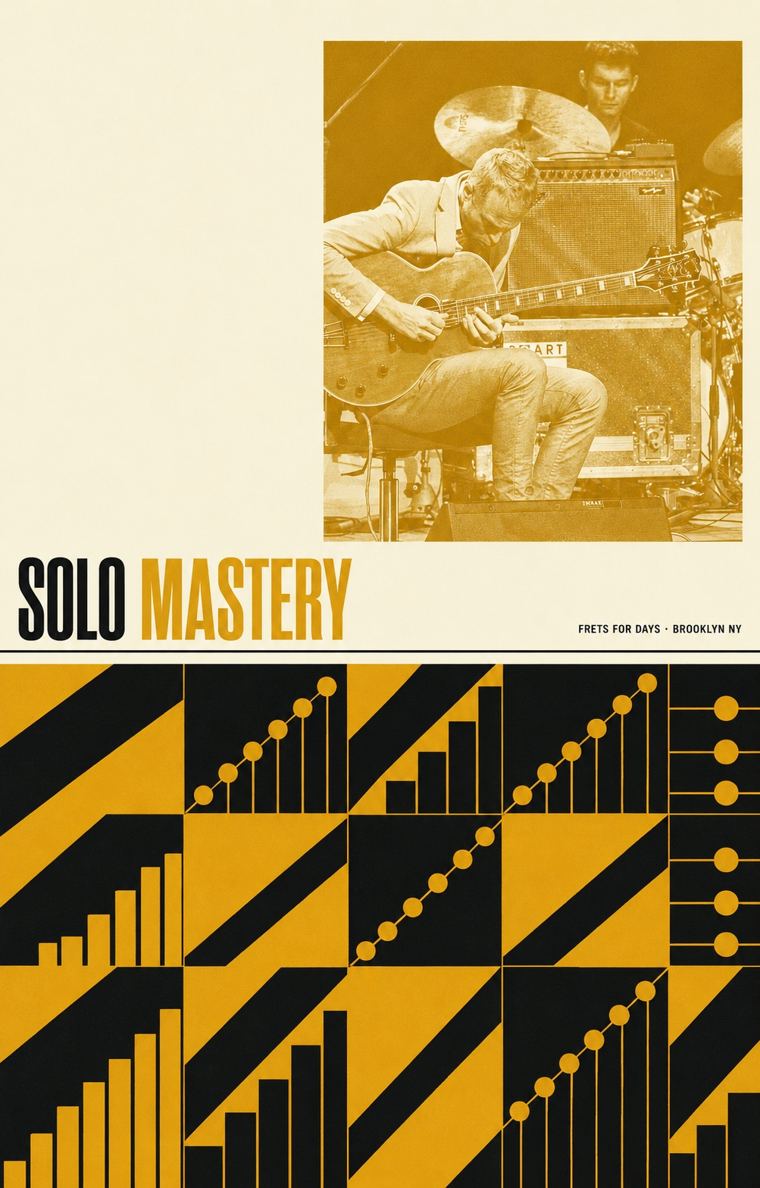
Solo Mastery is $77, once. You get all 62 lessons, every PDF worksheet and every jam track in your Frets For Days member area, and they stay there.
One payment · Lifetime access · 30-day guarantee
About your teacher
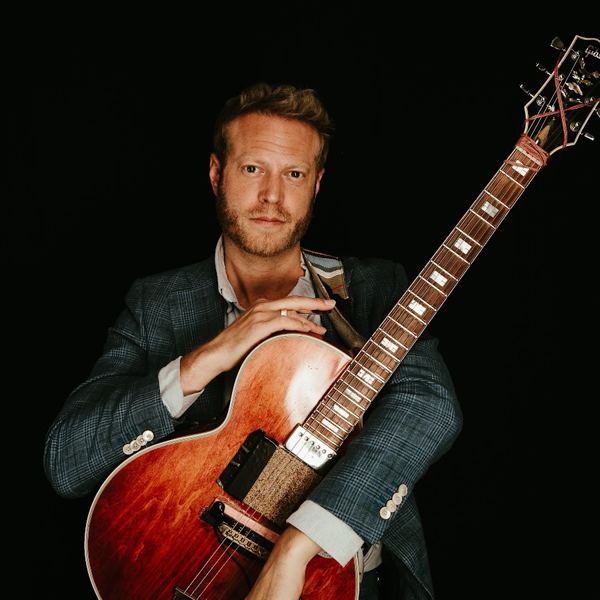
I'm Rotem Sivan.
I'm a jazz guitarist and educator in New York. I'm from Israel, and I studied at The New School.
I'm not telling you that to impress you. People look at musicians and think they just got it. No, it's a lot of work. I practice every day, and At those New York jam sessions, I always felt like I played the worst. This course is the 12 points, the listening and the framework that helped me, and still help me, to solo well.
Rotem
FAQ
Questions before you buy.
What's the format?
62 video lessons: a welcome and 16 sections. 45 of the lessons, across Sections 2 to 15, come with PDF worksheets, and there are 10 jam tracks to solo over. Everything lives in your Frets For Days member area, and you watch at your own pace.
What level is it for?
Intermediate. You should be able to fret cleanly, play in time and know a scale or two, like C major or A minor pentatonic. We use a lot of things you actually know. If you play rock, blues, jazz or funk, the ideas carry over.
Do I need to read music?
No. I explain everything with note names and numbers (the 3, the flat 7, the 9), and every PDF worksheet has tab under the notation.
How much time per week will it take?
Most lessons are under two minutes. In Section 1 I ask you to put a time in the calendar, 15 minutes, half an hour or an hour a day, whatever works for you. There's no schedule to keep up with.
How long do I have access?
For life. One payment, and the course stays in your member area.
What if it isn't for me?
There's a 30-day guarantee. Work through it, and if it isn't right for you, email [email protected] within 30 days for a refund.
Get out of the parking lot. Make a solo that says something.
You already know the notes. What nobody showed you is how to edit them, hear them against the center and put them in time. It's here, one phrase at a time.
$77 one time · 62 lessons · PDF worksheets with 45 of them · lifetime access
Get Solo Mastery: $77P.S. Here's a test you can run tonight. Take one short phrase you already play in C major or A minor pentatonic. Play it a few times in a row, in time, exactly the same, and try to make it a little better each time. Now play it once more and change only the last note. Listen to how different the phrase sounds with one note changed. That's editing. Section 2 gives you 12 of those moves, and the rest of the course shows you what to do with them.
Hugs,
Rotem