For guitarists who know the shapes but not what's inside them
Get that lush jazz chord sound anywhere on the neck, from four chords you'll know inside out.
Fmaj7, F7, Fm7 and the half-diminished, in every inversion on three string sets. Then I show you how to move between them so it sounds like music, not exercises.
One payment of $57 · Lifetime access
Get Jazz Chord Essentials52 video lessons · 11 PDF worksheets · 30-day guarantee
- Fmaj7, F7, Fm7, Fm7b5 in all four inversions
- 6th, 5th and 4th string sets
- Drop 2, explained in one lesson
- A ii-V-I in four places on the neck
- Diminished passing chords
- Upper structures over Cmaj7, C7 and Cm7
When I started playing guitar, I couldn't understand how people saw one C major chord and played it in all these different shapes all across the neck. This course gives you what I was missing, the building blocks: one chord you know completely, every inversion of it, and three more colors built from that same starting point. Then we make music with them.
Watch before you buy
Two full lessons from the course.
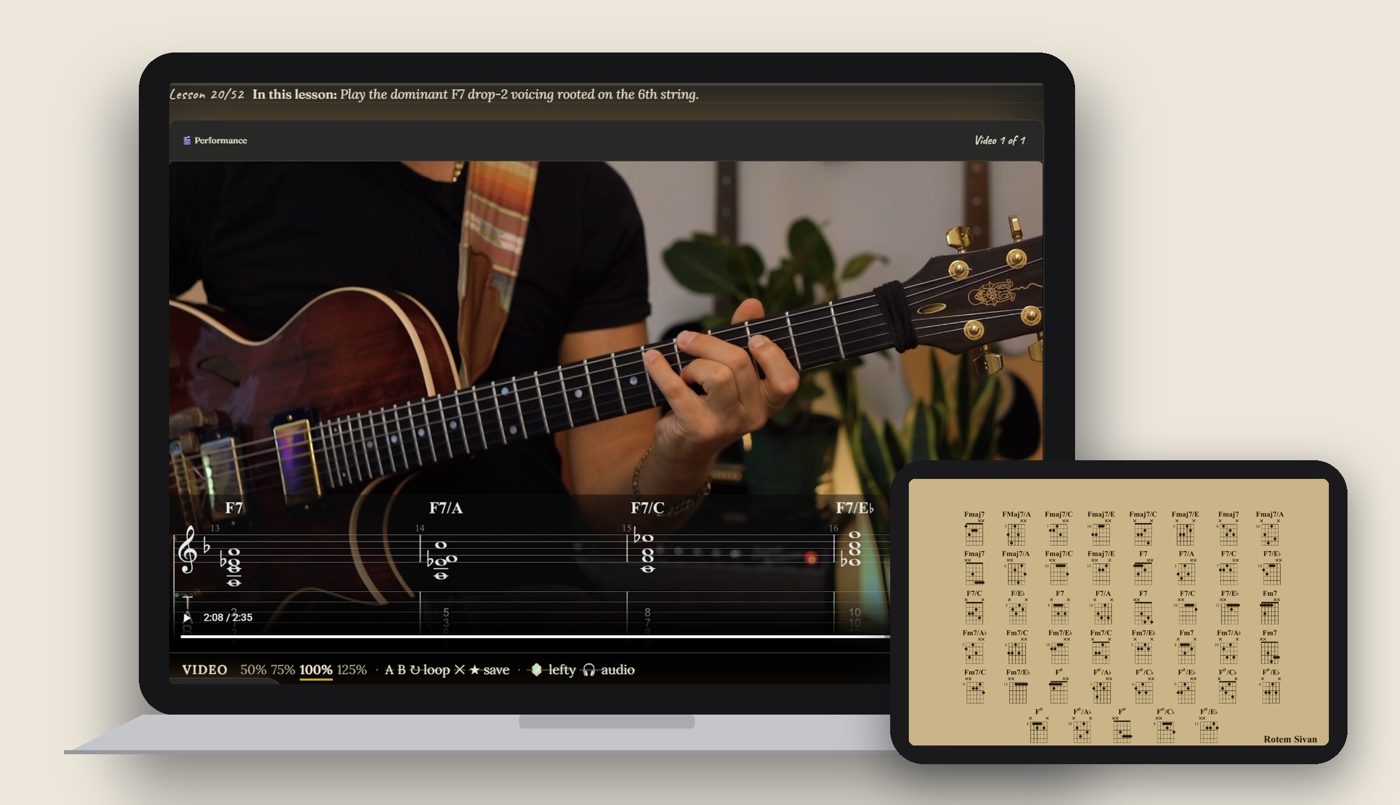
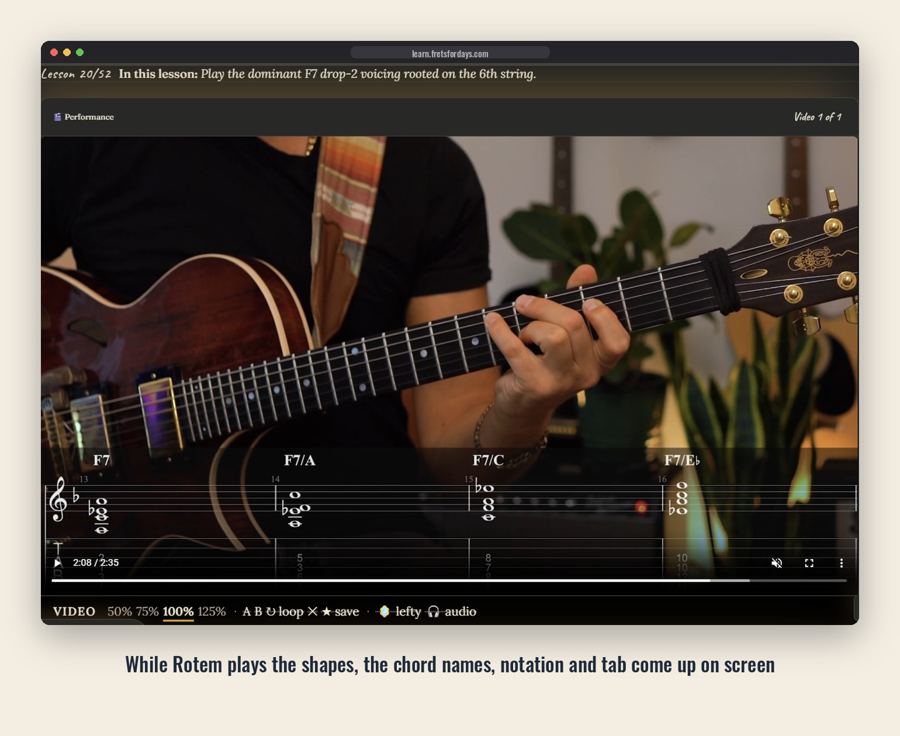
These are real lessons, exactly as they play in the member area, with the chord names, notation and tab on screen.
A letter from Rotem
I was too embarrassed to ask what an inversion was.
I'm going to come clean. When I started playing guitar, I was pretty bad. No, seriously. I played chords, but I was scared of knowing what I was doing, and I was scared of one word in particular.
Inversions.
There was a second thing I couldn't figure out. I'd see a guitarist take the chord C major and play it in all these different shapes, all across the neck. How is that possible?
The problem I had was not understanding the mechanism of the chord. I could play the chords. I didn't know what was going on inside them.
Now, grips work. Knowing the shapes is a huge part of this, and we need to do that. But notice what happens when that's all you have. A lot of times we just copy-paste the information. We play the shape, but we don't really listen, we don't really know what we're doing, and we don't really tag the colors deeply enough.
That's what I mean by copy-paste shapes, and here's what it costs you. A chart says C/E. You play something that works. You couldn't tell me it's C major in first inversion, and you couldn't change one note of it on purpose, because you don't know which note is which.
That's not a talent problem. A chord chart hands you a grip. A video hands you a cool shape. Neither one tells you what's in the bass, what's on top, or what the 7 is doing in there. And if you're anything like I was, you didn't ask. Looking back, if I'd understood that it's okay to not know and ask, I would have learned these things way faster.
So here's what I was missing: the building blocks. Once you understand them, it's way easier to invent shapes, find shapes and really hear the ideas.
- Every 7th chord is four notes, 1-3-5-7, and you get to choose which one sits in the bass and which one sits on top.
- Learn that completely on one chord, Fmaj7, and the other three colors are each one small change away, in the same places on the neck.
That's how the course is built. We learn Fmaj7 in root position and first, second and third inversion, from the 6th string, the 5th string and the 4th string. We play it in time. We sing it. We say out loud what's in the bass and what's on top, which, I know, is kind of funny to do. It's important.
Then we change one note and it's F7. One more and it's Fm7. One more and it's Fm7b5, the half-diminished. Same string sets, same four inversions, and you already know where your hand goes.
Something else starts to happen while you do this. The major 7 starts to feel more at peace. The dominant has a little more tension. The half-diminished sounds darker. You start recognizing those sounds in the wild, so when you hear a song, you pick up the chords way, way quicker.
And then we make music with it, because I'm a big, big fan of taking exercises into music as soon as we can. You'll take four chords, give yourself one small rule, and hear it cross over from exercise to music. You'll play a ii-V-I that stays in one area of the neck. You'll slip a diminished chord between two inversions the way a lot of keyboard and organ players do. By the end, I'll show you how to play one chord over another and get the 9, using only inversions you already know.
What it won't do. It won't happen this week. These shapes take time to memorize, like everything in music. I'd rather you understand and hear them in a few weeks or a few months than skim them tomorrow, and in the world of music, a few weeks or a few months are nothing. It also won't teach you to comp for a singer, play with a band or learn jazz standards. This is you, your guitar and the chords, practiced on your own until they're yours.
I always wanted to be able to play different shapes and express ideas on the spot. To be able to think about a sound. Right now maybe you don't feel that's possible. It's very possible. You take it step by step.
Rotem
Look inside
One real lesson. One real worksheet.
Here's exactly what you'd be working on, taken straight from the course.
Four chords and one rule
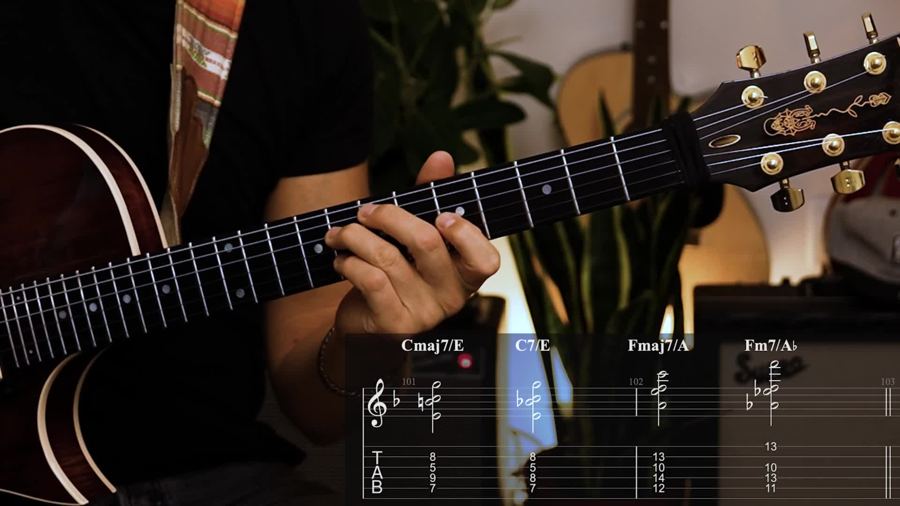
I take a simple progression: Cmaj7, C7, Fmaj7, Fm7. (Fm6 works there too. Both sound great.) Then I make a little rule for myself: first inversions only. Every chord, first inversion.
We play it in time, and two things happen. It almost starts feeling like music, even though it's an exercise. And I start playing with it. On the Fmaj7 I add the open E string, because I can. It's the same major 7. On the Fm7 I play a little fill.
That's the whole point of the lesson: small rules turn shapes into music. The next lesson runs the same four chords from the 6th string only, so you hear the bass line, then from the 4th string, so you hear the voice leading.
The four colors on one sheet
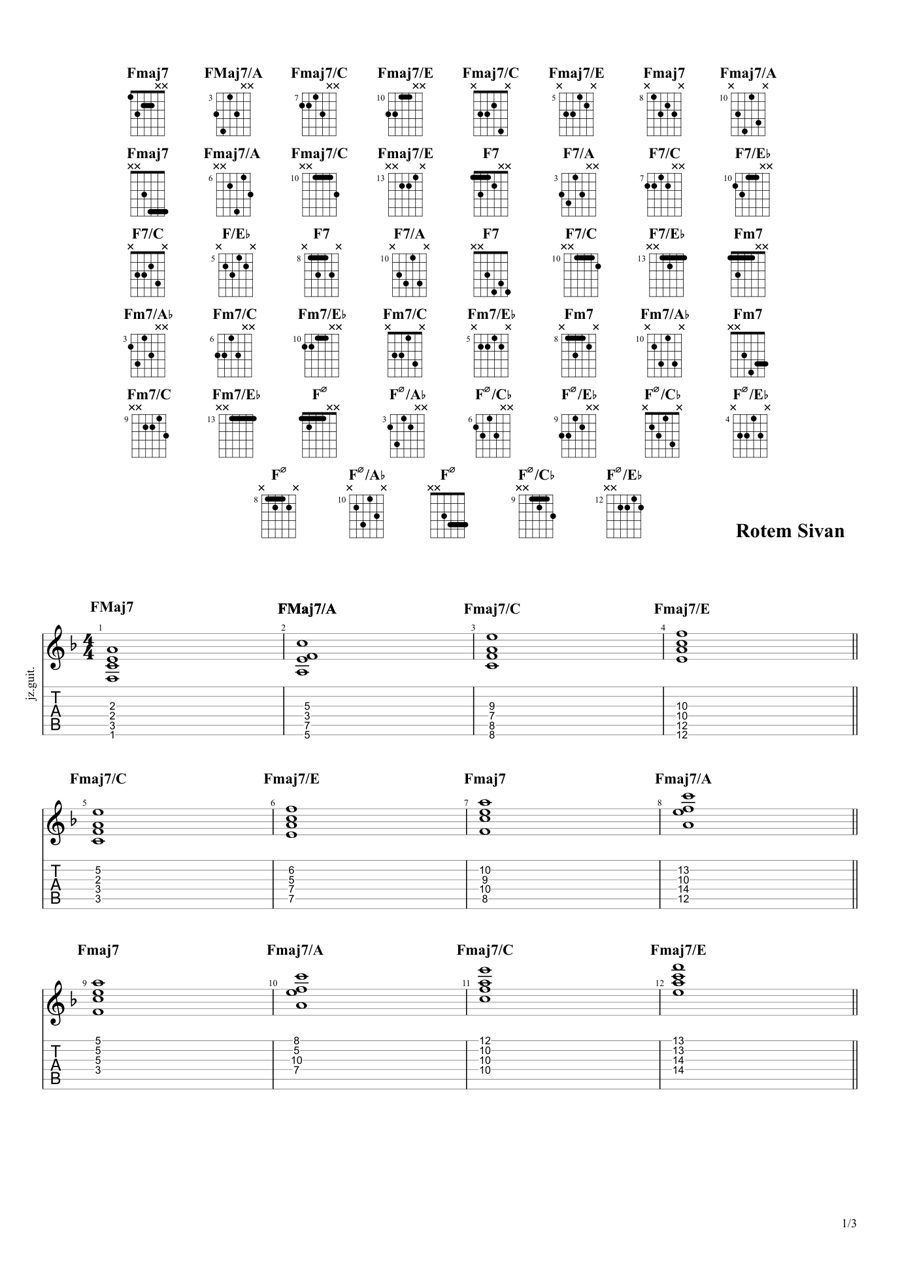
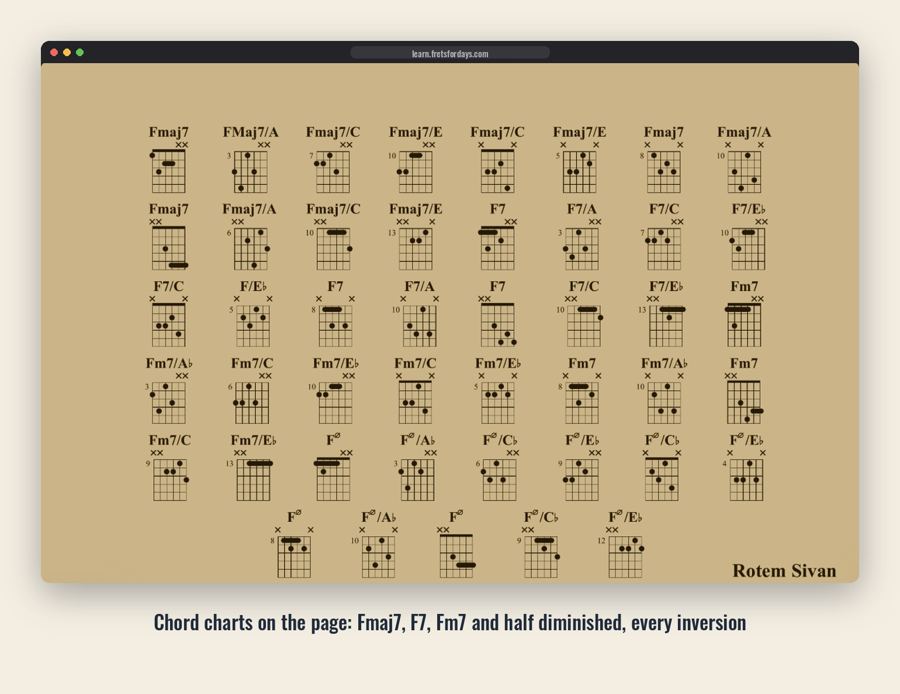
Page one is chord grids for Fmaj7, F7, Fm7 and F half-diminished, every inversion, each one named by its bass note: Fmaj7, Fmaj7/A, Fmaj7/C, Fmaj7/E, and so on through all four colors. Under the grids, the inversions are written out again in notation and tab, with the fret numbers.
It sits beside Sections 2 to 5, along with a separate "in order" sheet for each chord that writes out the climb up the neck through the inversions across the string sets. So when you're practicing, you can check which note is in the bass at a glance.
Inside the members area
Here's what you see when you log in.
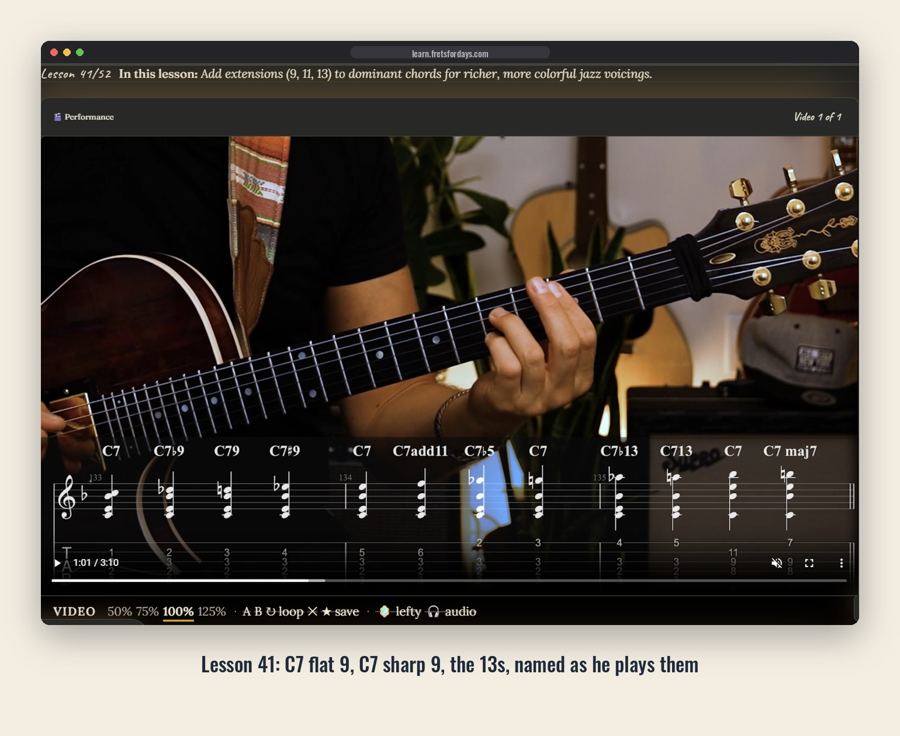
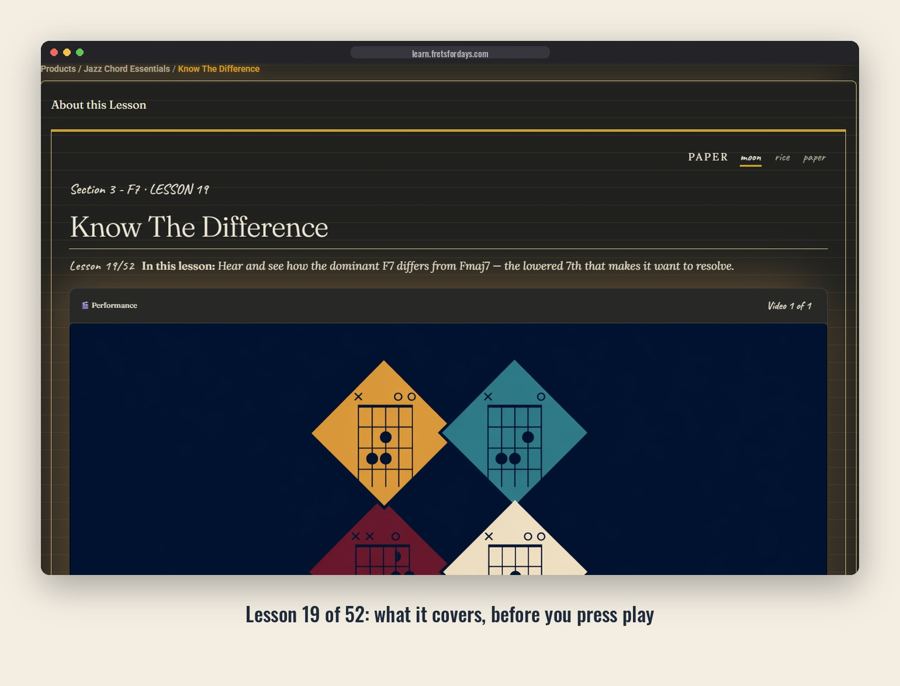
Real screens from the Frets For Days member area. The chord names, notation and tab come up on screen while I play, and every lesson has the speed and loop controls under the video.
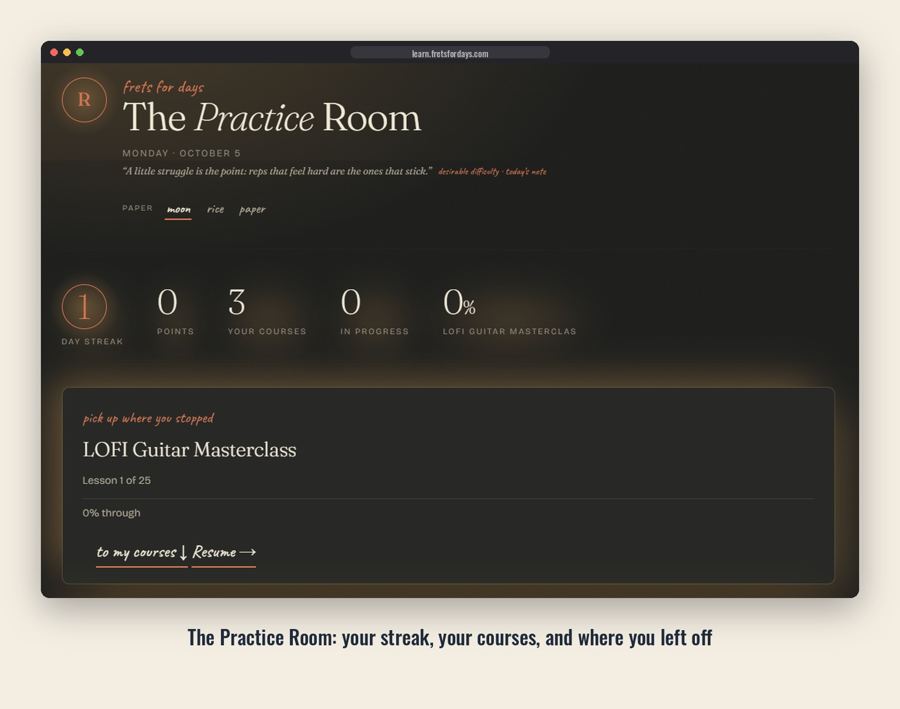
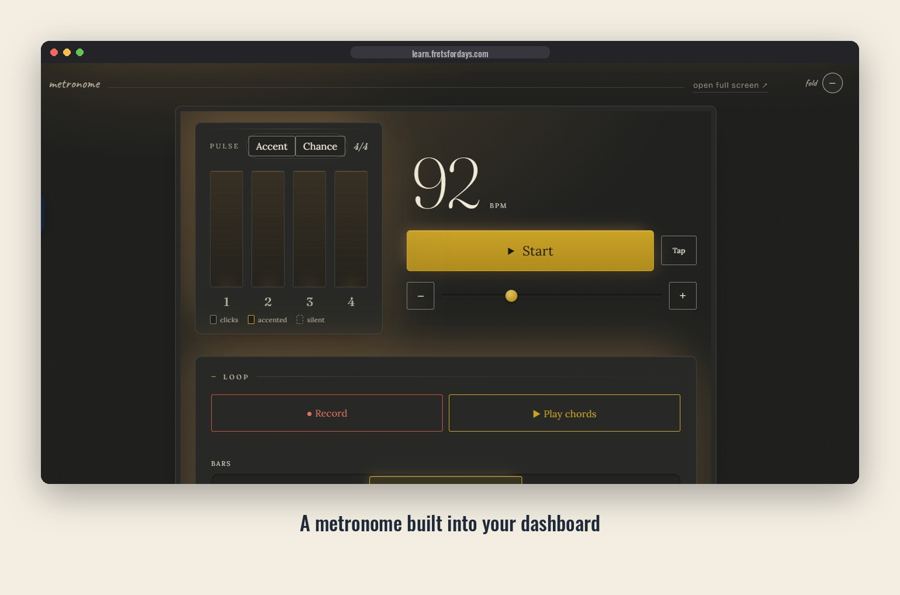
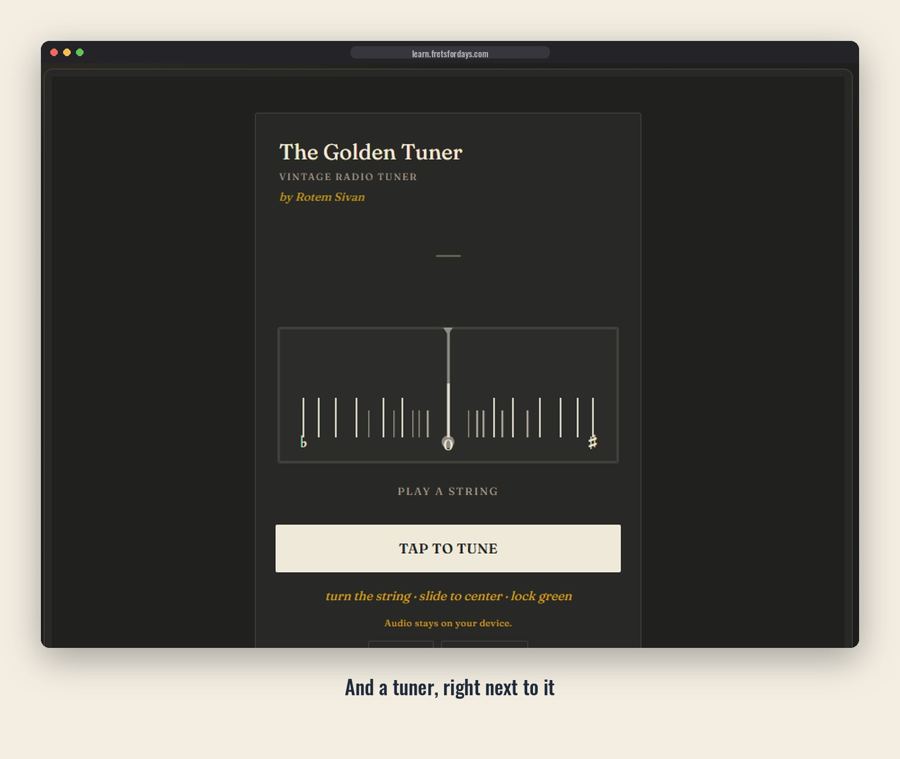
What's inside
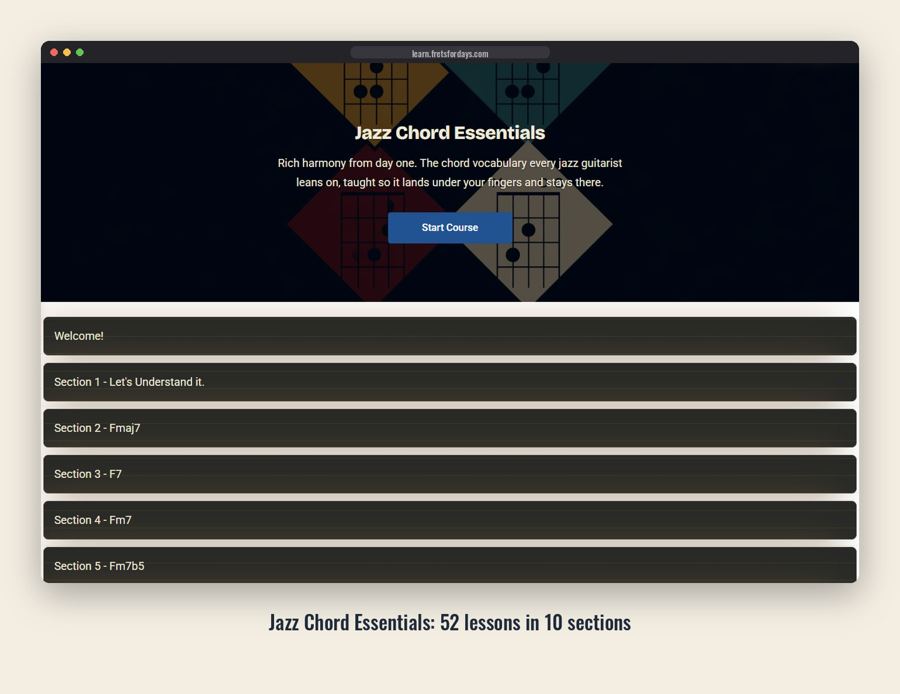
52 lessons, section by section.
Every chord, string set and move below is something I play or explain on camera.
Welcome + 1 Let's understand it
- The three things we work on together through the whole course, and the one I was missing when I started (it isn't the shapes).
- What I couldn't understand when I started playing: how one C major chord turns into all those shapes across the neck. And the problem underneath it.
- "Take your time, please." The lesson where I tell you how long this really takes, and why a few months is nothing in the world of music.
- The triads built on each note of C major, and why I want you to hear a chord as "the 2" and not only as "a minor chord."
- The four main colors: major 7, dominant 7, minor 7 and half-diminished, and what each one feels like to me (one feels at peace; one feels darker).
- The questions to ask about any chord you're playing: what's the top note, what's in the bass, how does it feel, how does it sound, and what's going on theoretically. (The top note is almost like the melody.)
- Singing Cmaj7 note by note, then C7, so you hear what the 7 does. You can do it on piano too.
- Drop 2: how a piano-style Cmaj7 gets rearranged into 1-5-7-3, a shape guitarists actually play, and why the stacked version gets uncomfortable the moment you change chords.
- A triad has three positions. A 7th chord has four. And what "C slash E" on a chart really means, so you can tweak it.
- Major against minor by ear: sing 1-3 and 1-5 of C major, then C minor.
2 Fmaj7
- Fmaj7 in root position and first, second and third inversion from the 6th string, listening for the bass note and the top note on each one.
- The stretchy first inversion, and how I play it without pressing too much: the elbow and the thumb do part of the work. "You can kinda almost breathe into it."
- The interval in the middle of that chord I love, and why it's one reason the chord sounds so beautiful.
- The 5th-string second inversion, the one I call "the stretchiest one" and "not my favorite shape," and how to keep from getting tired on it.
- The 4th-string shape a lot of people already know from Dm9. It's also Fmaj7.
- One of the big superpowers of knowing inversions: using the same shape over a different chord.
- Fmaj7 in order of inversions across the string sets: about three shapes per string set, then jump, so you climb the neck on one chord.
- A common practice habit: we take our time with the tough chord and rush the easy one. That's why we play in time. "Catch me even if you make a little mistake."
3 F7
- The one note that turns every Fmaj7 shape you just learned into F7.
- F7 in all four inversions from the 6th string, saying the bass and the top note out loud. "It's kind of funny to just say it out loud, but it's important to say it."
- The 5th-string third inversion, with the 7th in the bass, a shape you probably know.
- The 4th-string F7 you might already know, and the other three inversions around it.
- Fmaj7 against F7, side by side: 1-3-5-7 against 1-3-5-b7, and the mindset that puts you in a place of creating things on the spot instead of playing copy-paste shapes.
- F7 in order of inversions, switching string sets the same way we did with Fmaj7.
4 Fm7
- A pause to create: Bbmaj7 first inversion to Bbm7 first inversion, then Abmaj7 to Abm7. "How beautiful is that? So simple, right?"
- From F7, change one note and you're in minor: Fm7 in all four inversions from the 6th string.
- The Fm7 first inversion. "I love that first inversion, it's so beautiful."
- The 5th-string set, which is a little easier on the hand.
- The one-finger Fm7 a lot of people know on the 4th string, which is the third inversion, with Eb in the bass, not F.
- Fm7 ascending and descending in order of inversion while shifting string sets, so it stops being a visual or physical thing and starts being music.
5 Fm7b5
- The starting point: how all four colors grow from that first Fmaj7 shape, and why knowing Fmaj7 well makes the rest come without a lot of difficulty.
- m7b5 and half-diminished: two names for the same chord, and the one note that separates it from Fm7.
- The 6th-string second and third inversions, maybe a little less common for some people. "Pretty dark, but beautiful."
- The 5th-string and 4th-string sets, in time.
- Fm7b5 in order across the neck, and the freedom to shift anywhere. You don't have to play three chords per string set.
- The half-diminished substitution: play E half-diminished over C7 and you get the 9. "Just you wait."
6 Make that music now
- Cmaj7, C7, Fmaj7, Fm7 with one rule for which inversion you're allowed to use (the full lesson is in "Look inside" above).
- The same progression from the 6th string only: Cmaj7, C7 with Bb in the bass, Fmaj7 first inversion, Fm7 first inversion, and the bass line that comes from it.
- The same progression from the 4th string, staying close by. More notes in common, less motion: that's voice leading, and it's where these exercises start to come to life.
- Cmaj7 and Fmaj7 on the 4th string, weaving between them by finding the next chord close by, sometimes with the top note in common.
- The three variables in the exercise (the string set, the color and the chord), and how you can change any of them in your practice.
- Cm7 and Gm7 on the 5th string, so the bass steps up C, D, Eb, F, G and you know which inversion you're on at every step.
- Two PDF worksheets: the four-chord progression written out four ways, and musical ideas to explore, in notation and tab.
7 More essentials
- The diminished passing chord a lot of keyboard and organ players use: B diminished slipped between Cmaj7 and its next inversion, on the 5th string.
- Shell chords: 1, 3 and 7 (the 3 and the 7 are the most important notes in the chord), for Cmaj7, C7, Cm7 and diminished from the 5th and 6th strings.
- A Cmaj7 shell with each note of the C major scale on top, one at a time: the one I call really cool, and the one that's "kind of weird."
- A C7 shell with the top note moving up by half steps while we sing it: the b9, the 9, the #9 ("the Jimi Hendrix chord"), the b5, the b13, the 13. And the one I call "kind of like a no-go."
- A ii-V-I (Dm7, G7, Cmaj7) with inversions in four areas of the neck, never moving far. "It's such a big, big and beautiful world."
- The tension note that resolves down to the 3rd, and how that move shows up "not just in jazz, in classical music, in rock and pop."
- Where a G7sus4 sneaks in when the C is already sitting on top.
- Over Gm7, play E half-diminished and you get the 6. Then alternate it with diminished chords. "Really beautiful sound is being used in jazz a lot."
8 Open triads
- F major open triads, root, first and second inversion, on three string sets. "One of my favorite things with guitar."
- The same thing in F minor.
- In time, knowing what's in the bass and what's in the soprano: fa-la-do against la-do-fa, and how open the sound gets.
- The concept challenge: a 1-6-2-5 in C, alternating an inversion with a single note from the C major scale. "It's just automatically music."
- The b13 I land on over the G7, and the shell plus the 9.
9 Closed triads
- C major closed triads in root position, first and second inversion, ascending and descending in one area of the neck, then the next area up.
- The same in C minor.
- Saying "root, first inversion, second inversion" as you go and imagining the sound before you play it.
- How closed triads, open triads and inversions connect when you play a progression, so you can reach them all.
10 Advanced concepts
- Upper structures over Cmaj7 by stacking thirds: play Em7 and imagine the C in the bass, and every Em7 inversion becomes a Cmaj7 sound with the 9.
- The next one up, Gmaj7 over C. It has "some clashiness there," so it isn't for everything, but it works in a lot of situations.
- The furthest one, Bm7 over C: more intense and less C, with the 6, the 9 and the major 7.
- The one situation where I tell you to be careful with these (no bass player in the room).
- E half-diminished over C7 to get C9, all of its inversions, and moving between C7 first inversion and E half-diminished for a slight motion.
- Ebmaj7 over C for Cm9, and why that explains a shape people play oftentimes.
- Two more upper structures for C7 that I name and set aside, because they need shapes this course doesn't cover.
- The closing lesson: the balance between the lab, where you practice the shapes, and making music.
The curriculum
Every lesson, in order.
All 52 lessons, section by section. Tap a section to open it.
Section 1Let's understand it12 lessons
- 01Introduction
- 02Introduction to the theory
- 03Why do you need to know this
- 04Take your time, please
- 05Chord degrees
- 06Colors
- 07Drop 2 (watch it above)
- 08Listen: Cmaj7 and C7
- 09Major and minor: let's hear it
- 10What are 1-3-5 chords
- 11What are 7th chords
- 12What are inversions
Section 2Fmaj75 lessons
- 13Fmaj7, 4th string
- 14Fmaj7, 5th string
- 15Fmaj7, 6th string
- 16Fmaj7 in order of inversions
- 17Fmaj7 in time
Section 3F75 lessons
- 18F7, 4th string
- 19F7, 5th string
- 20F7, 6th string
- 21In order of inversions
- 22Know the difference
Section 4Fm75 lessons
- 23Create
- 24Fm7, 4th string
- 25Fm7, 5th string
- 26Fm7, 6th string
- 27In order of inversions
Section 5Fm7b56 lessons
- 28Starting point
- 29Fm7b5, 4th string
- 30Fm7b5, 5th string
- 31Fm7b5, 6th string
- 32Inversions in order
- 33Half-diminished substitution idea
Section 6Make that music now4 lessons
- 34Make it now (watch it above)
- 35Almost a song
- 36Cm7 and Gm7
- 37Cmaj7 and Fmaj7
Section 7More essentials6 lessons
- 38Diminished passing chord
- 39Dominant extensions
- 40ii-V-I with inversions
- 41m6 to diminished
- 42Shell and scale
- 43Shell chords and beyond
Section 8Open triads4 lessons
- 44Major 1-3-5 in time
- 45Major 1-3-5, open position
- 46Minor 1-3-5
- 47Concept challenge
Section 9Closed triads1 lesson
- 48Major and minor closed triads
Section 10Advanced concepts4 lessons
- 49C7 upper structure
- 50Cm7 upper structure
- 51Cmaj7 upper structure
- 52Thank you
Four colors. Four inversions. Three string sets. Then music.
One payment · Lifetime access · 30-day guarantee
Who it's for
Built for the player who has the grips and wants what's inside them.
Read both lists. If the second one sounds like you, save your money.
This is for you if...
- You play chords from charts and videos, and you couldn't say which note is in the bass.
- You see C/E or Fmaj7/A on a chart and play something that works without knowing why.
- You have one or two places for a chord and want all four inversions on three string sets.
- You're willing to sing quietly while you practice. You don't need to be an opera singer.
- You want exercises that turn into music in the same practice session.
This isn't for you if...
- You're still learning your first open and barre chords.
- You want to comp for a singer or a band, or learn jazz standards. This is solo practice.
- You want soloing licks. This is harmony.
- You want it all in a weekend. There's a whole lesson asking you to take your time.
The offer
One payment. $57. Yours for life.
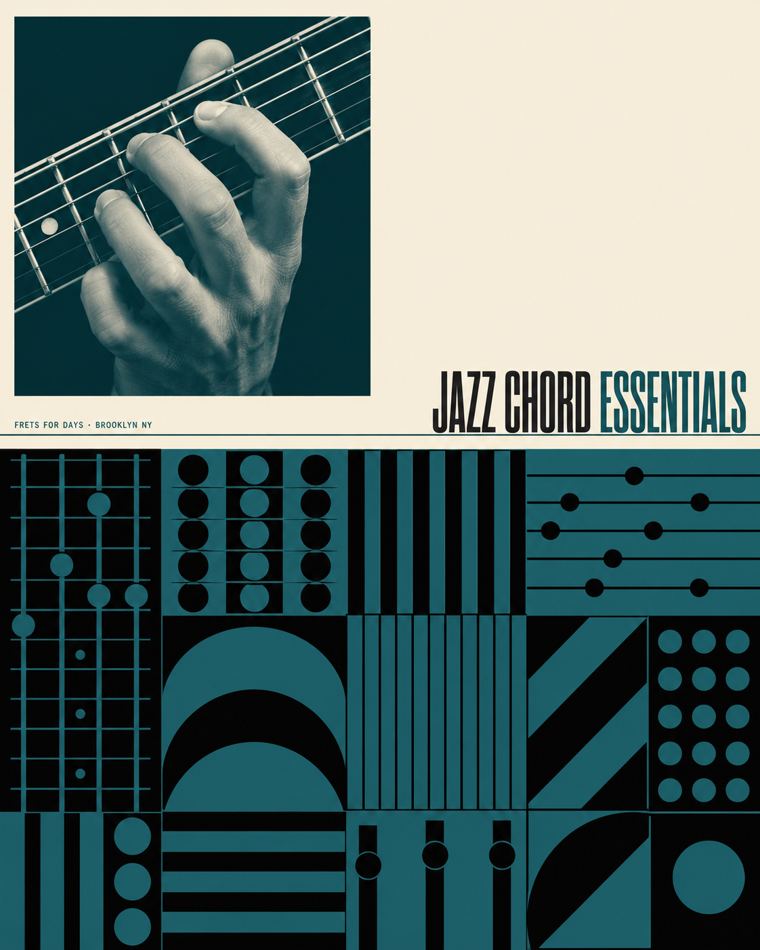
Jazz Chord Essentials is $57, once. You get all 52 lessons and every PDF worksheet in your Frets For Days member area, and they stay there.
One payment · Lifetime access · 30-day guarantee

About your teacher
I'm Rotem Sivan.
I'm a jazz guitarist and educator in New York. I'm from Israel, and I studied at The New School.
I'm not telling you that to impress you. Before any of it, I was the guitar player too embarrassed to ask what an inversion was. This course goes in the order I think it should: understand the chord, hear it, learn the shapes, and make music with them as soon as you can.
Rotem
FAQ
Questions before you buy.
What's the format?
52 video lessons: a welcome and Sections 1 to 10. There are 11 PDF worksheets alongside Sections 2 to 9. Everything lives in your Frets For Days member area, and you watch at your own pace.
What level is it for?
Intermediate. You should be comfortable with basic chord changes. Section 1 covers how triads, 7th chords and inversions are built, so for some of you it'll be a refresher and for some of you it'll be new. Either way, it's the foundation everything else stands on.
Do I need to read music?
No. I explain everything with note names and numbers (1-3-5-7), and every PDF worksheet has tab or chord grids next to the notation.
How much time per week will it take?
Most lessons are under two minutes. The practice is the part that takes time. There's no schedule to keep up with; I ask you to slow it down and make sure you understand, hear and see each shape before you move on.
How long do I have access?
For life. One payment, and the course stays in your member area.
What if it isn't for me?
There's a 30-day guarantee. Work through it, and if it isn't right for you, email [email protected] within 30 days for a refund.
Stop copy-pasting shapes. Know what you're playing.
Nobody handed you the building blocks. They're here now, one chord at a time, and you can take your time with them.
$57 one time · 52 lessons · 11 PDF worksheets · lifetime access
Get Jazz Chord Essentials: $57P.S. Here's a test you can run tonight. Play a Cmaj7, any shape you know. Sing each note from the bottom up: do, mi, sol, then the 7. Now play a C7 and sing it the same way. Which one feels at peace, and which one has a little more tension? If you could hear it, you just tagged your first two colors. The course does that for four colors, in every inversion, on three string sets.
Hugs,
Rotem