For guitarists who love lofi and neo-soul but can't get that sound out of their own guitar
Make lofi grooves of your own, from chords you already know and a loop that stays in time.
A few shapes for each chord color, a loop that's locked from the first beat, and a way to get the 9, the 11 and the 13 out of shapes you already play. Then we take three plain chords and layer them, one part at a time, into a groove you can solo over or write a song on.
One payment of $77 · Lifetime access
Get the Lofi Guitar Masterclass24 video lessons · 21 PDF worksheets · 30-day guarantee
- Major 7, minor 7, dominant and diminished shapes
- Locking a loop in time
- One-color songs
- Fingerpicking a chord as bass and top notes
- Upper structures for the 9, 11 and 13
- Three grooves, built layer by layer
If you're here, it means these colors, these sounds, make your heart tick. Here's the good news: the shapes behind them keep showing up again and again, in piano music, guitar music, lofi, neo-soul and beats, and the list isn't huge. I'll show you the ones I use, how to lock them into a loop, and how to take them from "I learned a cool shape" into music as fast as possible.
Watch before you buy
Two full lessons from the course.
These are real lessons, exactly as they play in the member area, with the chord names, notation and tab on screen.
A letter from Rotem
I could do the exercise. I couldn't make music with it.
For a while that was me. I'd practice scales or exercises non-stop, and I could do the exercise, but I couldn't make music with it. When I was in high school I realized that's not really cool.
So I changed one thing. I'd learn something, and right away I'd create a loop, or I'd literally play along with the record.
That's the whole idea behind this course, and it matters even more with lofi and neo-soul chords, because those shapes are so easy to collect. You see a beautiful voicing in a video. You learn it. And then what?
That's the drawer. If you love this sound, you probably have one. It's full of maj9 shapes, a 13 chord, a minor 11 you saw once. They work. Knowing shapes is a big part of this, and memorizing is great. But a lot of people skip the next part. They try to learn a lot of shapes without really knowing them, on a physical level, an emotional level or an intellectual one. So the shape stays a shape, and the groove never happens.
It isn't a talent problem. Nobody told you the list of shapes is short, that the loop under them has to be locked before anything sounds good, or that a plain triad you've known for years can sit right next to the lush chords and make them pop. For a long time I felt a simple triad was completely separated from everything, so I couldn't use it. That's not true. It took me a long time to understand how to move within the framework of a scale and be creative with it.
- The lofi sound comes from a short list of shapes for four colors, major 7, minor 7, dominant and half-diminished, played as colors you can hear and name, not just grips.
- Lock a loop first. Then layer on top of it: plain triads, a 7th chord, a hammer-on, an upper structure, one part at a time.
So that's how the course goes. First the basics: how to lock a loop, the tonal center, and what each chord color feels like. We sing them. I know. It helps.
Then the shapes I find myself using again and again, from the 6th, 5th and 4th strings: major 7s with the 6 and the 9, minor 9s and 11s, the 13, the b13 and the b9 on a dominant, a couple of half-diminished voicings, and a diminished chord that repeats every minor third. Then we make a little song from each color, fingerpick a chord as bass and top notes, and stack thirds to get extensions out of shapes you already know.
And then the part I love. I take three plain chords, G, Bm and Am, which don't sound lush at all, and layer them into a groove. I take a progression you'll find in a ton of pop, hip-hop, lofi and neo-soul songs and do the same. Then I hold one note, F, and find chords that all have it.
What it won't do. It won't happen overnight. Some of this takes time to implement, and a lot of times we feel we need to know things yesterday. Give yourself the time. It also isn't a soloing course: pentatonic ideas show up over the grooves, but this is chords, loops and layers. And it won't teach you to produce beats. It's you, your guitar, and a looper or a drum loop if you have one.
You can create beautiful songs with chords you know and progressions you already like. You just need to give it your own twist, and a lot of times the twist is paying attention and listening in a truthful and deep way.
Rotem
Look inside
One real lesson. One real worksheet.
Here's exactly what you'd be working on, taken straight from the course.
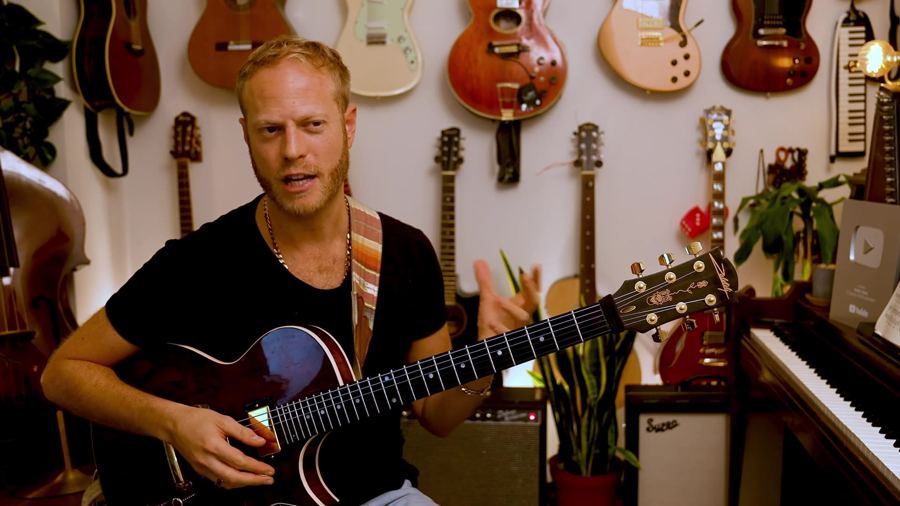
Three plain chords, one layer at a time
G, Bm, Am. In a way, nothing about that sounds lush. I start with triads only and loop that first layer, because it helps me to have the first thing really simple and clear.
Then I layer. Some 7th chords. A chromatic line, Bm7 to Bbm7 to Am7, because Am7 lasts two bars and why not. A Dmaj7 first inversion up the neck over the G, which is an upper structure, then Bm and Am in first inversion with a little hammer-on. On top of all of it, some simple ideas around E minor pentatonic.
The structure isn't complicated. What it needs is attention: knowing the degrees in G major, knowing the shapes for each chord, and knowing what an upper structure gets you.
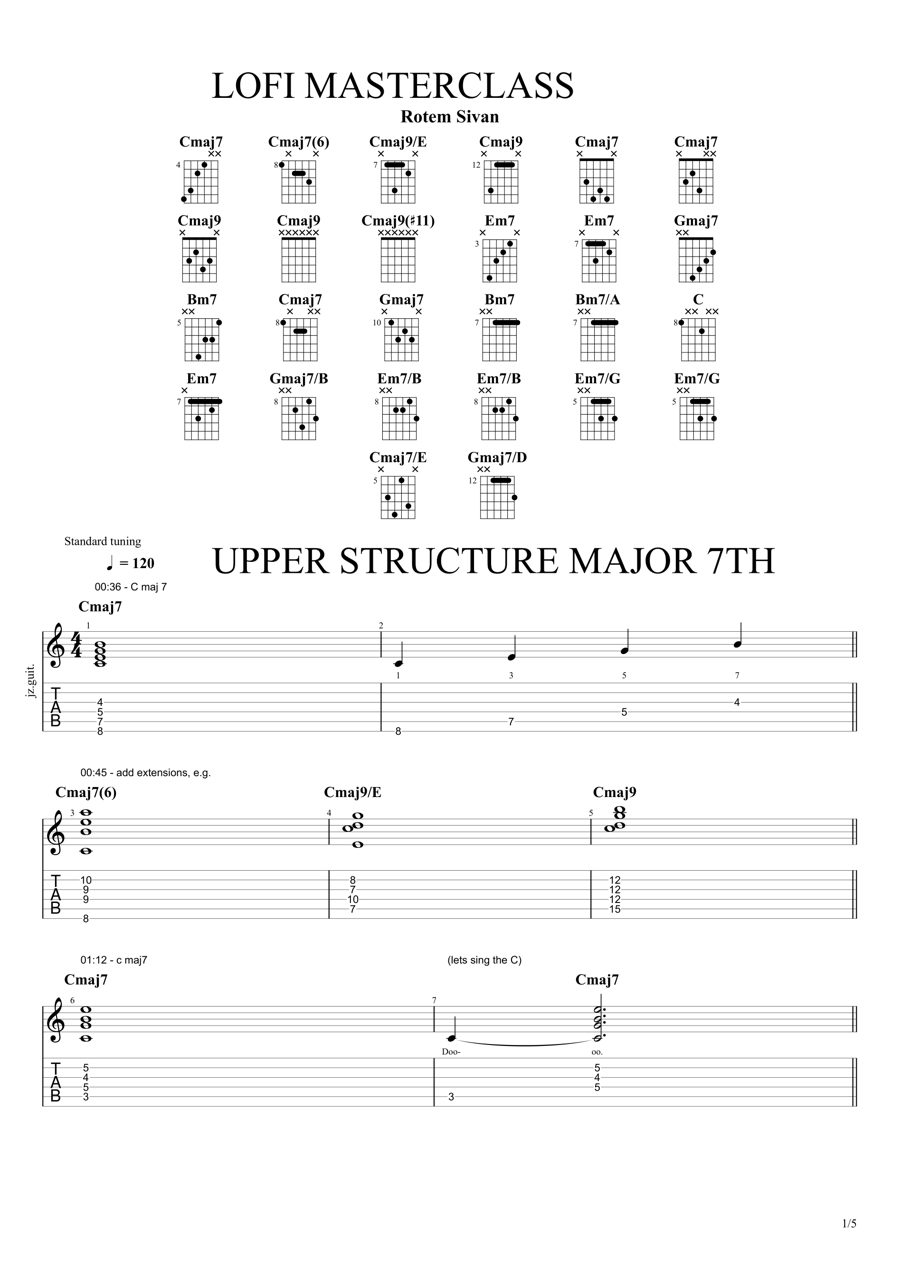
Upper structure, major 7th
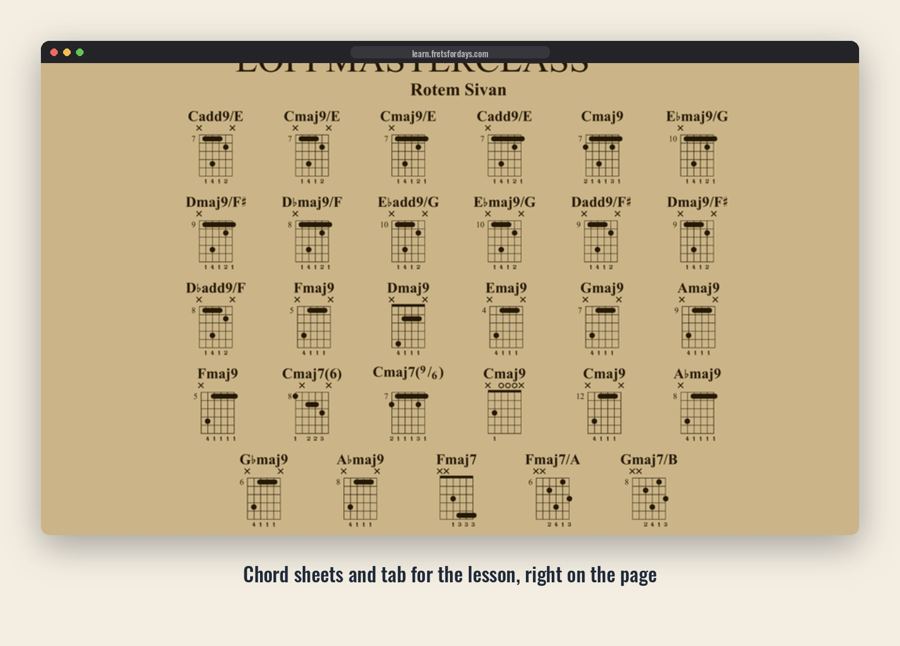
Page one opens with chord grids for every shape in the lesson: Cmaj7, Cmaj7(6), Cmaj9/E, Em7, Gmaj7, Bm7 and their inversions. Under the grids, the lesson is written out in notation and tab, and each example is marked with its time in the video, so you can jump straight to it.
The next page stacks thirds on C, 1-3-5-7-9, drops the C, and shows you what's left. Every lesson that has a worksheet works the same way: grids at the top, then notation and tab with the video times.
Inside the members area
Here's what you see when you log in.
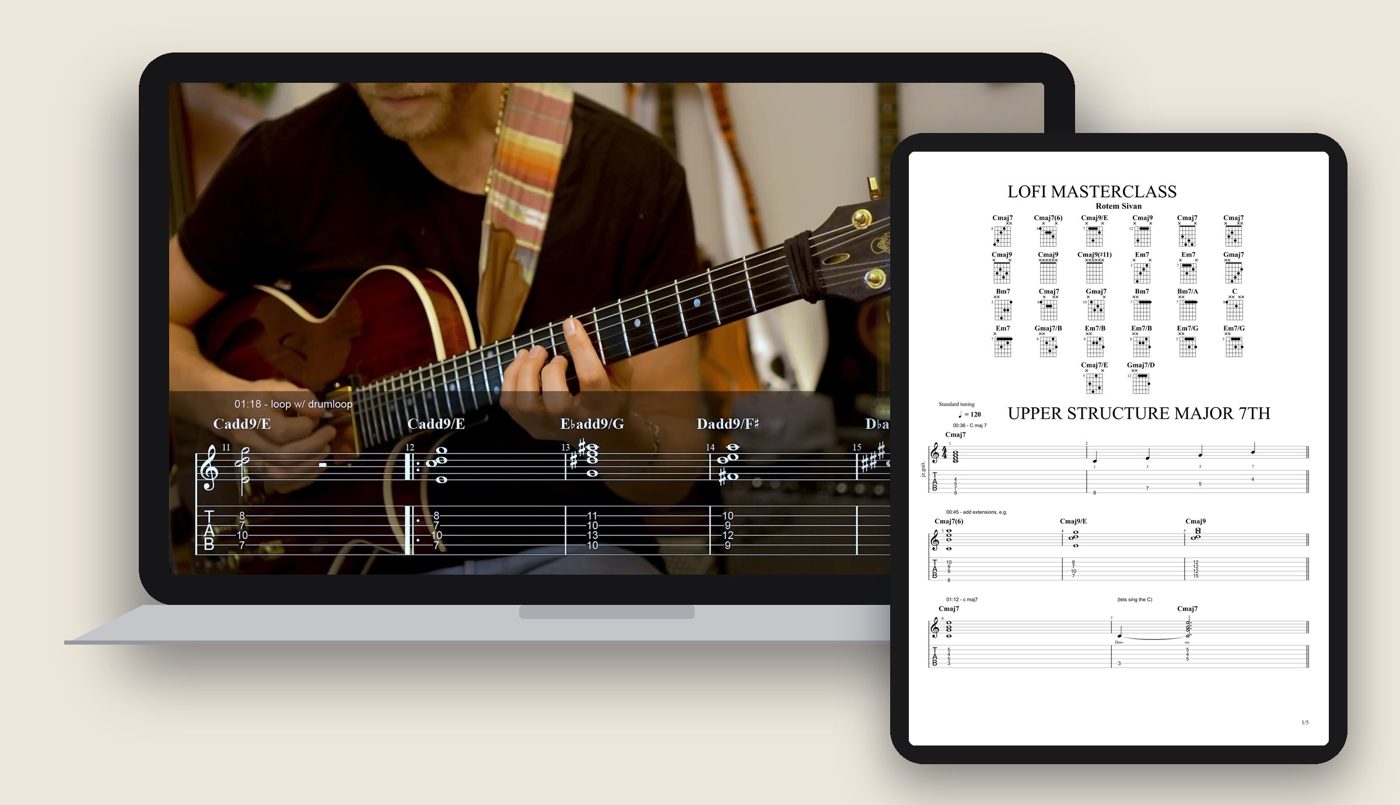
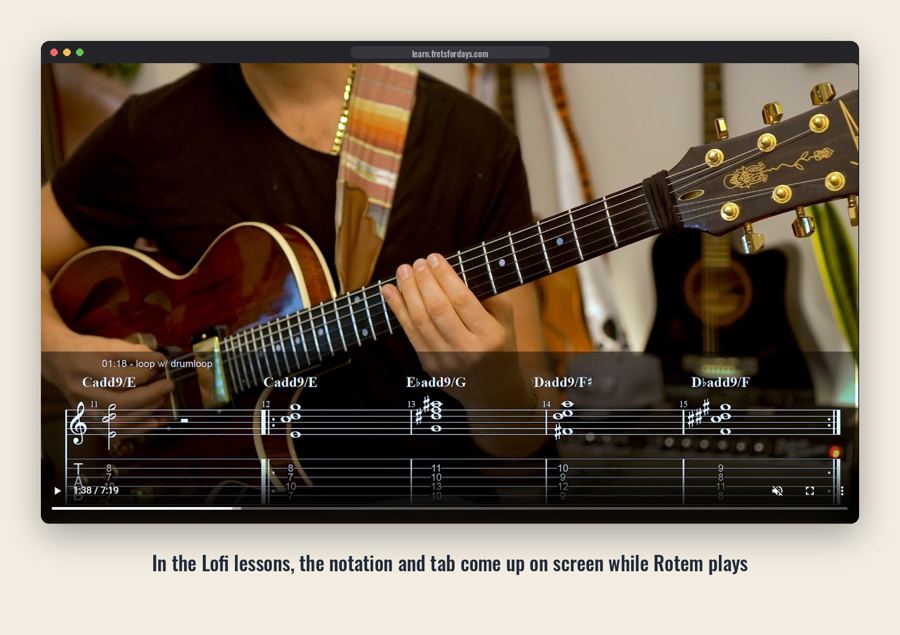
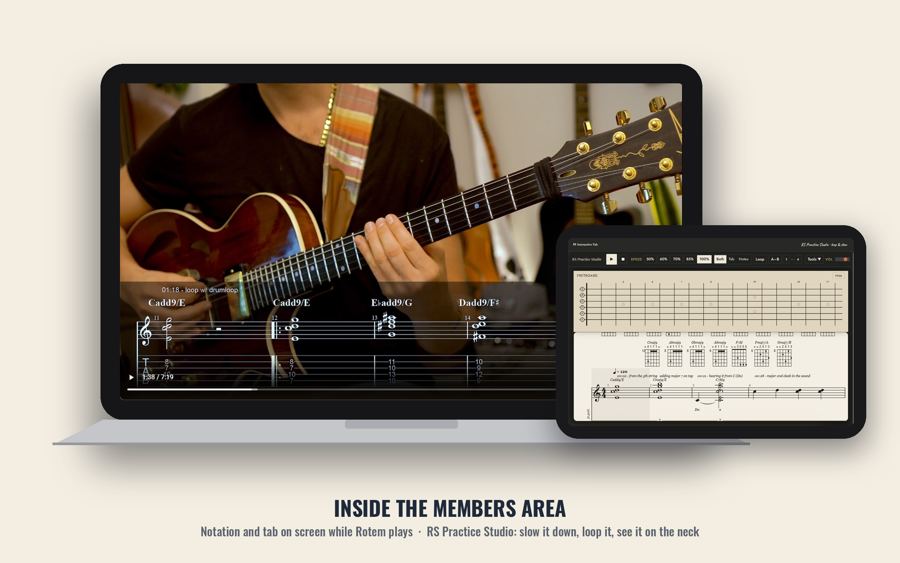
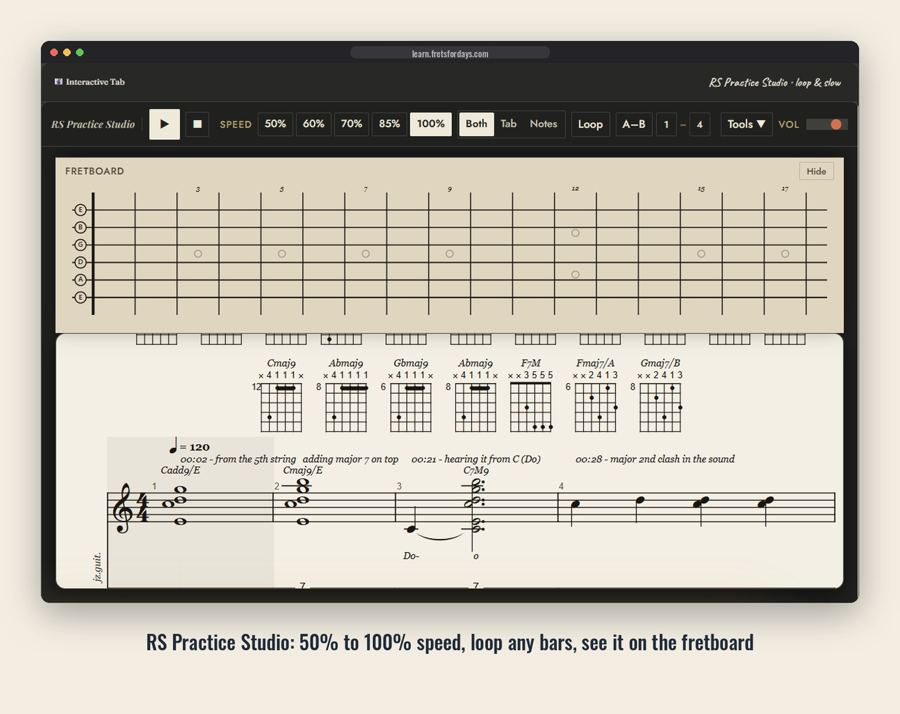
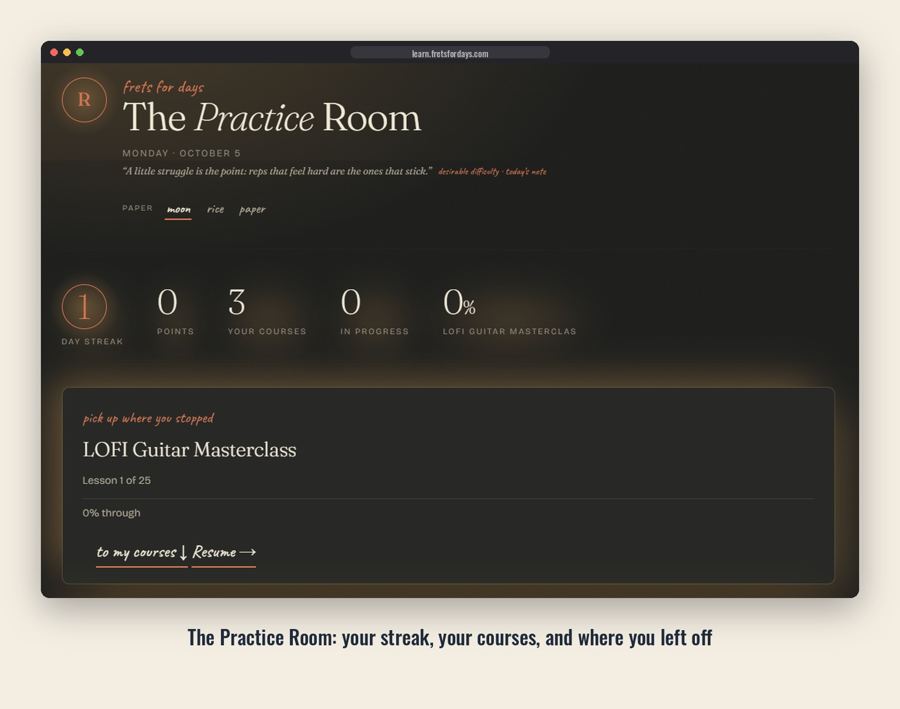
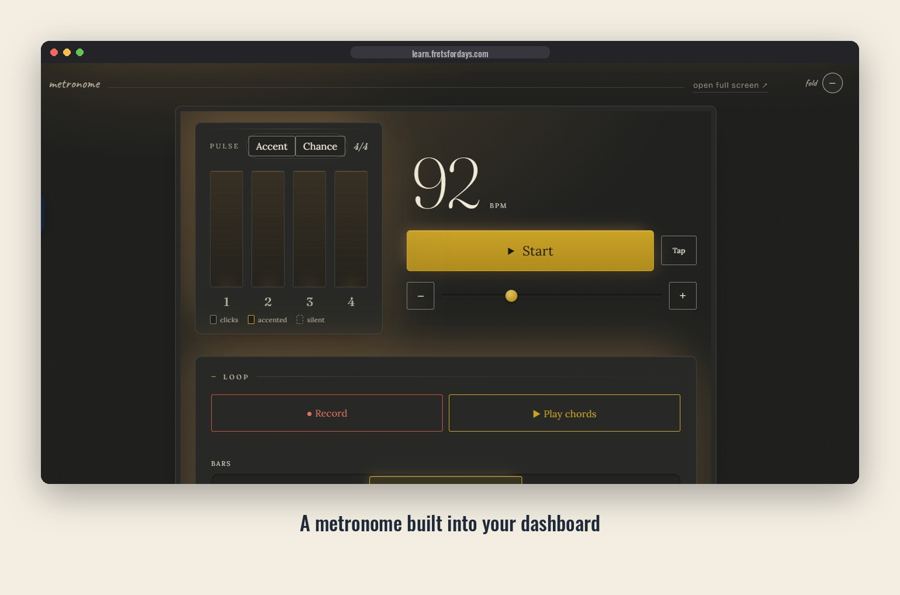
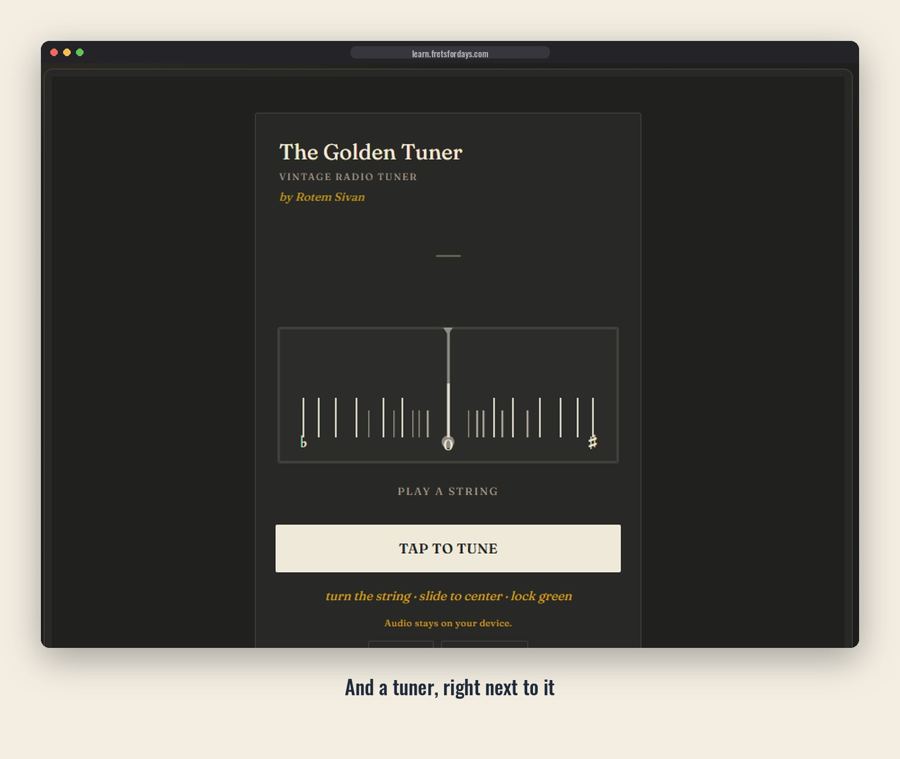
Real screens from the Frets For Days member area. In the Lofi lessons, the chord names, notation and tab come up on screen while I play. The lessons have chord sheets, the RS Practice Studio plays the tab from 50% to 100% speed with a loop and a fretboard view, and The Practice Room keeps your streak and your place, with a metronome and a tuner.
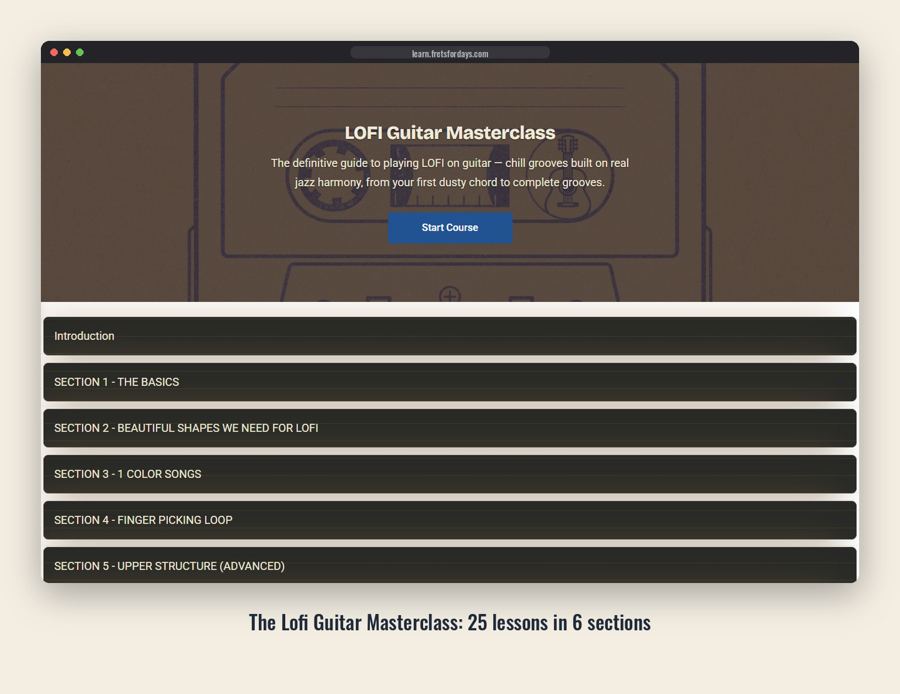
What's inside
24 lessons, section by section.
Every chord, shape and move below is something I play or explain on camera.
Intro + 1 The basics
- Two Fmaj9 and Dmaj9 shapes, and the small things I do before I ever hit the looper so the loop sounds locked. (One of them is notes you barely hear.)
- The exact beat I hit the looper on, start and end. Get this wrong and everything you layer on top feels shaky.
- Why slow loops drift, and the two ways I use a metronome to stop it, including looping the click itself.
- The split-second timing trick for stopping a second loop so it doesn't start another one.
- What actually makes guitar feel lofi to me. It isn't the tone of your guitar.
- The tonal center: the chords of F major, F, Gm, Am, Bb, C, Dm and E diminished, sung and played as degrees, so you hear the tension and release.
- The four colors, Cmaj7, C7, Cm7 and C half-diminished, sung over the C. "Don't take that lightly because this is a big part in the process of tagging."
2 Beautiful shapes we need for lofi
- The little cheat sheet: a few essential shapes I use again and again, and I find in piano music, guitar music, lofi, neo-soul and beats.
- Cmaj7 with the 6 from the 6th string, a shell chord plus one note, and the process I use for any new shape: play it in time, sing it, feel the color.
- Cadd9 in first inversion from the 5th string (E, C, D, G), the major 7 on top if you want it, and the clash inside it that makes it beautiful (watch it above).
- The Fmaj7 9 from the 5th string, and the top note that turns it into a 6/9.
- Two 4th-string major 7 shapes. "Even if you just take these two."
- Cm9, one of my favorites, plus a 5th-string Dm9 with the 11 on top and a hammer-on from the 11 to the 5.
- G7 with the 13, the b13 and the b9, and the first two notes of a chord that usually go away when you add extensions.
- Two or three half-diminished voicings, and diminished shapes. The chord is symmetrical, so move it a minor third and you get the same four notes in a different order.
3 One-color songs
- Plain triads next to lush chords: C, G/B, Am9, Fmaj9, and why the contrast makes the lush ones pop.
- A major 7 song: Amaj7, Gmaj7, Fmaj7 in whole steps, shell chords looped first, then the same chords layered in other shapes, the way I stack chords when I record.
- Where the melody usually sits when you play chords on guitar, and how I use shapes to bring it out.
- A minor 7 song from part of a song of mine: Em9, Dm9, Am9, Gm9, two shapes moved around, with a hammer-on.
- A dominant song, fingerstyle: A9 to E9, then down by half steps.
- The only rule I have when I'm getting a new color under my fingers.
4 Finger picking loop
- Stop strumming every chord as one block: play just the bass and the top note, or the bass and two notes, and hear how much color is in one shell chord.
- Hammer-ons inside an Fmaj7: C to D on the top string adds the 6, and G to A on the B string goes from the 9 to the 3.
- A full loop over F and C: shell chords, more layers, then a bass line, then C major and A minor pentatonic on top.
- The two notes I knew would work over both chords, and what they are on each one (the 9 and 3 on F, the 5 and 6 on C).
- F to C with two triads, an open string and a hammer-on (watch it above).
5 Upper structure (advanced)
- "One of the most important devices in music." Stack thirds on Cmaj7, drop the C, and the chord that's left is one you already know. Play it over C and you get the 9.
- The next two stacks up for Cmaj7, and when the furthest one is too much (with a singer, for example).
- Upper structures as fuel for improvising, not only as chords: B minor pentatonic over Cmaj7.
- Cm7: the chords that give you Cm9, Cm11, and a 6 that's "very clashy, very beautiful."
- C7: the chord that gets you the 9 without jumping around for new voicings, and how far the stack goes before it gets extreme.
6 The lofi sounds
- G, Bm, Am turned into a groove, layer by layer (the full lesson is in "Look inside" above).
- A progression that runs through so many songs, pop, hip-hop, lofi and neo-soul, with a secondary dominant and a minor 4. "By hearing that you will actually be able to hear quite a few songs."
- The #4 half-diminished passing chord that shows up in so much music.
- Homework: the same progression in F, and the upper structure for each chord.
- One note, F, held through Bbmaj9, Dbmaj7, Gm7 and Abmaj7 with the 6, then the same chords in another place on the neck, then upper structures on top.
- The one pentatonic that works over all of those chords as a thread.
- The closing lesson: why to be peaceful with the process.
The curriculum
Every lesson, in order.
All 24 lessons, section by section. Tap a section to open it.
IntroIntroduction1 lesson
- 01Intro
Section 1The basics4 lessons
- 02Loop essentials
- 03The sound
- 04Tonal center
- 05What are chords
Section 2Beautiful shapes we need for lofi6 lessons
- 06Introduction
- 07Major 7th shapes (6th string)
- 08Major 7th shapes (5th & 4th string) (watch it above)
- 09Minor 7th shapes
- 10Dominant 7th shapes
- 11Half dim & dim shapes
Section 3One-color songs4 lessons
- 12Color songs: 1-3-5
- 13Color songs: major 7th
- 14Color songs: minor 7th
- 15Color songs: dom 7th
Section 4Finger picking loop2 lessons
- 16Finger picking & looping (watch it above)
- 17Loop essentials
Section 5Upper structure (advanced)3 lessons
- 18Major 7th upper structure
- 19Minor 7th upper structure
- 20Dominant 7th upper structure
Section 6The lofi sounds4 lessons
- 21Lofi groove & sounds 1
- 22Lofi groove & sounds 2
- 23Lofi groove & sounds 3
- 24Thanks
A few shapes per color. A loop in time. Then grooves of your own.
One payment · Lifetime access · 30-day guarantee
Who it's for
Built for the player who loves the sound and wants to make it, not just hear it.
Read both lists. If the second one sounds like you, save your money.
This is for you if...
- You love lofi and neo-soul, and your own playing still sounds like open and barre chords.
- You've picked up beautiful shapes from videos and they sit in the drawer, unused.
- You loop, or want to, and your loops drift or never feel locked.
- You want to know you're playing the 9 or the 13, not only where your fingers go.
- You want to write little grooves and songs of your own.
This isn't for you if...
- You're still learning to fret your first chords cleanly.
- You want fast single-note soloing. This is a chord and groove course.
- You want to learn beat production or recording software. This is guitar, a looper and a drum loop.
- You want it all overnight. The closing lesson asks you to take your time.
The offer
One payment. $77. Yours for life.

The Lofi Guitar Masterclass is $77, once. You get all 24 lessons and every PDF worksheet in your Frets For Days member area, and they stay there.
One payment · Lifetime access · 30-day guarantee

About your teacher
I'm Rotem Sivan.
I'm a jazz guitarist and educator in New York. I'm from Israel, and I studied at The New School.
I'm not telling you that to impress you. For a while I was the guitarist who could do the exercise and couldn't make music with it. This course goes in the order that changed that for me: a few shapes, played in time and sung, then into a loop as soon as possible.
Rotem
FAQ
Questions before you buy.
What's the format?
24 video lessons: an introduction and Sections 1 to 6. 21 of them come with a PDF worksheet. Everything lives in your Frets For Days member area, and you watch at your own pace. A looper and a metronome help, but you don't need them: you can play a loop yourself and imagine it.
What level is it for?
You should be comfortable with basic chords and changing between them in time. Section 1 goes over the basics clearly, how chords are built, the tonal center and the four colors, so even if you don't have a lot of experience with lofi you can follow along. Section 5 is marked advanced, and it is.
Do I need to read music?
No. Every worksheet has chord grids and tab next to the notation, and in the lessons the chord names and tab come up on screen while I play.
How much time per week will it take?
There's no schedule. Lessons run from under a minute to about ten minutes. The practice is what takes time: getting a shape in time, singing it, and making a loop with it. Take a couple of shapes and make sure they're clear before you move on.
How long do I have access?
For life. One payment, and the course stays in your member area.
What if it isn't for me?
There's a 30-day guarantee. Work through it, and if it isn't right for you, email [email protected] within 30 days for a refund.
Get your shapes out of the drawer. Make a groove of your own.
You can create beautiful music with chords you already know. It starts with a few shapes and one loop that stays in time.
$77 one time · 24 lessons · 21 PDF worksheets · lifetime access
Get the Lofi Guitar Masterclass: $77P.S. Here's a test you can run tonight. Take any two major 7 chords you know. Count yourself in, one, two, three, four, and loop them for two bars, starting exactly on beat one. Let it go around four or five times and listen. Is it still locked, or did it start to shift? Slow loops tend to shift a little, and anything you put on top of a shaky loop feels shaky too. The first lesson in Section 1 is about fixing exactly that, before we add a single layer.
Hugs,
Rotem