For guitarists who've always wanted to solo, but felt scared and overwhelmed
Start soloing in a way that sounds tasteful and musical, built from one short line and the five notes you already know.
One A minor pentatonic, three short lines, and the building blocks inside them: the hot notes, the blue note, the bends, the double stops, the triplets. Then one of my favorite ways to turn all of that into a solo over a loop.
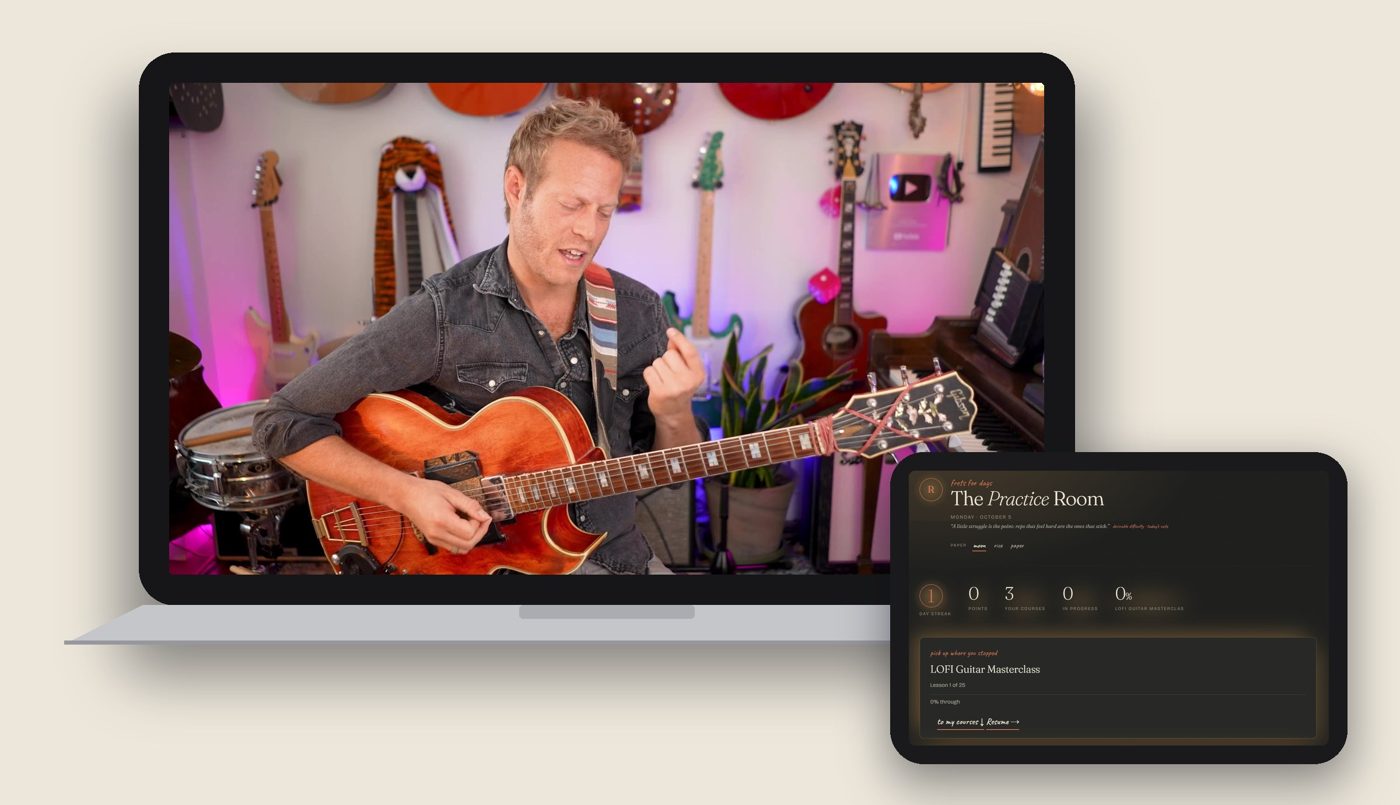
One payment of $57 · Lifetime access
Get Simple Tasteful Soloing31 video lessons · 30 PDF worksheets · 30-day guarantee
- A minor pentatonic, note by note
- The flat 3, the 6 and the 9
- The blue note, the flat 5
- Bends that only lean toward the note
- 8ths, triplets and 16ths in time
- A five-move solo technique
Soloing was something I always wanted to be able to do, but I was quite scared, and actually quite overwhelmed as well. I wish somebody had explained these ideas to me when I started, because I would have saved a lot of time. To solo well, you don't need to know a lot. What you do know needs to be on a very high level. So we take one scale you probably already know, and we go deep, until you can solo tastefully with what you actually know.
Watch before you buy
Two full lessons from the course.
These are real lessons, exactly as they play in the member area.
A letter from Rotem
I always wanted to solo. I was quite scared, and quite overwhelmed.
Soloing was something I always wanted to be able to do. But I was quite scared, and actually quite overwhelmed as well. I'm sure a lot of us feel that way.
For me that was the case for many years: it's just overwhelming. There's so much to do, and there's so little time.
What really helped me was thinking about music as a language, and trying to understand the building blocks of the thing I'm studying. That approach is what keeps me from getting overwhelmed.
Now, the pentatonic works. You probably know this shape. But here's my question: do you really know the shape? Do you really know everything that's happening there? Because if you do, the line in this course would be extremely easy.
Most of us don't, and here's how it happens. We get excited about learning things, so we want to check mark them. Learn the box, check. Learn a lick, check. Next video. That works for a lot of things. It's not the case with guitar and music. Check-marked notes end up as the scale going up and down, or as the same few licks in the same order, because you can play them but you don't hear what each one is doing.
That's not a talent problem. Nobody explained it to me this way when I started diving into guitar. I wish somebody had. I would have saved a lot of time, and I want to save that time for you.
- To solo well, you don't need to know a lot of information. What you do know needs to be on a very high level.
- One small line holds the building blocks of a solo. Learn each block until it's part of your ear, your fingers and your emotion, and you can call on it whenever you want.
That's how the course is built. We start with the A minor pentatonic and the note A, and we listen. Five notes, five colors, and each one feels a little different against that center. We sing them, with the guitar and then without it. I'm not asking you to be an opera singer. I want you to be able to hear something and repeat it.
Then we take a line. It sounds fancy, but it's actually very simple. We look at why it works, why it sounds the way it sounds and why it feels the way it feels: the hot notes, a note from outside the box, the double stop at the end. Then the blues scale, a line built on a full bar of triplets, bends that don't quite get to the note, and a line built on 16th notes. A lot of it we play together, in time, with a metronome.
And then one of my favorite techniques to solo. It's tremendously simple, and kind of amazing how much music it can bring out of us. A loop, the position, and a few rules. The first rule is just to stop.
What it won't do. It won't happen this week. Locking this in takes time, and I know it's not easy. It's also small on purpose: the A minor pentatonic plus the blue note, in one key, and the blues. It won't teach you the whole neck, other keys, jazz vocabulary or soloing over chord changes. A lot of it is slow practice with me and a metronome, and some of it is singing.
Whether you're starting guitar now, whether you're in your 20s, 40s, 50s or 60s, it doesn't matter. What matters is that you love music and you love the craft. You have the time. So take your time and dive deeply.
Rotem
Look inside
Two real lessons, up close.
Here's exactly what you'd be working on, taken straight from the course.
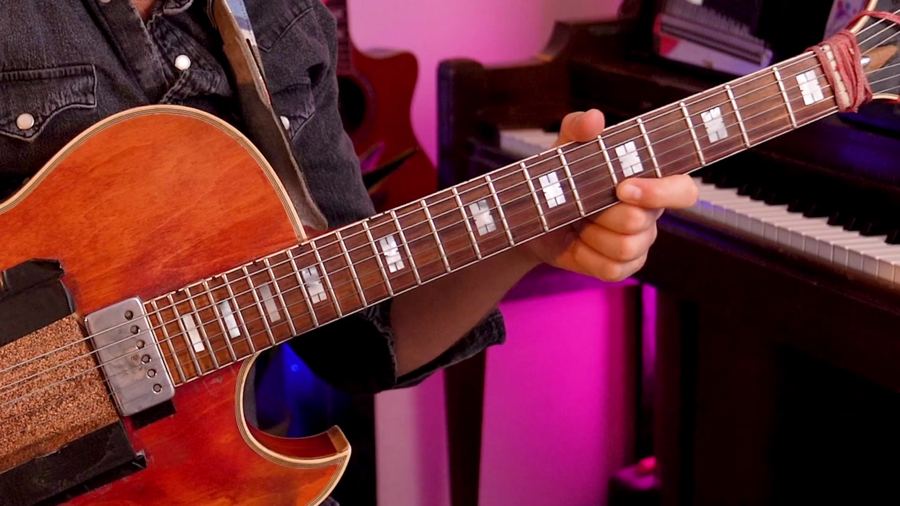
A loop, the position and a few rules
I put on a loop and play the framework of the position first, just 8th notes. "Nothing much. That's not music yet."
Then I allow myself one thing: to stop every once in a while. Then to change direction. Then to repeat an idea, and then a little bit of bending. It's very exercisey, and I'll tell you so. But it pushes you to see the position and imagine the colors, and you hear it start to turn into music.
Then we do the same thing with triplets. In the next lesson it's 16th notes, and then all three mixed. Five simple elements, and you start having this blooming of music.
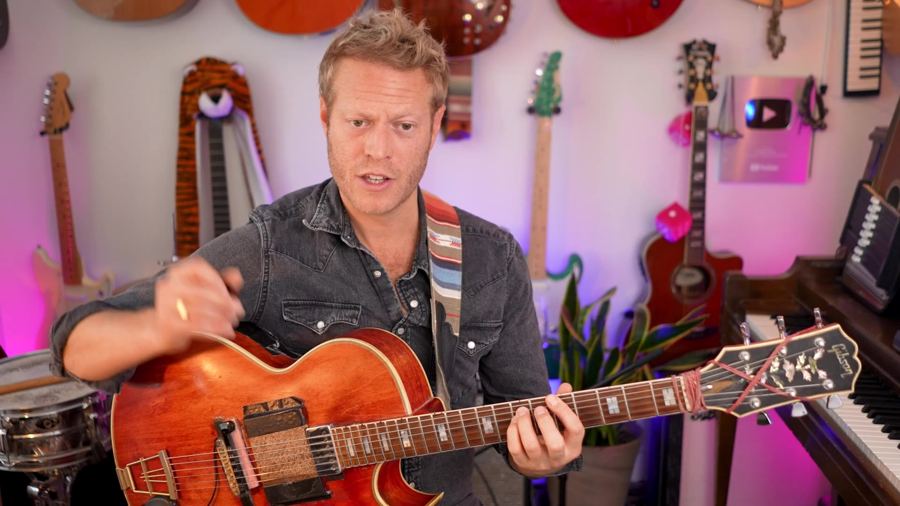
Sing it, then sing it without the guitar
We sing the A minor pentatonic note by note. Solfege or letter names, both are totally fine, and the octave you sing in doesn't matter. What matters is listening deeply and locking into the note with your guitar and your voice.
Then one more step: without playing, listen to the colors and sing them. I know for a lot of people this isn't easy. That means there's something important there.
Every lesson in this section and the three after it has its PDF worksheet beside it, in notation and tab.
Inside the members area
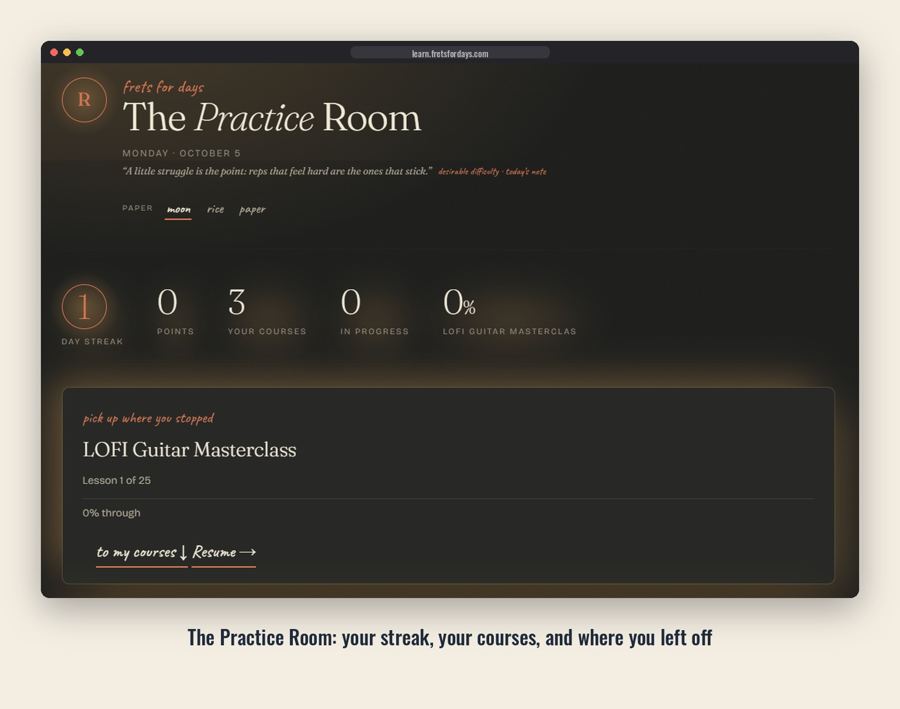
Here's what you see when you log in.
Real screens from the Frets For Days member area: the course outline, a lesson page, and the practice room, metronome and tuner that are there when you practice.
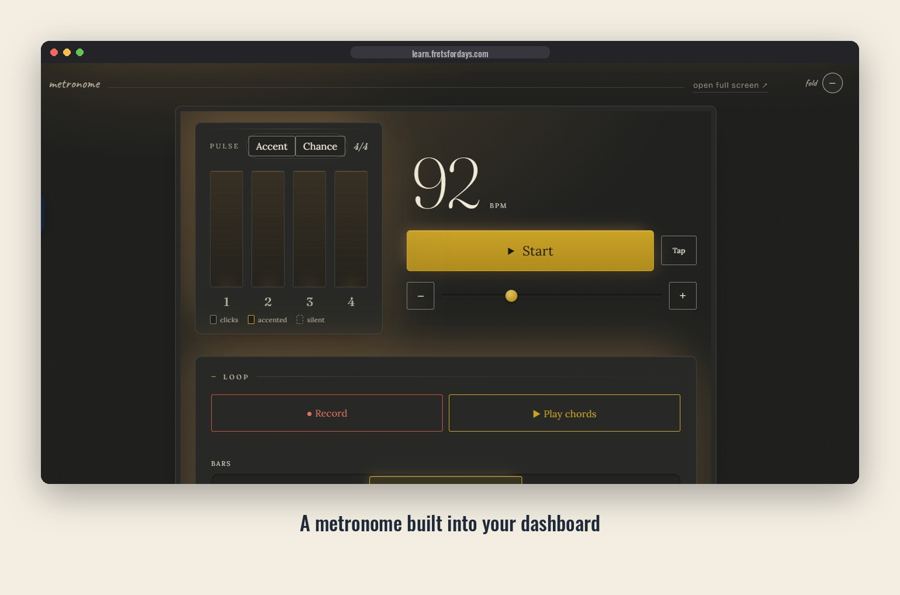
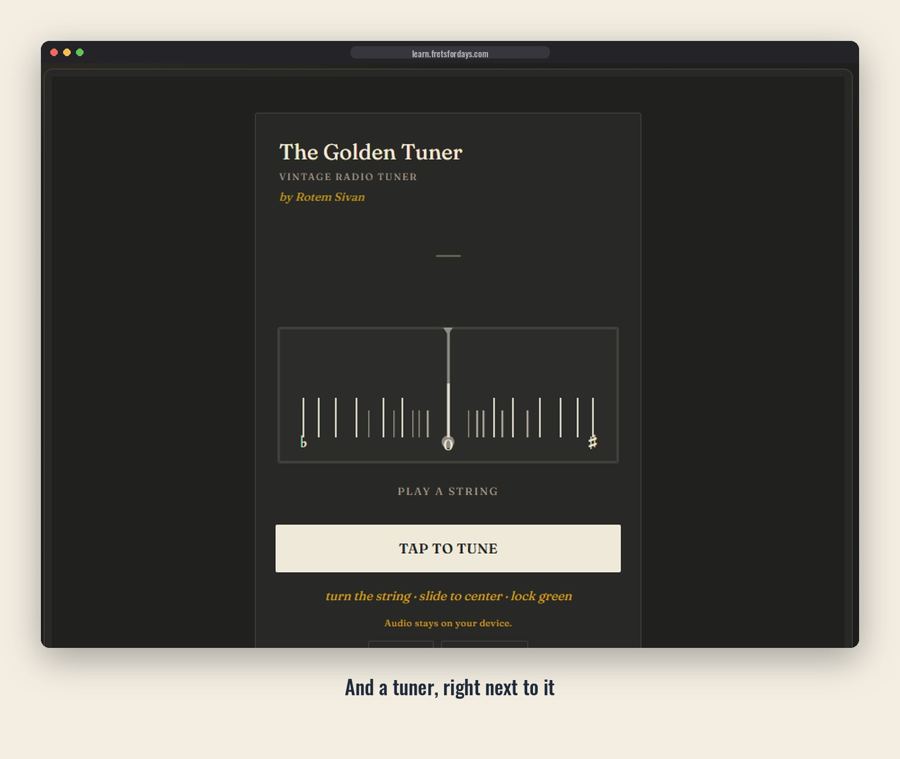
What's inside
31 lessons, section by section.
Every note, line and move below is something I play or explain on camera.
1 How to go about it
- The one sentence the whole course hangs on, about how much you need to know to solo well. (It's less than you think. The catch is in the second half of the sentence.)
- Thinking about music as a language, and the building-block approach that kept me from getting overwhelmed after years of feeling exactly that.
- What to listen to every day if you want to play blues, play lead or solo, and what it does for you later.
- Consistency: how much time a day I'd suggest, starting with something very doable, and the one logistic step that makes it stick.
- Dive deep: the check-mark habit a lot of us have, and the difference between being able to play something and having it in your ear, fingers and emotion.
- Rushing usually takes way more time. What I tell you about age and time, whether you're in your 20s or your 60s.
- Create and Interact: writing a melody or a song with these tools, and finding a buddy or a session to play with.
2 The Line & The Hot Notes
- The line: by the end of this section you'll play it, and know why it works, why it sounds the way it sounds and why it feels the way it feels.
- "Do you really know the shape?" The A minor pentatonic against the note A: five notes, five colors, and how to tag each one by what you feel. (Almost like a meditation.)
- Singing the scale with the guitar, then without it. You don't have to be a singer.
- Playing the scale in 8th notes in time, knowing every note as you go. If I stop you on a note, can you say it's the flat 3? The test for whether you really know a position.
- The hot notes: the flat 3 against the 1 in two octaves, and the relationship that lets the fingering matter less once you hear it.
- The note from outside the box that the line starts on, and what happens when you lower the 7 a half step.
- Double stops: the scale in harmonic thirds across the whole position, then a call and response built from the line, then a handful of new ideas derived from it with a little bend.
- Singing the line against the center, and leaning into how each note feels.
- Practice with me: quarter notes, 8ths, triplets and 16ths with the metronome, plus the trick for when getting in and out of triplets trips you up.
3 The Blues Framework
- The blue note, the flat 5: "very crunchy, a lot of pain," and what it does to the resolution.
- A line in two octaves built on a full bar of triplets, starting on beat 1 and ending on beat 1.
- Flat 5 or sharp 4, E flat or D sharp: the same tone, and both names are correct as long as you know the sound.
- The blues scale in quarter notes, 8ths and triplets. With that framework, you almost have the line.
- The C bend that goes toward C sharp and doesn't quite get there, and why you might leave it unresolved.
- Adding the open E string to the phrase, a slide from it, and the B bent almost to the C for extra tension, over all four bars.
- Hear it: singing the end of the line, and the gap between what you imagine and what you can actually play.
- Blues in A, three times through, with dynamics and a small tremolo (watch it above).
- A slow play-along in the blues scale, switching between 8ths and triplets. Slow makes it tougher, which is the point.
4 Blue Notes & Phrasing
- A new line built on bends and 16th notes: a small bend on the first C, then a double bend the second time.
- The line in two simple parts, including the full pentatonic that starts on the A, waits, and plays the last note twice.
- Bending the flat 3 toward the 3 ever so slightly, and how I mute with the right hand and a flattened finger so nothing else rings.
- Which note I often don't bend (it gives you the flat 9, "a little odd but possible"), and the one that's "really great."
- Practice together, the longest session in the course: 8ths, triplets and 16ths, pushing the tempo step by step, with your fingers a little round.
- The 50 percent rule for tempo: if you want 100 BPM at the gig, what you practice.
- The same phrase closer to the bridge for a brighter, more percussive sound, then softer, and how much that changes what people hear.
- Flipping which half of the line is soft and which is loud, and taking just one cell of the line instead of the whole thing.
5 New Solo Technique
- One of my favorite techniques to solo, over a loop: the position in 8th notes, then a few rules added one at a time (the full lesson is in "Look inside" above).
- The same rules with triplets, then 16th notes, then all three subdivisions mixed in one place, in one color.
- The questions to keep asking while you do it: which subdivision am I using, what's the sound, is it locking in?
- Short lines with me: tiny phrases repeated in time for as long as you can, with as much conviction as you can. A game I used to play a lot.
6 Thank you
- A short goodbye from me, and what I hope you do next: improvise, create, write, make music.
The curriculum
Every lesson, in order.
All 31 lessons, section by section. Tap a section to open it.
Section 1How to go about it6 lessons
- 01You don't need a lot
- 02Music building blocks
- 03Consistency
- 04Dive deep
- 05Create
- 06Interact
Section 2The Line & The Hot Notes9 lessons
- 07The line
- 08Relationship to key
- 09Sing the scale
- 10Play 8th notes in time
- 11Know the hot notes
- 12Play the line (watch it above)
- 13Double stops framework
- 14Play & sing line with me
- 15Practice with me
Section 3The Blues Framework7 lessons
- 16The line
- 17Know why
- 18Framework together
- 19Bends
- 20Hear it
- 21Blues in A (watch it above)
- 22Blues framework: play together
Section 4Blue Notes & Phrasing5 lessons
- 23The line
- 24Blue notes
- 25Practice together
- 26Line together
- 27Sing it
Section 5New Solo Technique3 lessons
- 28New solo technique
- 29Framework together
- 30Short lines with me
Section 6Thank you1 lesson
- 31Thanks
Five notes. Five colors. Three lines. Then a solo.
One payment · Lifetime access · 30-day guarantee
Who it's for
Built for the player who knows the box and wants to say something with it.
Read both lists. If the second one sounds like you, save your money.
This is for you if...
- You know the A minor pentatonic shape, and your solos still sound like the scale going up and down.
- You can play other people's licks note for note, but you couldn't say what any of the notes are doing.
- Your time slips when you switch from 8th notes to triplets, or back.
- You're willing to sing quietly while you practice. You don't need to be an opera singer.
- You'd rather know a few notes deeply than collect another hundred licks.
This isn't for you if...
- You can't play the basic A minor pentatonic shape yet.
- You want jazz vocabulary or soloing over chord changes. This is the blues in A.
- You want the whole neck in every key. This stays in one position, in one key, on purpose.
- You want tabs to memorize in a weekend. There's a whole lesson asking you to dive deep and take your time.
The offer
One payment. $57. Yours for life.
Simple Tasteful Soloing is $57, once. You get all 31 lessons and every PDF worksheet in your Frets For Days member area, and they stay there.
One payment · Lifetime access · 30-day guarantee

About your teacher
I'm Rotem Sivan.
I'm a jazz guitarist and educator in New York. I'm from Israel, and I studied at The New School.
I'm not telling you that to impress you. Soloing used to scare and overwhelm me too. This course goes in the order I wish someone had explained it to me: hear the notes, know the line, lock in the time, and then make music with it as soon as you can.
Rotem
FAQ
Questions before you buy.
What's the format?
31 video lessons in six sections. Some lessons have two or three short videos. There are 30 PDF worksheets in notation and tab beside the lessons in Sections 2 to 5. Everything lives in your Frets For Days member area, and you watch at your own pace.
What level is it for?
You should be able to play the basic A minor pentatonic shape. That's it. If you already know it, good. The course is about knowing it on a much higher level: every note, its color, and its place in time.
Do I need to read music?
No. I explain everything with note names and numbers (the flat 3, the 6, the 9), and every PDF worksheet has tab under the notation.
How much time per week will it take?
Most videos are under three minutes; the longest is a six-minute play-along. In the Consistency lesson I suggest practicing daily, even if it's 20 minutes or half an hour, ideally closer to an hour, starting with something very doable. Put it in your calendar.
How long do I have access?
For life. One payment, and the course stays in your member area.
What if it isn't for me?
There's a 30-day guarantee. Work through it, and if it isn't right for you, email [email protected] within 30 days for a refund.
Stop check-marking the scale. Start saying something with it.
You already have the five notes. Here's how to know them well enough that a solo can grow out of them, one building block at a time.
$57 one time · 31 lessons · 30 PDF worksheets · lifetime access
Get Simple Tasteful Soloing: $57P.S. Here's a test you can run tonight. It's close to one of the first things we do in the course. Play an A and let it ring. Over it, play the five notes of your A minor pentatonic shape, slowly, one at a time, and after each one ask yourself what you feel. Then put the guitar down and try to sing them. If two notes felt the same, or you couldn't sing one of them, that's a note you can play but don't know yet. The course goes through every one of them.
Hugs,
Rotem