For guitarists who've practiced scales for years and still can't say which note they're on
See the fretboard the way you've always wanted to: every note in the key lit up, by name and by sound, in every position.
The C major scale in five positions and seven three-notes-per-string shapes, the A minor pentatonic in all five, every interval from 3rds to 10ths, and triads and 7th chords in five positions. Sung, played in time, and taken into ten jams.
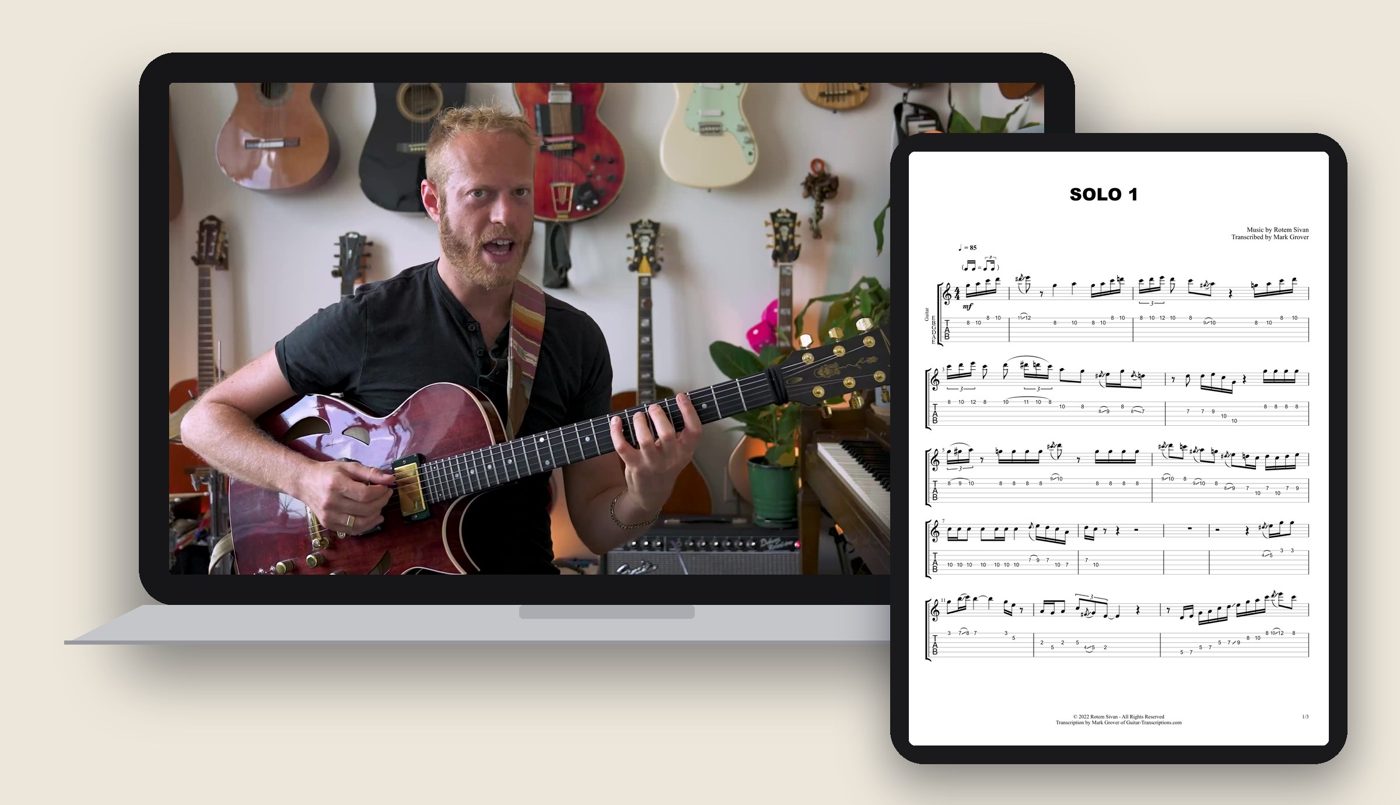
One payment of $77 · Lifetime access
Get Unlocking the Fretboard71 video lessons · 35 PDF worksheets · 30-day guarantee
- C major in 5 positions
- 7 positions, three notes per string
- A minor pentatonic, all 5 positions connected
- 8 intervals as double stops, 3rds to 10ths
- Triads and 7th chords in 5 positions
- 10 jams with backing tracks
It's not like you've never heard of the C major scale. The question is how you practiced it, how you're thinking about it, and how well you connect it to music. This course is the things I practiced, and still practice, so you can see the guitar the way you want to see it: the scale, the intervals and the chords of one key, in every position, heard and named. Then we make music with them.
Watch before you buy
Two full lessons from the course.
These are real lessons, exactly as they play in the member area.
A letter from Rotem
I remember being stuck. Not feeling at ease, not feeling free.
I know the feeling of trying to create, to be free and make music, and it can be very frustrating, because you don't see the framework. You don't see the guitar the way you want to see it.
A lot of people know the pentatonic, maybe even know the positions, and still can't really get out of the box. I understand the issue. I remember clearly being stuck, not feeling at ease, not feeling free. Even connecting the positions of the C major scale: I've practiced it quite a bit, so it's not hard now, but I remember how hard it was to see the connections.
Now, shapes work. Knowing your positions is a huge part of this, and one of the things that really helped me get out of the box was first learning the box well. But notice what happens when the shape is all you have. A lot of people tell me, "I'm practicing scales for three hours a day, or two hours a day, and nothing happens." It's not because they can't play the scale. It's that they're not making music with it.
It's almost as if you learned how to drive really well in the parking lot. You can park the car. But you don't actually go anywhere.
That's not a talent problem. Most of us were handed fingerings. Tab shows you where to put your fingers, which is good, but it doesn't tell you which note you're playing, so you don't see how it relates to the key. Run that shape up and down for a few years and you can play it fast and still not know you're on the 6th of C, or where the next E is.
For me, it took so many years to understand that even when I'm playing something technical, I'm still making music. If I'm not listening, I'm literally wasting my time.
- Every position gets three things at once: how each note sounds against C, what it's called, and where your fingers go, so you're not just running your fingers.
- Half the practice is the framework. The other half is making music with it, right away.
That's how the course is built. We start with the C major scale in five positions, then seven more three-notes-per-string shapes across the neck. Then the A minor pentatonic in all five positions, and how to connect them. Then every interval in the key, played as a double stop and sung. Then the triads and 7th chords of the key, first inside one position, then in five positions across the whole guitar. We sing it, we play it in time with a click, and most sections end with a jam where I play first and then hand it to you.
The goal is to see C all across the guitar, almost like dots of light that light up, so you can choose anything on the fretboard. When a song goes from C to F, the triads let you articulate that change in your solo, so you can tell us exactly where you are. And the intervals stop being exercises: you'll hear how bright and open a 5th is next to a 4th, or the chord hiding inside a 6th.
What it won't do. It won't happen in a weekend. I know it's a lot of information, so take one thing at a time: one position, played a bunch of times and sung, then the next one tomorrow, then mix them. It's all taught from C: the C major scale, the A minor pentatonic, and triads and 7th chords built on C. It isn't a legato course, a modes course or a song course. Legato comes up, and I tell you right in the lesson it's a big topic we won't dive into fully. This is the framework, mapped and heard, and used in jams.
I don't want you to feel locked and not free. I want you to feel free to create, and I want you to see the fingerboard so you can really use all your potential and all the musicality that you have. How does that sound?
Rotem
Look inside
One real lesson. One real worksheet.
Here's exactly what you'd be working on, taken straight from the course.
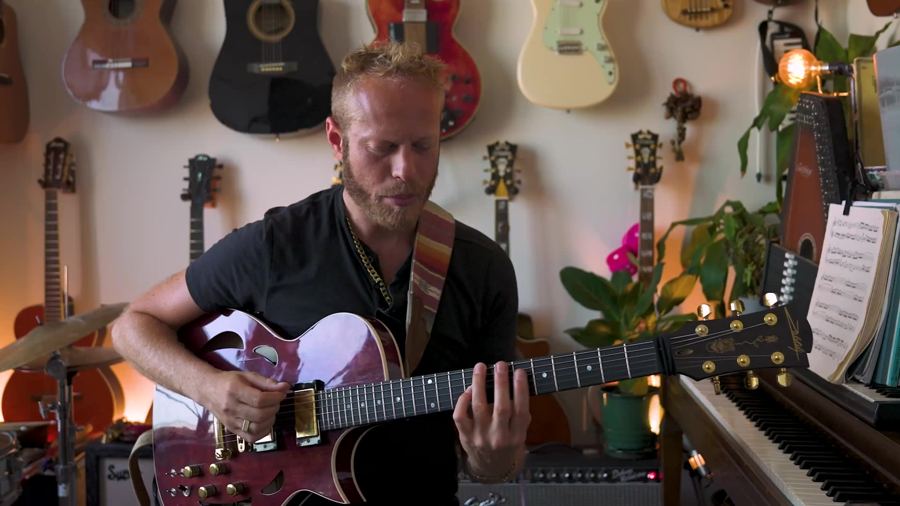
"It's like saying I live in Brooklyn"
Say the song goes from C to F. That's it. You can solo over it with the colors of the key, and that's great. I do that too. But if there's no connection between the chords and your solo, it's like telling someone "I live in Brooklyn." It's a good indication. It's not enough for us to meet up.
The triads are the geographical points. It doesn't mean all you play is triads. It means you can say exactly where you are: this is C, here's the location, and I can express it.
That's the lesson near the end of Section 9, after you've mapped C major and C minor triads in five positions, and right before you jam on C, F, C and A minor with them.
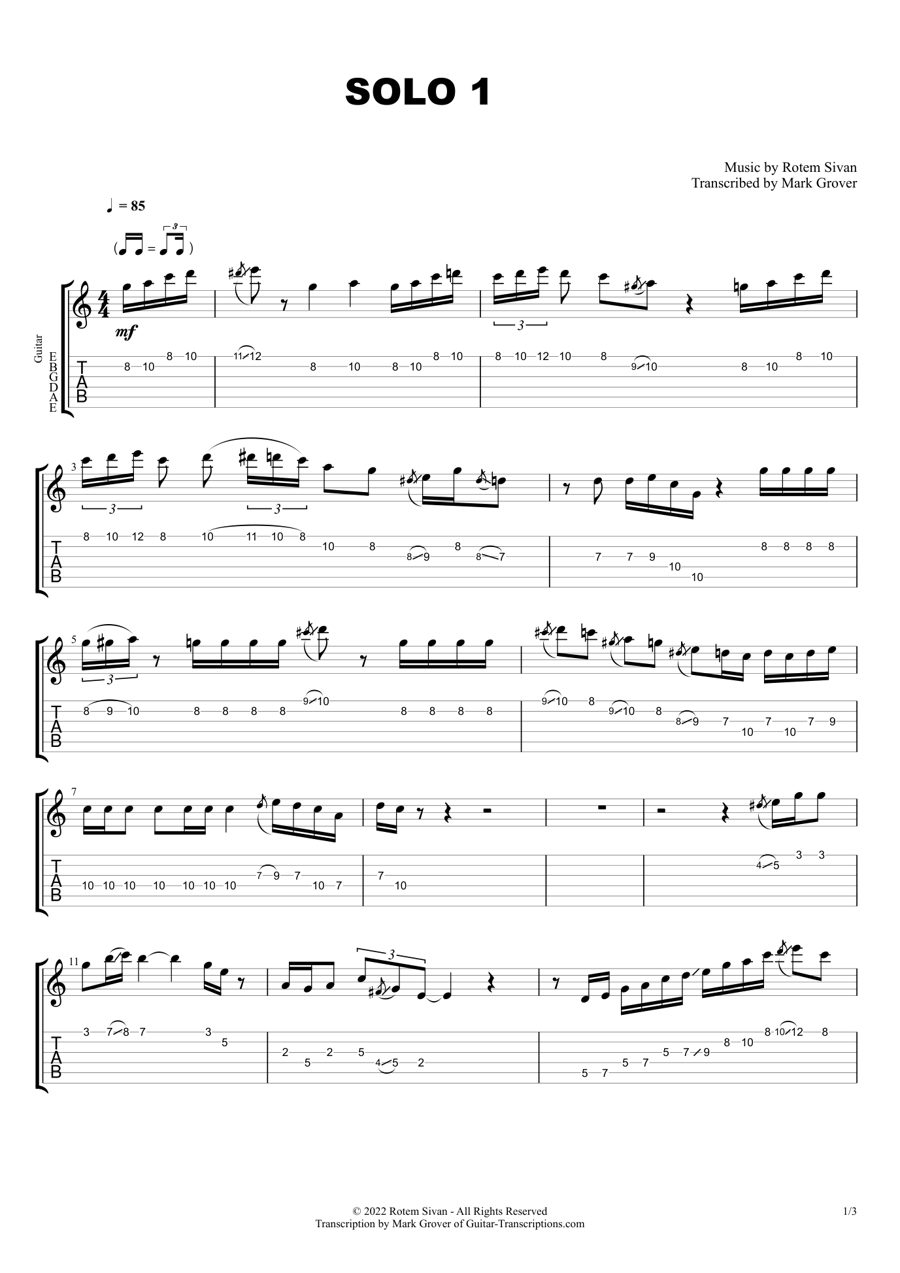
A solo, written out note for note
Page one is headed "SOLO 1", music by Rotem Sivan, transcribed by Mark Grover. The tempo is marked at 85 with a swing feel at the top, and every bar is written in notation with the tab directly underneath, so you can read the fret numbers or the notes, whichever is comfortable for you.
It sits beside the first jam, where I solo over a simple track in C using the C major scale. Each of the ten jams has a solo PDF like it, so when you hear something you like, you can find exactly where it sits on the neck.
Inside the members area
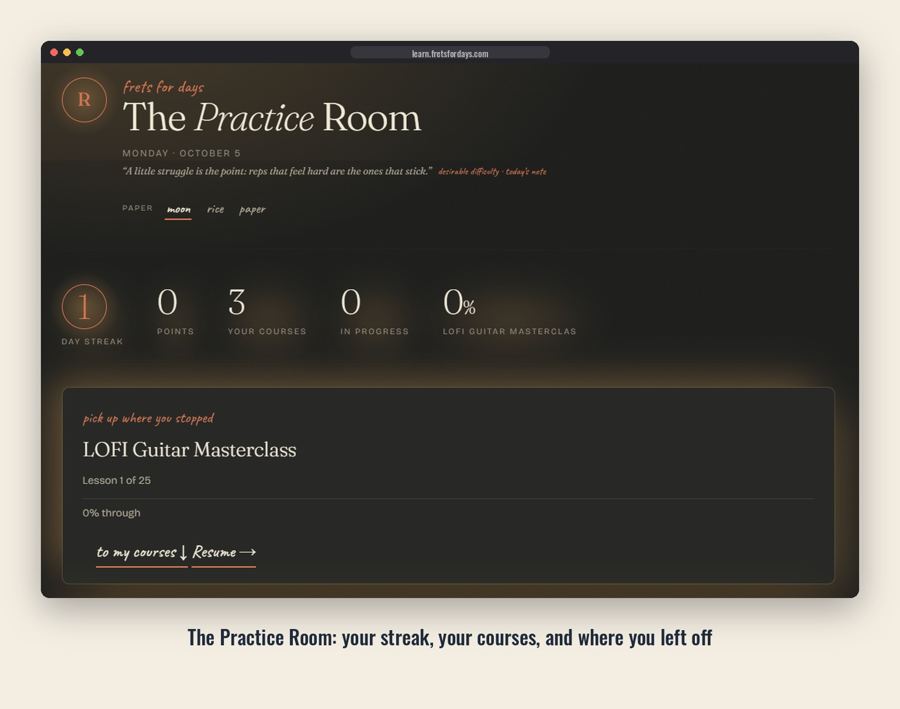
Here's what you see when you log in.
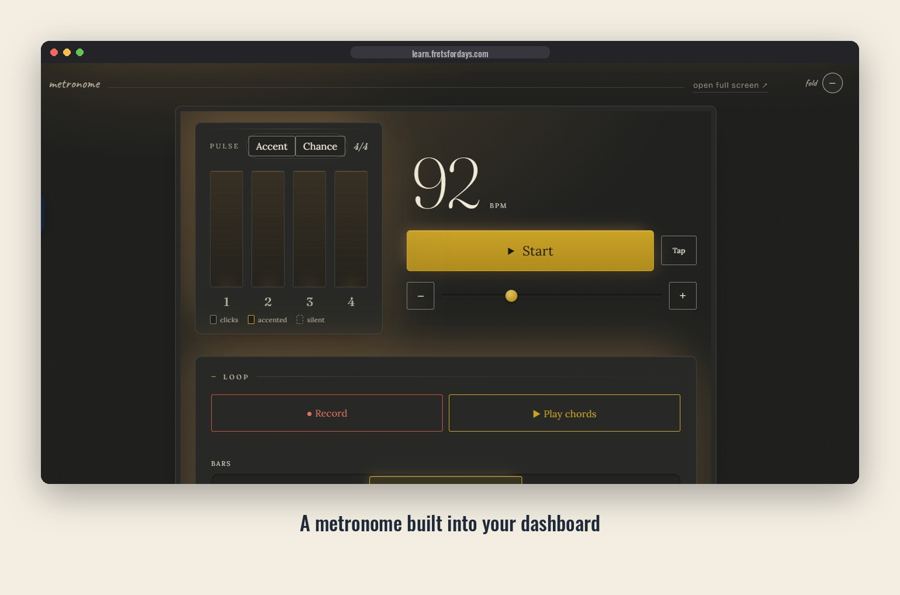
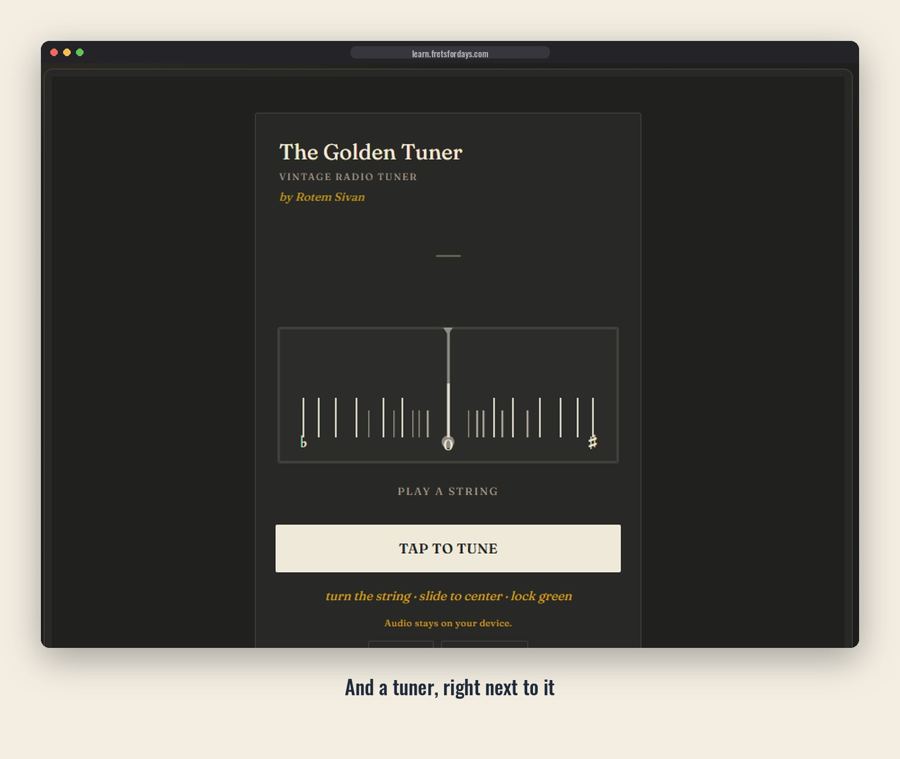
Real screens from the Frets For Days member area. The Practice Room keeps your streak and shows where you left off, and there's a metronome and a tuner right in your dashboard for all the in-time work. In some lessons, like the 7th chord positions, the notation and tab come up on screen while I play.
What's inside
71 lessons, section by section.
Every position, interval and chord below is something I play or explain on camera. Many lessons are several short videos, one per position or exercise.
Welcome + 1 Five important tips before we start
- The question I ask in the first video. Not whether you know the C major scale, but how you practiced it, and how well you connect it to music.
- Believe: why even five percent better a year is huge, because a lot of us will play music for years.
- Slow it down. "One of my biggest mistakes when I started working on music was trying to do everything faster." Everything that's happening when you play one simple triad, and the difference between testing yourself and practicing.
- Colors: the sound of each note against the center (watch it above).
- Time: feeling the click as a groove you connect to, "not this thing that is clicking in the background."
- Playful: the parking-lot problem, and the split I use between framework and making music.
2 Basic theory you need
- What the C major scale really is. A sound first, then the half steps and whole steps, and the one formula that gives you F major too.
- Triads as 1-3-5, the four triad colors (major, minor, diminished, augmented), and what each note of the chord tells you.
- The chords of C major as numbers, so "1 to 6" means the same sound in any key.
- 7th chords in C as shell chords, and the four main colors: Cmaj7, C7, Cm7 and C diminished.
- Basic rhythm: 4/4, notes and rests, and the upbeat a lot of people don't feel completely at home with.
- Tab and notation: what tab leaves out, how to read the key, time signature and clef, and why everything in this course is written in both.
- Sing it. "You don't need to be an opera singer." Why I started taking vocal lessons, and why singing along in the shower counts.
- Tension and release, harmonic, melodic and rhythmic.
3 The C major scale in 5 positions
- The three things you keep in mind in every position: the sound, the name of the note (letters or solfège, both are fine) and where your fingers go.
- All five positions, with the fingerings I use. There's no one best fingering: "every variation is acceptable, the question is when, why and what."
- Holding a C while you play the scale up and down, so you hear what every note does against it. "You're going to meet E a lot of times."
- The sound exercise: exploring notes over a held C out of time, then singing lines with the guitar down.
- Quarter notes, eighths, triplets and sixteenths at 60, one position at a time. If it's hard, how to take it one step back to a single note.
- Connecting the positions in time, and shifting in the places that feel "like a black hole."
- Jam 1: one position, C major only, then your turn (watch it above). Plus the solo written out.
4 7 positions of the C major scale
- C major three notes per string, seven positions from the 5th string, then seven from the 6th string, starting from the lowest F you can play without open strings.
- What a second system gives you: another way to see the same scale, and lines that travel up the neck physically.
- The "extension": the same 5th-string fingering with one more string below it.
- Alternate picking against legato, the very different sound of each, and why I practice both, slowly, with a click.
- Listening for dynamics and balanced notes, the way you'd whisper or raise your voice in a conversation.
- One at a time: one shape today, the next tomorrow, then mix them.
- Jam 2: soloing with the three-notes-per-string shapes.
5 A minor pentatonic
- "A lot of us feel like, you know, we got it. But really, do you really know it?"
- Singing la, do, re, mi, sol before you play, then soloing with your voice only.
- All five positions at 60 with subdivisions, and why I stop to breathe even on simple exercises.
- Pentatonic three notes per string, with the doubled notes and the legato sound that comes with them, and how I handle the stretches so my hand doesn't get tired.
- Connecting the five positions with your own rules, like sliding across a group of two or three strings.
- Get out of the box: the mini exercises you invent to move between positions.
- Eighth notes through all five positions, switching where it's slightly uncomfortable on purpose.
- Five lines, in the PDF: the blue note, a triplet line that lands on beat one with a low A, a line on one string that reminds me of a slide. And how to change one note of a line to make it yours.
- Jam 3.
6 Double stops and intervals
- Every interval in C as a double stop, singing the bass note: 3rds, 4ths, 5ths, 6ths, 7ths, octaves, 9ths and 10ths. Then each one melodically, ascending, descending and both ways, in time.
- The one 4th in the key that's actually a tritone, and where it comes from.
- 5ths against 4ths. "For a long time, I remember having a hard time distinguishing when I started playing guitar between the fifth and the fourth." The sound difference that helped me.
- 6ths as incomplete chords: hearing F major, A minor and B diminished inside two notes. And why singing the bottom note is sometimes even more important than the top.
- 7ths and 9ths, the harsh ones, and how I like to throw in a 9th "even when it doesn't really fit."
- Octaves two ways, so you can stay in position, and why they're not as easy as people think.
- 10ths: a 3rd an octave apart. "You can really hear the chord."
- Do all of it in every position, not just the one I show.
- Three jams: one on 3rds, one after the 5ths, and one using all the intervals.
7 Triads in position
- Every triad in C (C, Dm, Em, F, G, Am, B diminished) as 1-3-5 inside the first position, ascending and descending.
- "It's not about a competition with yourself."
- Variations on the same idea: soft, loud, legato, short and staccato.
- Jam 7, and an afterthought on what I actually played: C major scale ideas, a little C major pentatonic, and triads in different areas of the guitar.
8 7th chords in position
- The move at the end of the last solo that spelled out a Cmaj7, and the next step from triads to 7th chords.
- 1-3-5-7 for every chord in C, Cmaj7 through B half-diminished, in one position, with the fingering I use so it stays flexible.
- A breathing pattern I use while I play these.
- Jam 8: hitting more and more chord tones so you can hear the Cmaj7, the G7 and the Am7 in the solo.
9 Triads in 5 positions
- Why this section matters so much: you map the chords all across the guitar, not only in positions, hearing them and seeing them everywhere.
- C major triads in five positions, with the fingering choices I make and the ones I avoid.
- The three-octave arpeggio. "I remember listening to all these piano players play all these big arpeggios and I was kind of jealous always."
- C minor in the same five positions: instead of E natural, E flat, a half step down.
- Closed triads, root position and first and second inversion, in the same areas of the neck.
- Why triads (the full lesson is in "Look inside" above).
- Jam 9 on C, F, C and A minor, first with triads only, then mixing in the C major scale.
10 7th chords in 5 positions
- The four main colors, Cmaj7, C7, Cm7 and Cm7b5, each in five positions, built on the triad shapes you already know.
- Moving a shape to another root, like Ebmaj7, once the fingerings are clear.
- Minor 7. "I remember how confused I was when I started practicing them. They all look the same."
- The half-diminished, maybe the least known color, and a trick with it: play E half-diminished over C7 and you get the 9. "I remember wrestling with it quite a bit, but it's really worth your time."
- Jam 10, and a closing word from me.
The curriculum
Every lesson, in order.
All 71 lessons, section by section. Tap a section to open it.
WelcomeWelcome to this course1 lesson
- 01Hiya
Section 1Five important tips before we start6 lessons
- 02Introduction
- 03Tip 1: Believe
- 04Tip 2: Slow, chill
- 05Tip 3: Colors (watch it above)
- 06Tip 4: Time, rhythm
- 07Tip 5: Playful
Section 2Basic theory you need8 lessons
- 08Introduction
- 09What is the C major scale
- 10Triads
- 11What are 7th chords
- 12Basic rhythm
- 13Tab notation
- 14Sing it
- 15Tension and release
Section 3The C major scale in 5 positions5 lessons
- 16Introduction
- 17C major scale, 5 positions
- 18Sound exercise
- 19In time with subdivisions (play-along)
- 20Jam: solo 1 (watch it above)
Section 47 positions of the C major scale6 lessons
- 217 positions from the 5th string
- 225th to 6th string
- 237 positions from the 6th string
- 24Legato
- 25One at a time
- 26Jam: solo 2
Section 5A minor pentatonic9 lessons
- 27How to learn the pentatonic
- 285 positions
- 293 notes per string
- 303 notes per string, subdivisions 1 to 4
- 31Connecting the 5 positions
- 32Get out of the box
- 338th notes
- 345 lines
- 35Jam: solo 3
Section 6Double stops and intervals13 lessons
- 36Introduction
- 373rds
- 38Jam: solo 4
- 394ths
- 405ths
- 41Jam: solo 5
- 426ths
- 437ths
- 44Octaves
- 45Some practice tips
- 469ths
- 4710ths
- 48Jam: solo 6
Section 7Triads in position5 lessons
- 49Introduction
- 501-3-5 ascending and descending
- 51Take your time
- 521-3-5 variations
- 53Jam: solo 7
Section 87th chords in position4 lessons
- 54Introduction
- 551-3-5-7 ascending and descending
- 561-3-5-7 variations
- 57Jam: solo 8
Section 9Triads in 5 positions6 lessons
- 58Introduction
- 59Major
- 60Closed triads
- 61Minor
- 62Why triads
- 63Jam: solo 9
Section 107th chords in 5 positions7 lessons
- 64Introduction
- 65Major 7th
- 66Dominant 7th
- 67Minor 7th
- 68m7b5
- 69Cool trick with m7b5
- 70Jam: solo 10
ClosingCongratulations1 lesson
- 71Thanks
Five positions. Every interval. Every chord in the key. Then ten jams.
One payment · Lifetime access · 30-day guarantee
Who it's for
Built for the player who knows the shapes and wants to see the whole neck.
Read both lists. If the second one sounds like you, save your money.
This is for you if...
- You know the pentatonic in one or two spots and freeze when you leave them.
- You've run scale fingerings up and down for years and couldn't name the note you're on.
- You can sing a line you like but have a hard time finding it on the neck.
- You want scales, intervals and chords of one key on the same map, played in time with a click.
- You're willing to sing quietly while you practice. You don't need to be an opera singer.
This isn't for you if...
- You want songs, or a blues course in A. It's all taught from C, with A minor for the pentatonic.
- You want licks to copy. There are five short lines and ten written-out solos, and they're there for you to change.
- You want a legato or speed course. Legato comes up, but it isn't the focus.
- You want it all in a weekend. I ask you to take one position at a time.
The offer
One payment. $77. Yours for life.
Unlocking the Fretboard is $77, once. You get all 71 lessons, every PDF worksheet and every jam track in your Frets For Days member area, and they stay there.
One payment · Lifetime access · 30-day guarantee

About your teacher
I'm Rotem Sivan.
I'm a jazz guitarist and educator in New York. I'm from Israel, and I studied at The New School.
I'm not telling you that to impress you. Before any of it, I was stuck in the box too, and I remember how hard it was to see the connections on the neck. This course goes in the order I practice it: hear it, name it, know where your fingers go, play it in time, and make music with it.
Rotem
FAQ
Questions before you buy.
What's the format?
71 video lessons: a welcome, Sections 1 to 10 and a closing word. Many lessons are several short videos, one per position or exercise. There are 35 PDF worksheets, and ten jam lessons with a backing track. Everything lives in your Frets For Days member area, and you watch at your own pace.
What level is it for?
You should already play a little and be able to keep time with a click. Section 2 covers the basic theory you need: the C major scale, triads, 7th chords, rhythm, tab and notation. Some of you will know it and some of you will need a refresher. Either way, it's there so nothing later is a guess.
Do I need to read music?
No. Everything in the course is written in notation and tab, and you're free to use whichever is comfortable for you. I explain the notes with letters, numbers and solfège.
How much time per week will it take?
Most videos are under two minutes. The practice is what takes time, and there's no schedule to keep up with. I suggest one position at a time: play it a bunch of times, sing it, then do the next one tomorrow.
How long do I have access?
For life. One payment, and the course stays in your member area.
What if it isn't for me?
There's a 30-day guarantee. Work through it, and if it isn't right for you, email [email protected] within 30 days for a refund.
Stop just running your fingers. See the whole neck, and make music with it.
Nobody handed you the map. You got fingerings. The map is here now, one position at a time, heard and named, and you can take your time with it.
$77 one time · 71 lessons · 35 PDF worksheets · lifetime access
Get Unlocking the Fretboard: $77P.S. Here's a test you can run tonight. Play the C major scale in the one position you know best. Now play it again, slowly, while you sing and hold a C, and name every note out loud as you go: this is D, this is how it sounds against C, this is E. If you lost track of the names halfway up, or the notes stopped meaning anything against the C, that's the gap. The course closes it in five positions, then seven, then with the pentatonic, the intervals and the chords.
Hugs,
Rotem