For guitarists who've played songs for years without really knowing what they were playing
Turn a progression that sounds like a million songs into a guitar part that sounds like yours, with the major and minor chords you already play.
Every chord in C major in root position, first and second inversion, closed and open, all across the neck. Then we take four real progressions and try different inversions on them until they start sounding like your song.
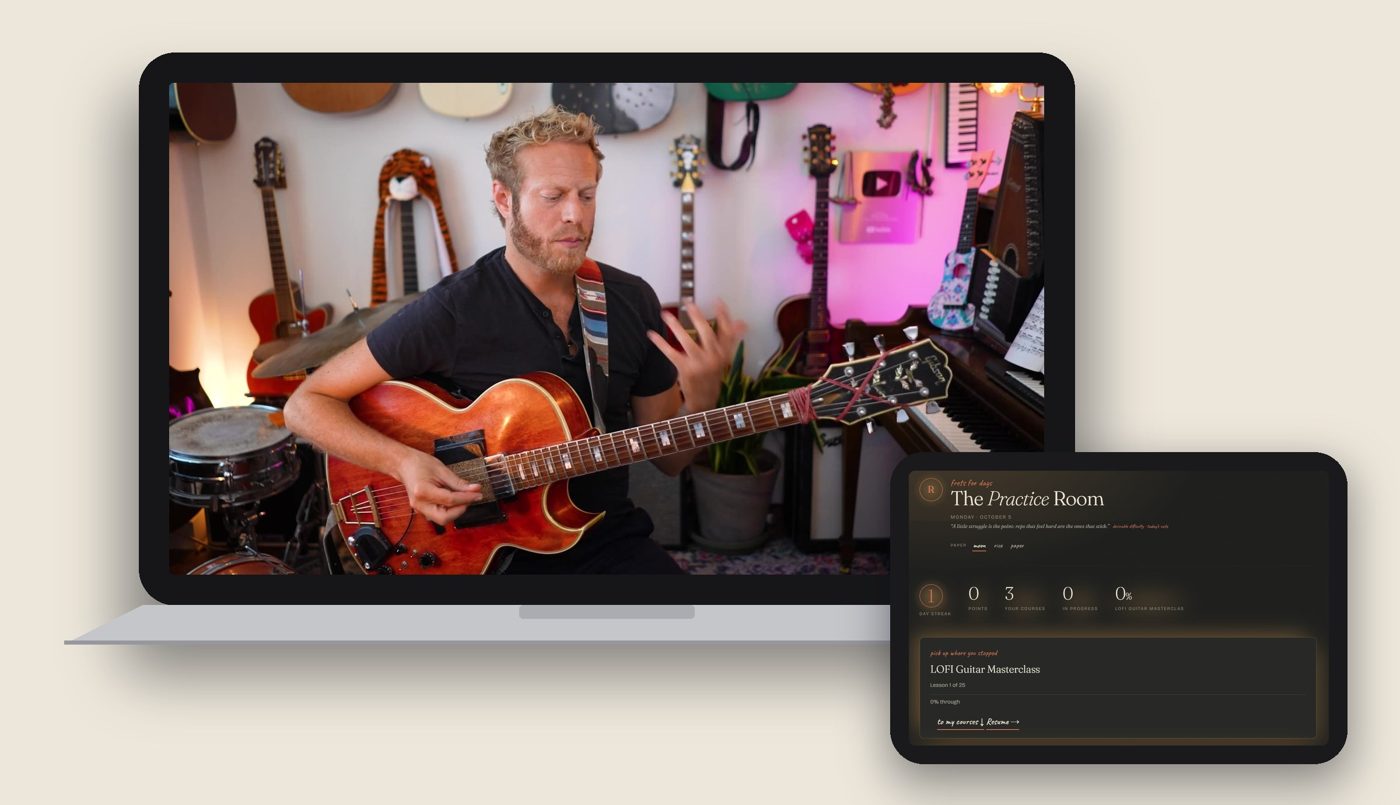
One payment of $47 · Lifetime access
Get The Inversions Course28 video lessons · PDF worksheets with 25 of them · 30-day guarantee
- Root, first and second inversion, named by the bass
- C major and C minor through each area of the neck
- All seven chords of C major, B diminished included
- Open triads from the 6th, 5th and 4th strings
- In time, humming the bass
- Four real progressions, rearranged
I remember very clearly trying to play a Bach piece from the violin sonatas and not being able to see the chord. I was playing guitar, and I couldn't see a G minor chord. So I paused and mapped the triads. This course does that with you: the chords of C major in every inversion, one area of the neck at a time, until you can see them. Then we make music with them.
Watch before you buy
Two full lessons from the course.
These are real lessons, exactly as they play in the member area. Most of the playing is filmed close up on the neck, so you can see every shape.
A letter from Rotem
I was playing guitar, and I couldn't see a G minor chord.
I remember very clearly trying to play this Bach piece. It's from the violin sonatas. I was trying to see one chord and play it, and I couldn't see it. I didn't understand where the notes were. It was hard for me to understand the triad.
Then I said to myself, okay: if I look at a piano, and I'm not a piano player, I can still play triads better than I play them on guitar, because it's so clear.
So I paused, and I mapped the triads. That was very big for me, because I started seeing the guitar not as shapes in locked positions, but rather, okay, it's music.
Now, shapes work. I use shapes. You probably know a lot of the shapes in this course already, and you never thought about them this way. That's the trap. You know a grip for C, a grip for A minor, a barre chord for F, and every song gets the same grips.
There's a default a lot of us agree to: oh, I know four chords, and that's it. That's a limitation. Take A minor, F, E minor and C. Play them as plain chords and there's nothing wrong with it. It sounds okay. It also sounds like a million songs, because it's everybody's version.
That's not a talent problem. Oftentimes when people play guitar, understanding what they're playing is one of the parts they skip. Most of us never stop to say which note is in the bass, what that chord is in the key, or what happens if you move one note.
- The bass tells you the inversion. C in the bass is C major in root position, E is first inversion, G is second, however the other notes are laid out above it.
- See every chord in the key that way, all across the neck, and a progression stops being four grips. It becomes a set of choices.
That's how the course is built. First the framework: C major and C minor in root position, first and second inversion, mapped onto the scale positions, one area of the neck at a time. Then every chord in the key, B diminished included, in each inversion. We sing the bass. We say the degrees out loud: this is the 1, this is the 2, this is how it feels. We play it in time with a metronome.
Then the open triads, which are one of my favorite colors ever on the instrument, from the 6th, 5th and 4th strings in major and minor.
And then we make music, because that's the meaning of the whole course. We take four chord progressions and change the inversions. One chord in first inversion here, another in second there. You'll hear the inversions give you melodic options on top of the same chords. You'll go from one chord to the next with two notes keeping their place. You'll try a secondary dominant and hear it lead somewhere. And you'll start asking, how would this song sound if I played only first inversions?
It also changes what you see when you solo. When you're soloing and playing melodies, the relationship between the chords and the melody is very, very tight knit, and the triads are the most essential notes in the chord.
What it won't do. It won't happen in a weekend. I'll be honest: if you work on these things for a couple of minutes a day for a few weeks, you'll start seeing the guitar way, way, way better. That's the real time frame. It also isn't a 7th-chord course. Everything here is a three-note triad, major, minor and diminished, in the key of C (the open triads start on G). It doesn't teach you songs, and it's not about playing with a band. It's you, the guitar and the chords, until you can choose them on purpose.
You won't always be happy with what you try. Sometimes it won't sound exactly like you want. That's fine. That process of exploring and trying to find the sound in your head will teach you a lot about music and guitar. And this is really the fun of it.
Rotem
Look inside
Two real lessons, up close.
Here's exactly what you'd be working on, taken straight from the course.
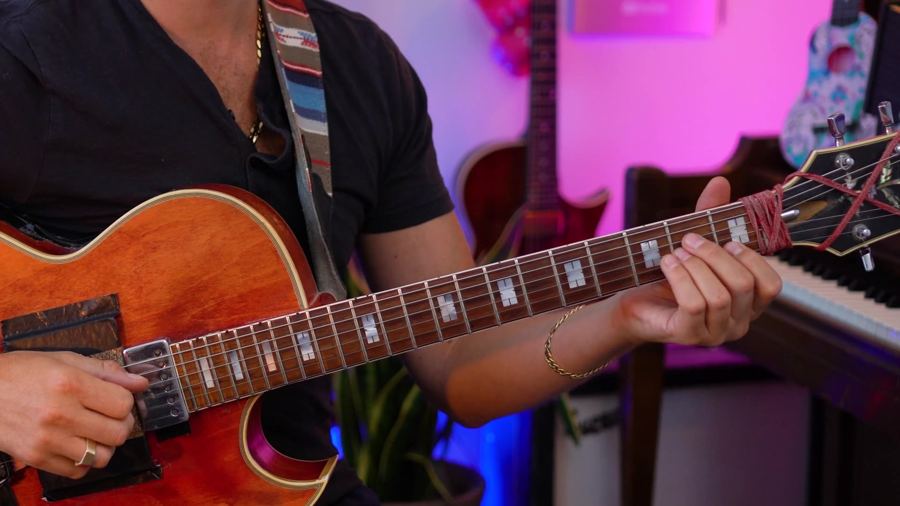
A shape you know, with a name you didn't
Second inversion means the 5 is in the bass. For C major that's G, C, E. We keep that going through the key: D minor with A in the bass, E minor with B, F with C, G with D.
Then A minor. I have a strong feeling you know this shape. People play it with the open string. Without the open A, it's A minor in second inversion. Add the open A and it's root position. Then B diminished, the 7th degree, with its 5 in the bass.
This might take a minute, because it's all new stuff, and that's not a problem. Make sure you know the degrees in the key, the colors (major, then minor) and the notes, and the process gets way, way easier.
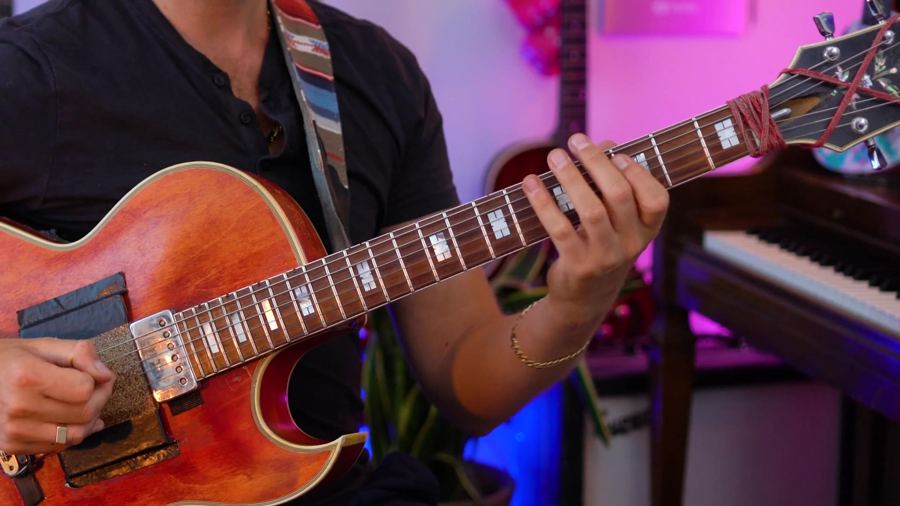
Trying options until it sounds right
C major, then B major, which is the 5 of 3: a secondary dominant, a chord that's not in the key but leads us somewhere. Then E minor to F.
I try F in second inversion. I don't like the F at all, so I go to F in root position. Much better. What if it's F minor instead? It's a little harsh. What if I go back to C before the F minor? Not crazy about it, but it's possible.
That's the lesson. I'm adjusting things until I'm happy with the sound, out loud, on camera. You're not always going to be happy with it, and the exploring is where you learn.
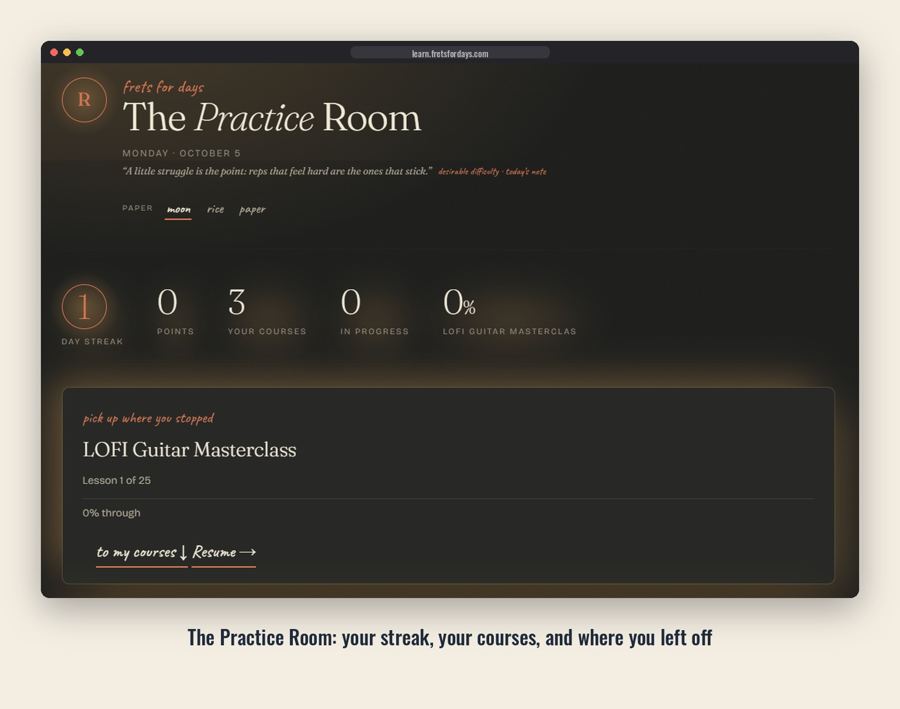
Inside the members area
Here's what you see when you log in.
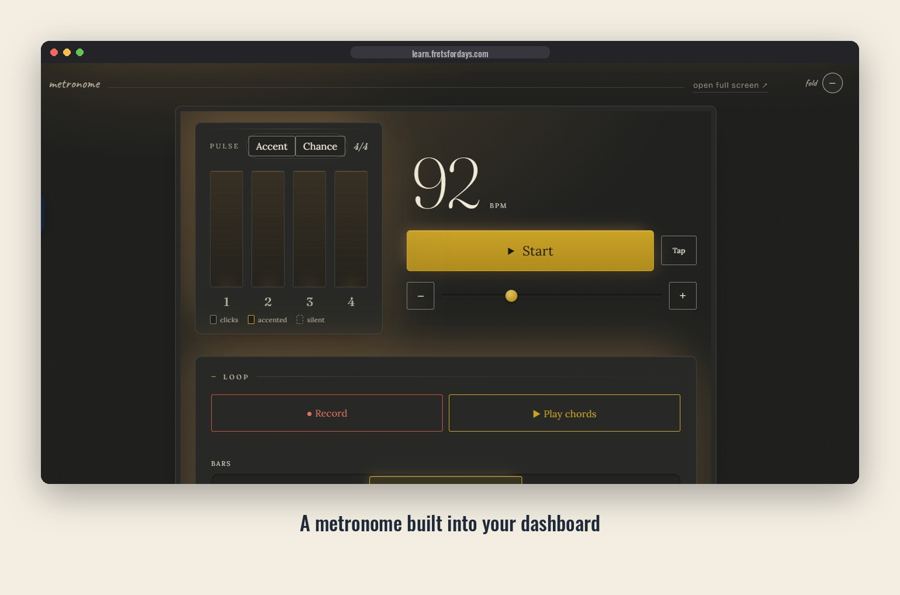
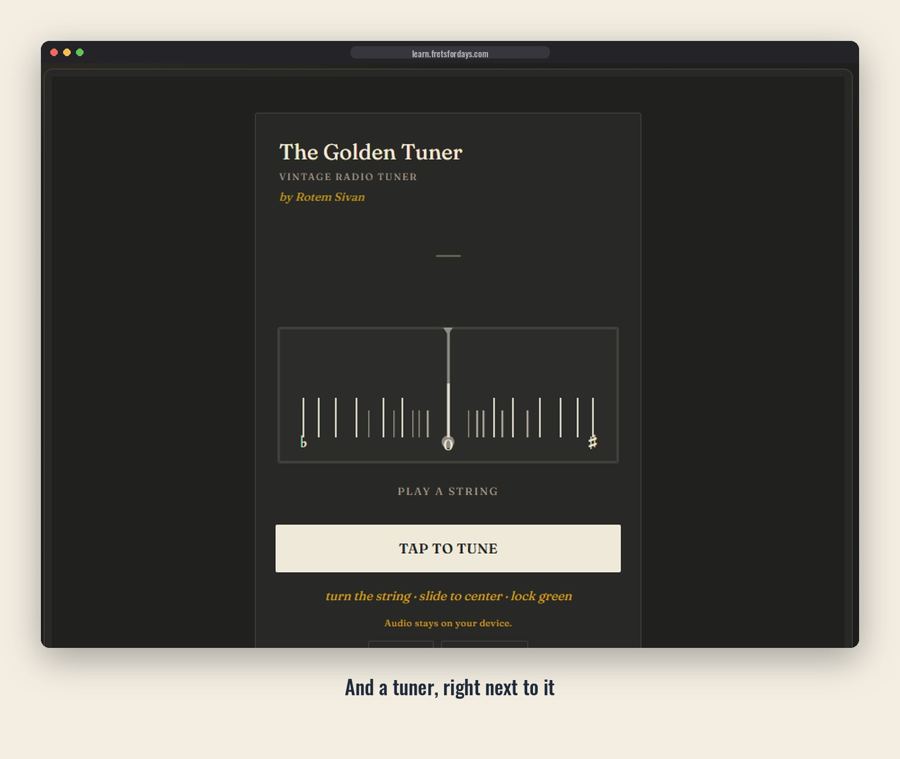
Real screens from the Frets For Days member area. The Practice Room keeps your streak and shows where you left off, and there's a metronome and a tuner right in your dashboard, so the click for the in-time lessons is one tap away.
What's inside
28 lessons, section by section.
Every chord, shape and move below is something I play or explain on camera.
1 Know the basics
- What inversions let you do with a chord besides play it as a chord. (It's the reason soloists need them too.)
- What a triad is, in note names you can say out loud, and the one note you lower a half step to turn major into minor.
- Why a big C major chord shape is really only three notes, with a lot of doubles.
- Root position, first inversion and second inversion as numbers: 1-3-5, 3-5-1, 5-1-3.
- The one note that tells you which inversion you're playing, even when the chord is spread out, has an open string in it, or is only two notes.
- The chords of C major, played one at a time while I sing the root, and why I want you to feel each one "on an emotional level so I can tag it and therefore hear it in the real world."
- The part of guitar most people skip. (It's the part that makes the rest go quickly.)
- "Take it slow." How slow I mean, and why it doesn't have to be everything at once.
2 The framework: closed position
- C major in every inversion, attached to the positions of the C major scale, so each area of the neck has its own set.
- The lowest place you can play C major on the guitar, and which inversion it turns out to be.
- "You probably know some of these shapes, but you never thought about it this kind of way."
- The area built around the barre chord shape you already know, and the inversions you play in it.
- Why five areas turn out to be more like four.
- C minor through the same areas, using the C minor scale positions as the template.
- Singing the bass: "I'm really, really a big supporter of singing what you're doing as much as possible."
3 Closed triads in the key, part 1
- All seven chords of C major in root position, ascending and descending in one area, humming the bass as you go.
- B diminished: 1, b3, b5, and the shape that goes with it.
- Every chord in first inversion, starting from the lowest one the guitar allows: D minor with F in the bass and two open strings.
- Every chord in second inversion, the 5 in the bass.
- The open A minor chord almost everybody plays, and what it really is without the open A string.
- The F and G shapes you probably already know, and the inversion they belong to.
4 Closed triads in the key, part 2
- Root, first and second inversion through the key in the next areas up, thinking of the C major scale in each one.
- The common barre chord that turns out to be one of these shapes plus the bass.
- B diminished again: "really beautiful, very harsh."
- What to do when it gets confusing. "You pause... and understand what is not clear."
- "There's no one way to do these things." Choosing where to shift on your own.
5 Closed triads in the key, part 3
- One more area of the neck, saying the numbers and the letters together: it's not just C, it's the 1.
- Why knowing the function helps the same relationships feel familiar in other keys.
- How long it really takes, in minutes a day and weeks.
- Practicing in time with a metronome, giving yourself one rule (first inversions only, through the key) and singing the bass while you play it.
- What even a slow click does to how fast you learn.
6 Open triads
- What makes a triad closed or open, and the 1-5-3 layout that makes it sound so good on guitar (the full lesson is in "Watch before you buy" above).
- G major in root position, first and second inversion from the 6th, 5th and 4th strings, naming every note.
- Why I keep the same string sets, and what it lets your picking hand do.
- Seeing each shape around the notes it holds, so you're not guessing shapes.
- Playing them in time, in order of inversion: root, first, second, switching string sets to get there.
- G minor from the same three string sets, by changing one note.
- The stretchy first inversion: how I use the thumb and the elbow to loosen it, and an easier fingering when you're only playing one chord.
- Optional fingerings for major and minor: the same notes, ordered on different strings.
7 C major scale open chord ideas
- Every chord in C major as an open triad, root, first, second and back, B diminished included.
- Two inversions per chord, and the point where it starts getting into the realm of music.
- What to do when a song sits on one chord for a while.
- Ascend one chord, descend the next: the variation that makes you see it better.
- One pair of shapes, first inversion to root position, moved around the neck: B major to C, A major to D. "Sounds almost random, but actually you can find really cool sounds."
8 Making music
- 4-1-6-5 (F, C, A minor, G) as barre chords, then with inversions: which two chords I change first, and what happens to the line on top.
- The same progression in another area of the neck, and the move where one note changes and two keep their place.
- "How would this song be if I play only first inversion?" A question to ask about any song you know.
- Why this matters "as a singer, songwriter, as a creator."
- 6-4-3-1 (A minor, F, E minor, C) turned into a little loop of your own (the full lesson is in "Watch before you buy" above).
- A secondary dominant, C to E major to A minor, played with triads and inversions instead of the usual grips.
- C, B major, E minor, F: trying options out loud, keeping some and throwing some away (more in "Look inside" above).
The curriculum
Every lesson, in order.
All 28 lessons, section by section. Tap a section to open it.
IntroductionWelcome1 lesson
- 01Introduction
Section 1Know the basics6 lessons
- 02Why inversions
- 03What are triads
- 04What are inversions
- 05How we define the right inversion
- 06Know the scale chords
- 07Slow it down
Section 2The framework: closed position3 lessons
- 081st position, closed major 1-3-5
- 09Positions 2 to 5, closed major 1-3-5
- 10C minor 1-3-5, all positions
Section 3Closed triads in the key, part 13 lessons
- 11C major key, root position
- 12C major key, 1st inversion
- 13C major key, 2nd inversion
Section 4Closed triads in the key, part 21 lesson
- 14Root position, 1st and 2nd inversion
Section 5Closed triads in the key, part 32 lessons
- 15Root position, 1st and 2nd inversion
- 16Practice in time
Section 6Open triads5 lessons
- 17What's the sound (watch it above)
- 18G major: 6th, 5th and 4th string shapes
- 19Practice in time
- 20G minor: 6th, 5th and 4th string shapes
- 21Optional fingerings for major and minor
Section 7C major scale open chord ideas2 lessons
- 22Variation 1
- 23Variation 2
Section 8Making music4 lessons
- 24Progression 1
- 25Progression 2 (watch it above)
- 26Progression 3
- 27Progression 4
ClosingThank you1 lesson
- 28Thank you
Seven chords. Every inversion. Then four progressions that sound like yours.
One payment · Lifetime access · 30-day guarantee
Who it's for
Built for the player who knows the chords and only one way to play each.
Read both lists. If the second one sounds like you, save your money.
This is for you if...
- You know your open and barre chords, and you couldn't say which note is in the bass of most of them.
- You play A minor, F, E minor, C and it sounds like everybody's version.
- You write songs, or want to, and want a guitar part that's yours.
- You solo and want to see the chord tones under your lines.
- You're willing to hum the bass note while you practice. Humming is plenty.
This isn't for you if...
- You're still learning your first chords.
- You want 7th chords and extensions. This course is triads.
- You want to learn specific songs, or to comp with a band. This is you and the guitar.
- You want it all this week. There's a whole lesson asking you to slow down.
The offer
One payment. $47. Yours for life.
The Inversions Course is $47, once. You get all 28 lessons, and the PDF worksheets that come with 25 of them, in your Frets For Days member area, and they stay there.
One payment · Lifetime access · 30-day guarantee

About your teacher
I'm Rotem Sivan.
I'm a jazz guitarist and educator in New York. I'm from Israel, and I studied at The New School.
I'm not telling you that to impress you. I'm telling you because I was once the guitar player who couldn't see a G minor chord in a Bach piece. Mapping the triads is what changed that for me, and this course maps them with you: understand the triad, hear it, map it across the neck, then make music with it.
Rotem
FAQ
Questions before you buy.
What's the format?
28 video lessons: an introduction, Sections 1 to 8 and a thank-you. 25 of the lessons come with a PDF worksheet. Everything lives in your Frets For Days member area, and you watch at your own pace.
What level is it for?
Intermediate. You should know your basic chords. Section 1 covers what triads and inversions are, so for some of you it'll be a refresher and for some of you it'll be new. It helps to know the C major scale in a few positions, because the shapes are mapped onto it.
Do I need to read music?
No. In the videos I name the notes and the numbers as I play (C, E, G; 1-3-5), and most of the playing is filmed close up on the neck, so you can see every shape.
How much time per week will it take?
Most of the videos are under three minutes. The practice is the part that takes time. I'll be honest: a couple of minutes a day for a few weeks, and you'll start seeing the guitar way, way better. There's no schedule to keep up with.
How long do I have access?
For life. One payment, and the course stays in your member area.
What if it isn't for me?
There's a 30-day guarantee. Work through it, and if it isn't right for you, email [email protected] within 30 days for a refund.
Stop playing the default. Choose the sound.
The chords you already play have more than one shape each. Here they are, every inversion, one area of the neck at a time, and then four progressions to make your own.
$47 one time · 28 lessons · PDF worksheets with 25 of them · lifetime access
Get The Inversions Course: $47P.S. Here's a test you can run tonight. Play the open A minor chord you've played a thousand times. Now play it again without the open A string. What's in the bass? It's E, the 5. That's A minor in second inversion. Add the open A back and it's root position. Hum the bass of each one and listen. That's one chord in the key. The course does it for all seven, all across the neck.
Hugs,
Rotem