For guitarists who can play a G minor chord but couldn't point to every G, B flat and D on the neck
Play lines that sound like the chord, from three notes you can find all over the neck.
Major and minor triads in three octaves from the 6th string and two from the 5th, permutations, every triad in the key, five positions in C and open triads. Then a 12-bar blues in A, played with triads.
One payment of $47 · Lifetime access
Get the Triads Workshop25 video lessons · PDF worksheets with the lessons · 30-day guarantee
- G major and minor in three octaves
- C major and minor from the 5th string
- Permutations of 1-3-5
- Every triad in G and C, changing direction
- C major triads in five positions
- Open triads on three string sets
In high school I learned songs by memorizing the chords, C minor, G minor, C7, without really understanding what was happening there. So I didn't hear them as much, and I couldn't play the songs in different keys, or maybe I could, but very slowly. This workshop does the opposite: one triad, mapped from one note, then moved around the neck, one short video at a time. Near the end we take it to a blues in A.
Watch before you buy
Two full lessons from the course.
These are real lessons, exactly as they play in the member area, filmed close up so you can see both hands.
A letter from Rotem
I memorized the chords. I didn't understand what was happening in them.
I remember learning songs on guitar by trying to memorize these long sequences of chords. And I was very frustrated, because I just didn't get it. Wow, this is a lot of chords. How can I remember it?
In high school, I just memorized them. C minor, G minor, C7.
And because I didn't understand it, I didn't hear it as much. I couldn't play the song in different keys. Or maybe I could, but very slowly.
Now, memorizing works. You can get through a whole song that way. But notice what it gives you: a list of grips, each chord one shape in one place. Ask for the same chord somewhere else on the neck, or a half step down, or in another key, and the list can't help you.
That's what I mean by memorized chords, and here's what it costs you. You know G minor as a grip. You don't know where every G, B flat and D is on the neck, so you can't find that chord anywhere but the one place you memorized it.
It isn't that you never learned triads. A lot of us have played them before, and that doesn't mean we really hear the notes. I say it in the second lesson: if you're here, it means you want to solo and open up the fingerboard as much as possible, and triads and arpeggios are a really, really helpful way to do it.
So this workshop does the opposite of memorizing a list. We take one triad from one note and map it. "I have this note G, and I map the board." Then the note C. Then we start moving it across the neck, using the 6th and 5th strings as points of reference.
- A triad is three notes, 1-3-5, and a lot of lines, even the ones with chromatic notes in them, really go around those three notes.
- Map them from one starting note, then move them around the neck, and you stop guessing where the chord is.
Lesson 1 is G major and G minor from the 6th string, three octaves, in quarter notes, eighth notes, triplets and sixteenths, while I tell myself G, B flat, D the whole time. Then C major and C minor from the 5th string. Then permutations, every triad in the key with the direction changing, triads moving by half steps, whole steps, minor thirds and around the cycle of fourths, and C major triads in five positions.
Then we make music with it. I take a 12-bar blues in A and play just triads, eighth notes. Then I start adding notes that lead into them, and it turns into a line. Then open triads, 1-5-3, an arrangement of the chord that sounds really cool on guitar, from the 6th, 5th and 4th strings and around the cycle of fourths.
What it won't do. This is a workshop, not a lecture. Most lessons are under two minutes, and most of each one is me playing the exercise so you can play it with me, so there isn't a lot of talking. It won't teach you songs or licks to copy, and there are no 7th chords in it. In the five-position lessons I play the triads of the key in three positions and leave the last two for you to figure out. And it won't happen in a week. You don't need to do everything at once.
Take your time with it. In the process of starting these triads, there's a lot of musicality that's just about to happen.
Rotem
Look inside
Two real lessons, up close.
Here's exactly what you'd be working on, taken straight from the course.

One triad, three octaves, four rhythms
I take G from the 6th string and play the triad, 1-3-5, through three octaves. First we hear the sound. We want to see the notes, sing them and really listen carefully. Then the fingering, starting with the first finger, and a few options, like sliding that finger.
Then we play it in time: quarter notes, eighth notes, triplets and sixteenths, really slowly and relaxed. You can start without a click and put one on later.
Then G minor, the same way. And even playing it slowly, I'm saying the notes to myself all the time, G, B flat, D, so every time I see one of those notes I know what it is, all across the board.
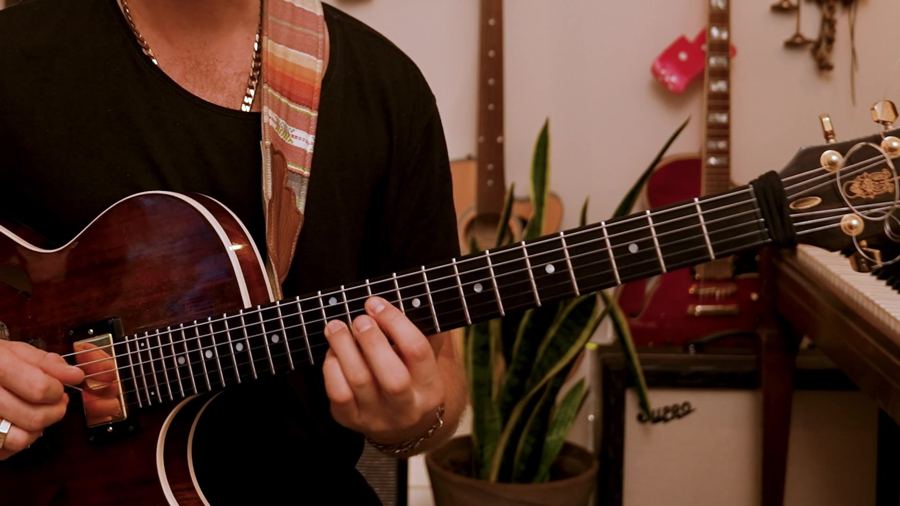
The same three notes, spread out
Take C major, 1-3-5, and rearrange it as 1-5-3, an arrangement that sounds really cool on guitar. It sounds beautiful. Then I play it in root position, first inversion and second inversion from the 6th string, the 5th string and the 4th string.
Then in time, in order of inversion, switching string sets as I go. You can switch in different places, as long as you keep the inversion right.
Then C minor, and you know it's minor because the E became E flat. And then we start moving around the cycle of fourths: C major to F, B flat, E flat.
Inside the members area
Here's what you see when you log in.
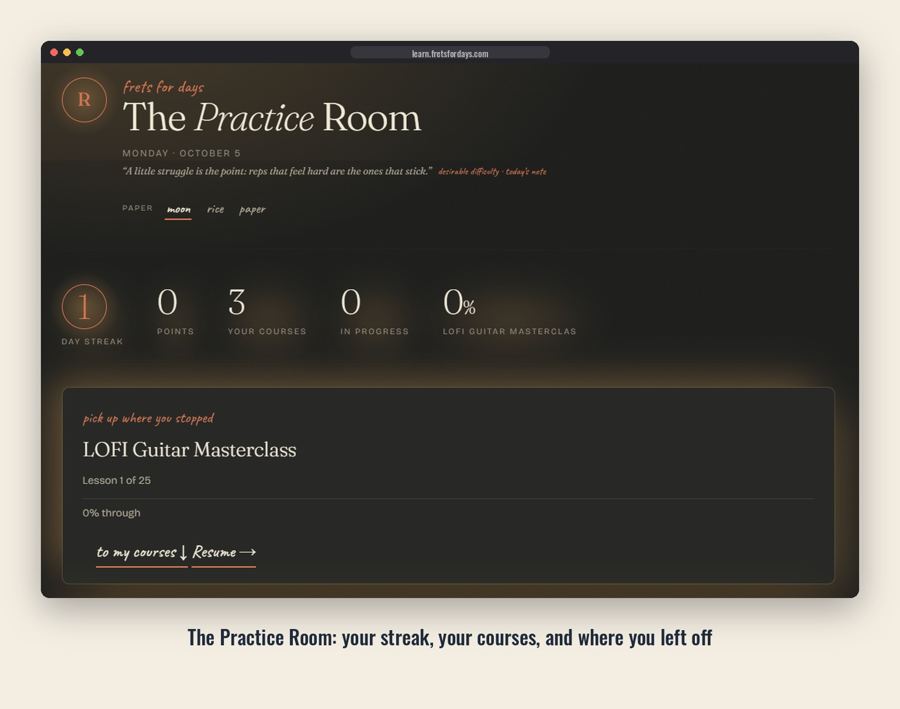
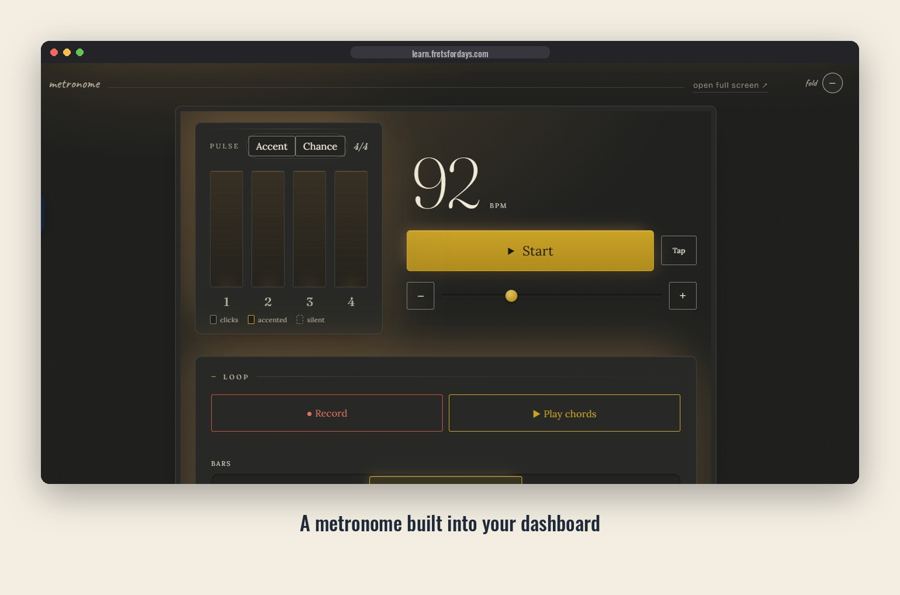
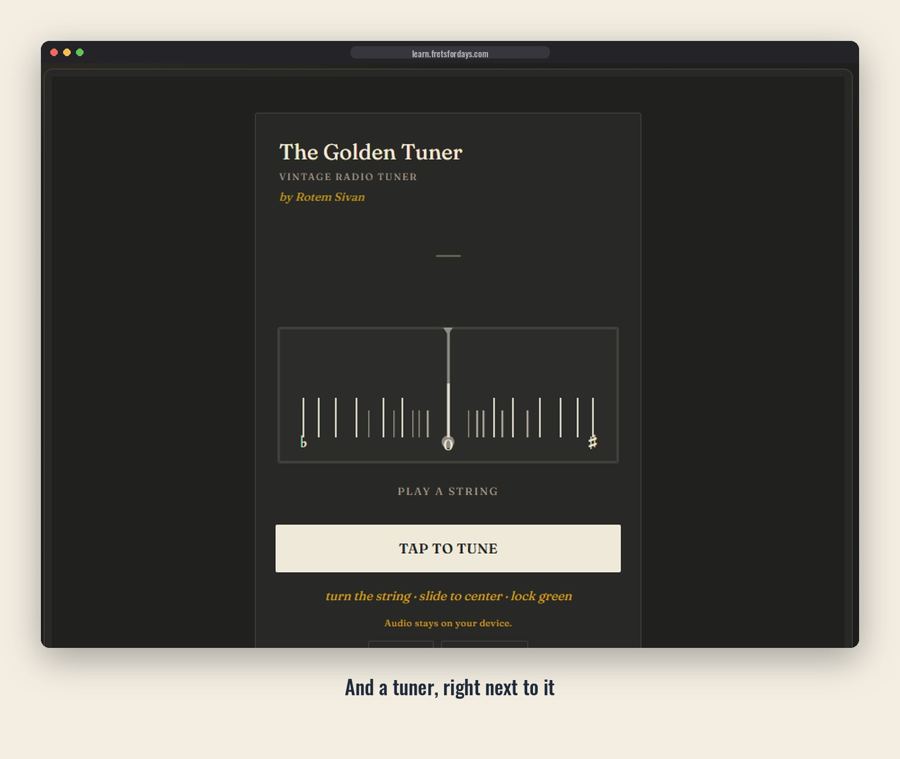
Real screens from the Frets For Days member area. The Practice Room keeps your streak and shows where you left off in each course, and there's a metronome and a tuner right in your dashboard for when you put the click on.
What's inside
25 lessons, part by part.
Every triad, string and move below is something I play or say on camera.
1 Start here: G and C, major and minor
- G major from the 6th string, 1-3-5 in three octaves, and the finger I start it with (plus where you can slide instead).
- Quarter notes, eighth notes, triplets and sixteenths, "really slowly and relaxed," with or without a click.
- G minor the same way, while you say G, B flat, D to yourself, so you're tagging every one of those notes across the board.
- C major from the 5th string in two octaves: do, mi, sol. "Even if you've done it before... doesn't mean that we really hear the note."
- C minor, 1, flat 3, 5, a few ways to go up and down, then in time.
2 Permutations
- G major in a different order than 1-3-5, 1-3-5 (watch this one above).
- The version where you double the same note twice.
- G minor permutations.
- C major and C minor permutations from the 5th string.
3 Triads in the key, changing direction
- Every triad in G major from the 6th string only, up and down, diminished included.
- Up on G, down on A minor, up on B minor, down on C: the direction change.
- The opposite way round: down on G, up on A minor.
- The three-octave version with the direction change.
- Every triad in C major from the 5th string, so you can say, "this is the sound of major, this is the sound of a minor chord," and feel how each one sits against the center.
4 Moving triads around the neck
- Chromatic changes: C major to B minor, B flat major to A minor, switching between major and minor.
- Whole steps, C major to B flat major in three octaves, then in minor. What to do when an exercise starts feeling too easy.
- Major triads a minor third apart from the 6th string: F, A flat, B, D, and back to F, up one and down the next.
- Half steps from the 5th string: G major, F sharp minor, F, E minor.
- Closed minor triads around the cycle of fourths. "It's not an easy exercise," and it makes you hear and see the shape all around the board.
5 Five positions in C major
- C major triads in five positions, with two fingerings for one of them.
- The same five positions in minor.
- How you get to know them: one position at a time, in time, eighth notes, triplets and sixteenths, saying the notes to yourself again and again.
- Every triad in the key inside a position, C major, D minor, E minor, F, G, A minor, B diminished, ascending and descending.
- Three positions played on camera, and the next two left for you to figure out.
6 Making music with triads
- A 12-bar blues in A with just triads in eighth notes, then chromatic and leading notes added on top (watch it above).
- Open triads, 1-5-3, in every inversion from the 6th, 5th and 4th strings, in time (more on it in "Look inside" above).
- Open triads in minor, around the cycle of fourths, and seeing where your hand takes you when you shift between them: first inversion to root, first inversion to root.
The curriculum
Every lesson, in order.
All 25 lessons, part by part. Tap a part to open it.
Part 1Start here: G and C3 lessons
- 01Lesson 1: G major and G minor from the 6th string
- 02C major, 5th string
- 03C minor, 5th string
Part 2Permutations4 lessons
- 04G major permutations (watch it above)
- 05G minor permutations
- 06C major permutations, 5th string
- 07C minor permutations, 5th string
Part 3Triads in the key5 lessons
- 08G major diatonic triads, 6th string
- 09G major diatonic triads with direction change
- 10G major 3-octave triads with direction change
- 11G major 6th string diatonic triads with direction change
- 12C major diatonic triads, 5th string
Part 4Moving triads around the neck5 lessons
- 13Chromatic changes, major and minor, from the 6th string
- 14Whole-step triads
- 15Major triads in minor 3rds from the 6th string
- 16Major and minor triads in half steps, 5th string
- 17Closed minor triads in the cycle of 4ths
Part 5Five positions in C major5 lessons
- 185 positions for C major triads
- 195 positions for C major triads, part 2
- 20C major scale triads, position 1
- 21C major scale triads, position 2
- 22C major scale triads, position 3
Part 6Making music with triads3 lessons
- 23A blues with triads (watch it above)
- 24Major and minor open triad chords
- 25Minor open triad chords in the cycle of 4ths
Three notes. Three octaves. Five positions. Then a blues.
One payment · Lifetime access · 30-day guarantee
Who it's for
Built for the player who knows the grip and wants every note of it.
Read both lists. If the second one sounds like you, save your money.
This is for you if...
- You know major and minor chords as grips, and you couldn't find their three notes in another part of the neck.
- You solo with scale shapes and want to know where the chord is inside them.
- You play blues or jazz and want to hear the triad standing behind a line.
- You'll play an exercise slowly, in time, and say the notes to yourself while you do.
- You like short lessons you can play along with, more than long explanations.
This isn't for you if...
- You're still learning to fret notes cleanly.
- You want licks and songs to copy.
- You want 7th chords and jazz voicings. This is triads only.
- You want it all talked through. Most of each lesson is me playing.
The offer
One payment. $47. Yours for life.
The Triads Workshop is $47, once. You get all 25 lessons and the PDF worksheets in your Frets For Days member area, and they stay there.
One payment · Lifetime access · 30-day guarantee

About your teacher
I'm Rotem Sivan.
I'm a jazz guitarist and educator in New York. I'm from Israel, and I studied at The New School.
I'm not telling you that to impress you. Before any of it, I was the high school guitar player memorizing C minor, G minor, C7 without really understanding what was happening in them. This workshop goes one step at a time: one triad from one note, in time, then moving it, then making music with it.
Rotem
FAQ
Questions before you buy.
What's the format?
25 short video lessons in six parts, with PDF worksheets alongside them. Everything lives in your Frets For Days member area, and you watch at your own pace.
What level is it for?
Intermediate. You should know what a major and a minor chord are, and be able to fret notes cleanly. The first lesson starts from one G major triad, so if you've played triads before, it's a chance to really hear them this time.
Do I need to read music?
No. The videos are filmed so you can see both hands, most with a close-up camera, and I often name the notes and the numbers (1-3-5) as I go.
How much time per week will it take?
Most lessons are under two minutes, and about half are under one. The practice is the part that takes time. You don't need to do everything at once; play each one slowly until you can see and hear the notes, then move on.
How long do I have access?
For life. One payment, and the course stays in your member area.
What if it isn't for me?
There's a 30-day guarantee. Work through it, and if it isn't right for you, email [email protected] within 30 days for a refund.
Stop memorizing grips. See the chord all over the neck.
You've probably played triads before. That doesn't mean you really hear the notes. Start with one G, three octaves, and take your time.
$47 one time · 25 lessons · PDF worksheets · lifetime access
Get the Triads Workshop: $47P.S. Here's a test you can run tonight. Find a G on your 6th string and play G major, 1-3-5, up through three octaves. Now say every note as you play it: G, B, D. Then do G minor and say G, B flat, D. If you stopped to work out even one of those notes, that's the gap this workshop closes, one triad at a time.
Hugs,
Rotem